
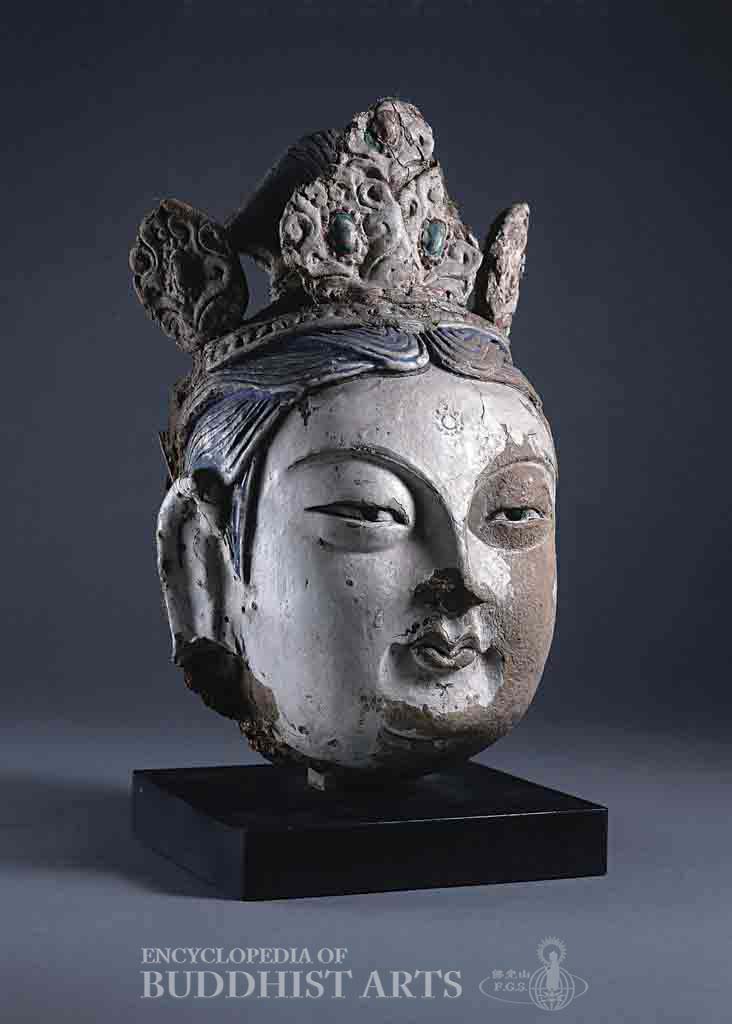
Qigxin: Head of a Bodhisattva
Stucco
Qigxin: Head of a Bodhisattva
CHINA, Xinjiang, Bayingolin
The style of this head is different from most of those excavated from the same site as the features resemble contemporary statues from the Tang dynasty (618–907). The face is rounded, the eyes narrow, and the small mouth bow-shaped. The eyebrows are represented by ridges that run down to form the sides of the nose. A slight mustache is visible above the mouth. A three-leafed crown encrusted with gems is on the head while beneath it, the hair is layered and built into a topknot. The ears at one time had the long lobes common in statues of Buddhist figures.
For more details, go to the Encyclopedia of Buddhist Arts: Sculpture N-Sr, page 851.
Cite this article:
Hsingyun, et al. "Qigxin: Head of a Bodhisattva." Encyclopedia of Buddhist Arts: Sculpture N-Sr, vol. 12, 2016, pp. 851.
Hsingyun, Youheng, Yann Lovelock, Yuan Chou, Susan Huntington, Gary Edson, and Robert Neather. 2016. "Qigxin: Head of a Bodhisattva" In Encyclopedia of Buddhist Arts: Sculpture N-Sr, 12:851.
Hsingyun, Youheng, Lovelock, Y., Chou, Y., Huntington, S., Edson, G., & Neather, R.. (2016). Qigxin: Head of a Bodhisattva. In Encyclopedia of Buddhist Arts: Sculpture N-Sr (Vol. 12, pp. 851).
@misc{Hsingyun2016,
author = Hsingyun and Youheng and Lovelock, Yann and Chou, Yuan and Huntington, Susan and Edson, Gary and Neather, Robert,
booktitle = {Encyclopedia of Buddhist Arts: Sculpture N-Sr},
pages = 851,
title = {{Qigxin: Head of a Bodhisattva}},
volume = 12,
year = {2016}}
author = Hsingyun and Youheng and Lovelock, Yann and Chou, Yuan and Huntington, Susan and Edson, Gary and Neather, Robert,
booktitle = {Encyclopedia of Buddhist Arts: Sculpture N-Sr},
pages = 851,
title = {{Qigxin: Head of a Bodhisattva}},
volume = 12,
year = {2016}}