
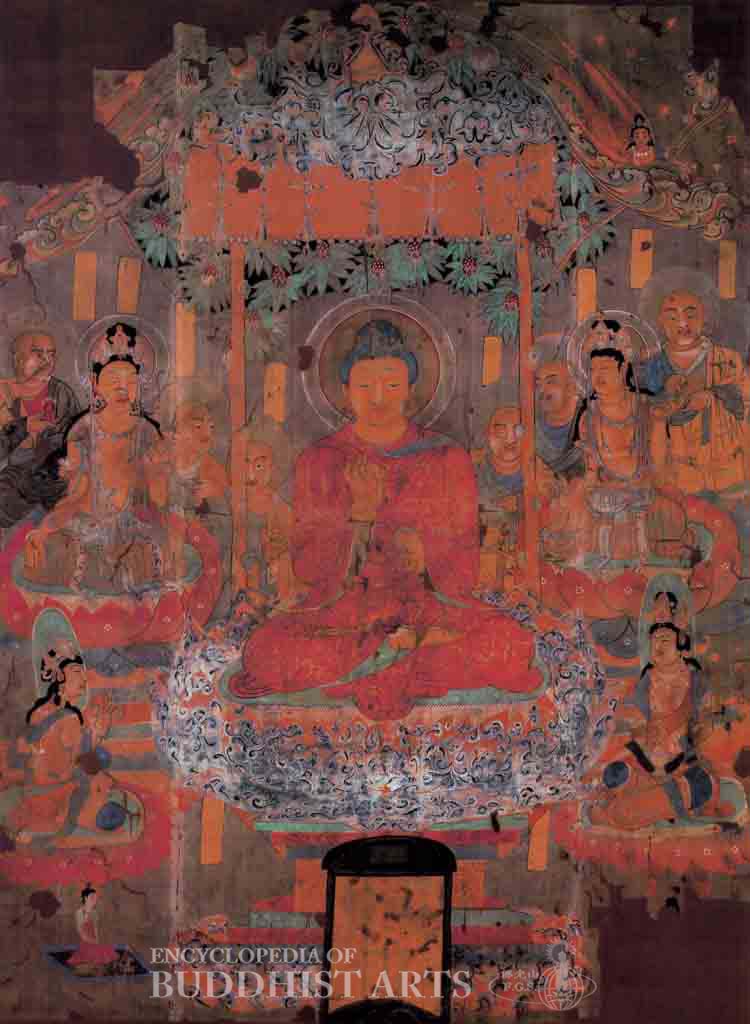
Mogao Cave 17: Buddha Teaching the Dharma
Ink and color on silk

Mogao Cave 17: Buddha Teaching the Dharma (detail)

Mogao Cave 17: Buddha Teaching the Dharma (detail)
Mogao Cave 17: Buddha Teaching the Dharma
CHINA, Gansu, Dunhuang; Tang dynasty
Based on a comparison with murals from the Sui dynasty (581–618) and Early Tang period (618–712), as well as on the composition and the techniques used, this painting is thought to date from the early 8th century. The central figure, Sakyamuni Buddha, sits in full lotus position on a unique lotus throne decorated with blue patterns. The Buddha has blue hair, a tall usnisa, and a large nose. He wears a red monastic robe and forms the vitarka (teaching) mudra with his right hand. On either side of the Buddha, three disciples with nimbuses stand beside a seated Bodhisattva wearing a decorative headdress. Below each group of figures, another Bodhisattva kneels by the Buddha’s lotus throne. The Bodhisattva on the right holds a vase, while the one on the left offers flowers. In the lower left corner, a small figure kneels on a carpet. This is possibly a depiction of one of the sponsors of the painting.
Above the Buddha, a canopy supported by two long poles hangs in front of a blossoming Bodhi tree. In the upper corners, apsaras fly behind clouds, scattering flowers.
For more details, go to the Encyclopedia of Buddhist Arts: Painting I-O, page 574.
Cite this article:
author = Hsingyun and Youheng and Youlu and Wilson, Graham and Manho and Mankuang and Huntington, Susan,
booktitle = {Encyclopedia of Buddhist Arts: Painting I-O},
pages = 574,
title = {{Mogao Cave 17: Buddha Teaching the Dharma}},
volume = 15,
year = {2016}}