
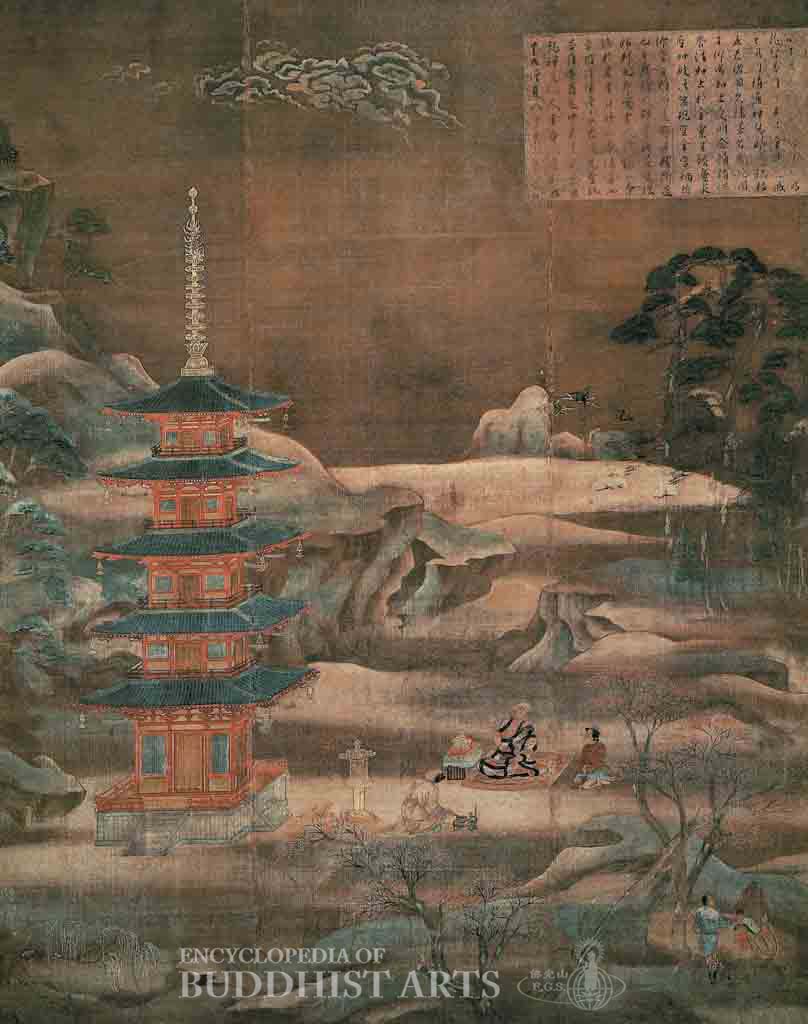
Divinely Inspired Reception of the Two Great Sutras - Reception of the Vairocana Sutra by Subhakarasimha
Ink and color on silk
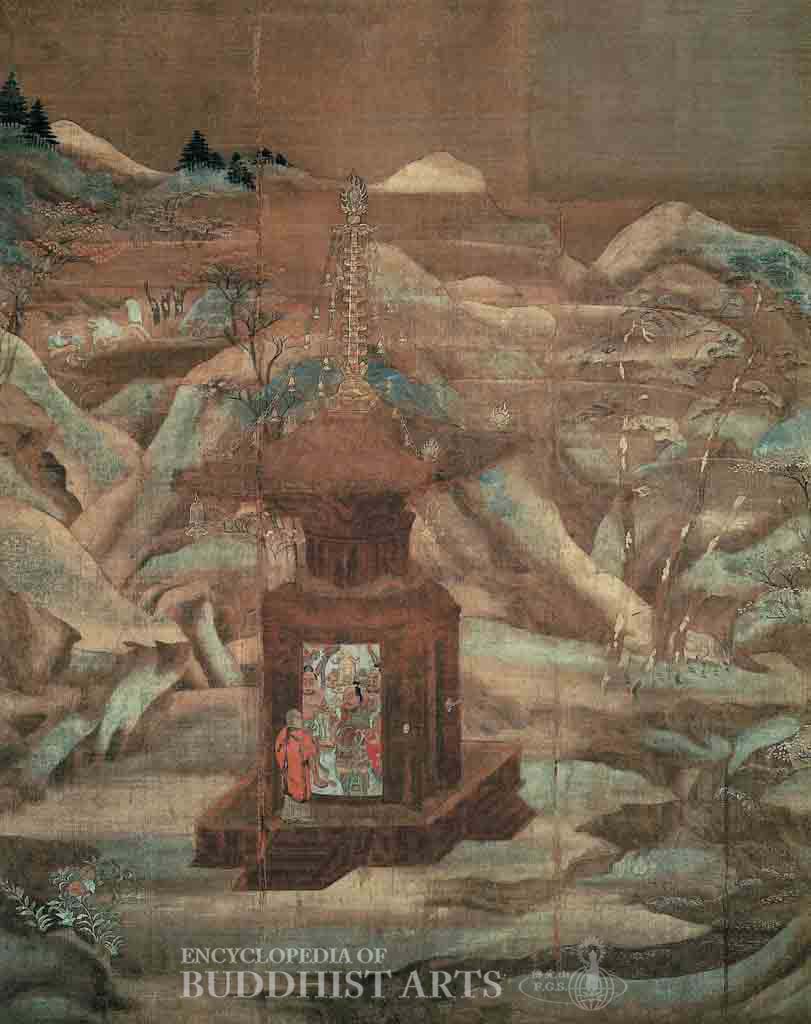
Divinely Inspired Reception of the Two Great Sutras - Reception of the Vajrasekhara Sutra by Nagarjuna
Divinely Inspired Reception of the Two Great Sutras
JAPAN; Heian period
These two painted scrolls depict the reception of the Mahavairocana Sutra and the Vajrasekhara Sutra by the Indian monks Subhakarasimha and Nagarjuna. The scrolls date from the early Heian period, and were originally hung in the Shingon Hall of Uchiyama Eikyu Temple in Nara. The first scroll depicts Subhakarasimha performing a ritual and receiving the Mahavairocana Sutra, while the second scroll illustrates Nagarjuna receiving the teaching of the Vajrasekhara Sutra within the iron stupa in southern India. These sutras are two of the principal texts of Vajrayana Buddhism. The Uchiyama Eikyuji Temple Inauguration Text attributes the scrolls to the court painter Fujiwara no Munehiro, although the inscription on the Subhakarasimha scroll states that it was painted by Fujiwara no Sadonobu. The scrolls were listed as a National Treasure of Japan in 1973.
According to legend, the King of Gandhara in Northern India asked Subhakrasimha to perform a ritual beside a five-story pagoda built to honor a Buddha of the past kalpa who had expounded the Dharma there. As the ritual was performed, golden clouds gathered in the sky and transformed into the text of the Mahavairocana Liturgy. In the painting, Subhakarasimha, dressed in a monastic robe, sits on a cushion beside the pagoda. He looks up at the golden clouds above and instructs his attendant to transcribe the text into the Mahavairocana Sutra. The figures are surrounded by trees and mountains.
The second scroll depicts Nagarjuna entering the iron stupa to receive the Vajrasekhara Sutra. When Nagarjuna first came to the stupa, it was sealed and guarded by fierce Dharma protectors. Determined to enter, Nagarjuna chanted and circumambulated around the stupa for seven days, accumulating blessings and merit. When the door finally opened, Nagarjuna entered and remained inside until he memorized the sutra. Here, Nagarjuna is shown standing at the entrance to the stupa. The three Dharma protectors are inside. White light seems to radiate from the interior of the stupa. The bare mountains and trees with brown leaves in the background suggest that it is autumn. In the upper left corner, two white lions frolic in a meadow.
For more details, go to the Encyclopedia of Buddhist Arts: Painting A-H, page 193.
Cite this article:
author = Hsingyun and Youheng and Youlu and Wilson, Graham and Manho and Mankuang and Huntington, Susan,
booktitle = {Encyclopedia of Buddhist Arts: Painting A-H},
pages = 193,
title = {{Divinely Inspired Reception of the Two Great Sutras}},
volume = 14,
year = {2016}}