
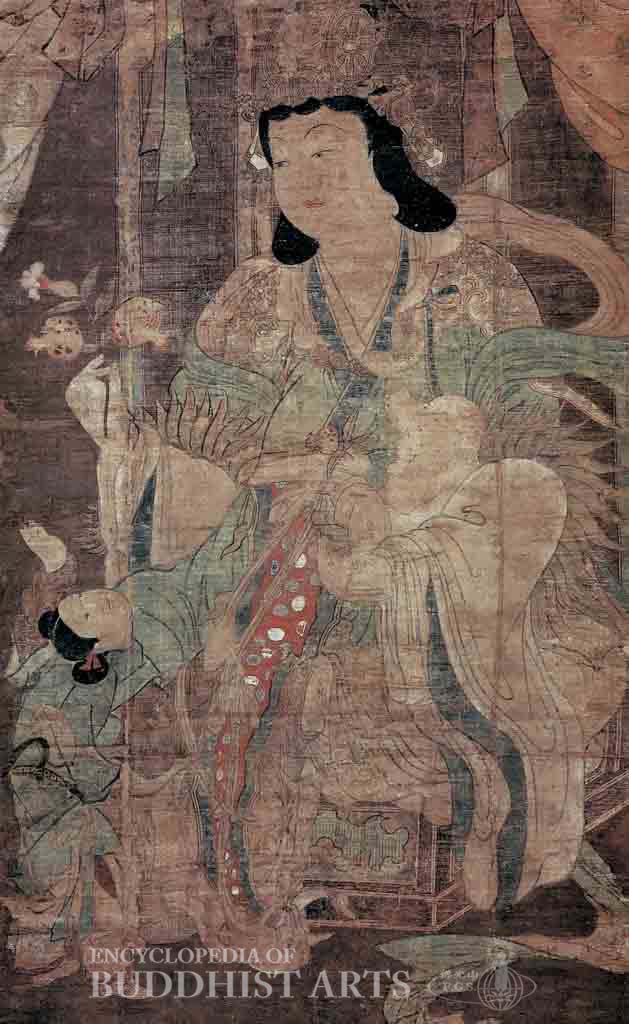
Daigoji Temple: Hariti
Ink and color on silk
Daigoji Temple: Hariti
JAPAN, Kyoto; Kamakura period
Hariti, known as Kishimojin in Japan, was once an ogress who fed on children, but was converted by the teaching of Buddha and became the guardian deity of childbirth and infants. This 12th century painting of Hariti was listed as a National Treasure in 1955.
Hariti is seated on a throne under a hanging valance, with a folded screen behind her. She holds a baby with her left hand, and her right hand holds a pomegranate stalk with one flower and many fruits, a symbol of fertility. Hariti is styled as a noblewoman of the Tang dynasty (618–907). A child clamoring for her attention stands in front of her, characterizing her as an affectionate mother. Hariti and the child are dressed in clothes colored in pale blue, green, and white, giving the painting a mild but bright quality. The clothing folds traced with light ink in complicated lines of varying thickness, and the absence of gold color, display the influence of Buddhist paintings from the Song dynasty (960–1279).
For more details, go to the Encyclopedia of Buddhist Arts: Painting A-H, page 177.
Cite this article:
author = Hsingyun and Youheng and Youlu and Wilson, Graham and Manho and Mankuang and Huntington, Susan,
booktitle = {Encyclopedia of Buddhist Arts: Painting A-H},
pages = 177,
title = {{Daigoji Temple: Hariti}},
volume = 14,
year = {2016}}