
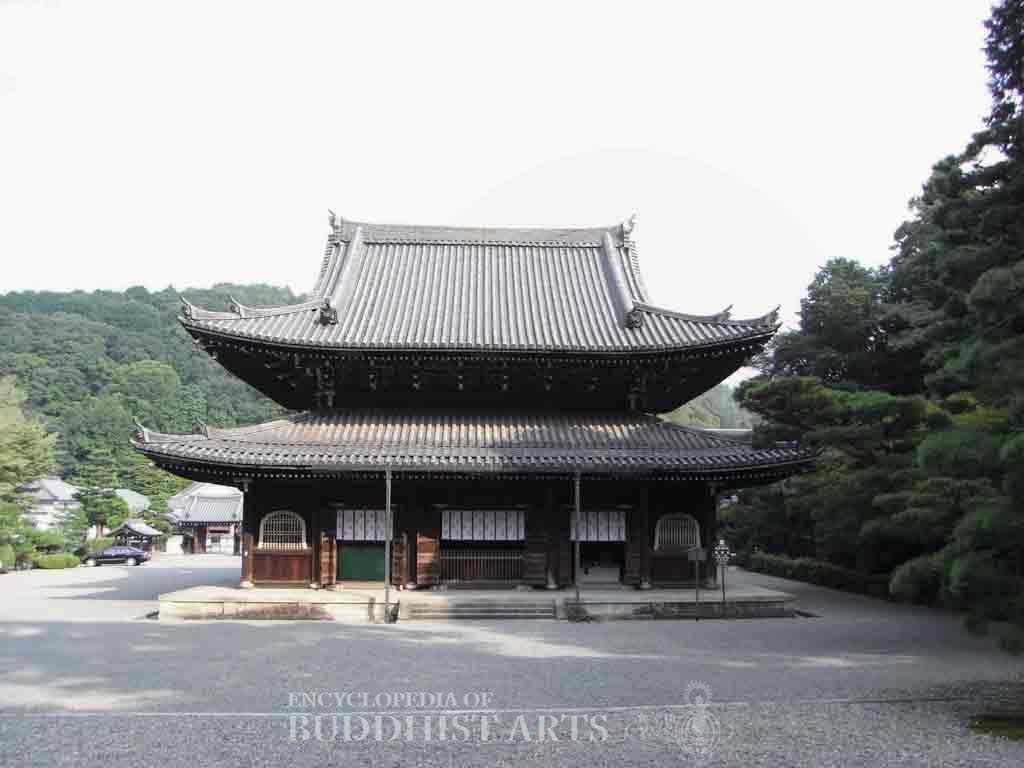
Sennyuji Temple: Buddha Hall
Sennyuji Temple
JAPAN, Kyoto
Sennyuji means Flowing Spring Temple. It is the head temple of the Sennyuji branch of the Shingon school of Japanese Buddhism. The date of its construction is unknown. It was originally named Horinji (Dharma Wheel Temple) and was renamed Senyuji Temple in 1218 during the Kamakura period after clear water began to flow within its grounds. The following year, with the support of Emperor Go-Toba (reigned 1183–1198), a large sum of money was spent on reviving the temple and in 1224 it became a temple for the imperial family. It was abandoned during the Onin War (1467–1477) but subsequently revived by Nobunaga and Toyotomi Hideyoshi, who donated land for its re-establishment.
The main buildings, modeled after Chinese temples built during the Song dynasty, include the main temple gate, Buddha hall, founder’s hall, and founder’s stupa, all of which were listed as Important Cultural Properties in 1966. The construction of the three-by-three bay Buddha hall began in 1669 during the Edo period. It has a double-eave hip-and-gable roof covered in cylindrical tiles. The depictions of dragons and clouds on the ceiling and an image of Avalokitesvara Bodhisattva in a White Robe on the wall were painted by Kano Tanyu. Sakyamuni Buddha, Amitabha Buddha, and Maitreya Buddha are enshrined on the Sumeru platform.
The temple houses ancient documents, such as a letter soliciting donations for the temple restoration and a certificate of advanced learning in Buddhism, both of which have been listed as National Treasures. Other Important Cultural Properties include portraits of Chinese Vinaya Masters Daoxuan and Dazhi, as well as Japanese Master Shunjo.
For more details, go to the Encyclopedia of Buddhist Arts: Architecture M-S, page 953.
Cite this article:
author = Hsingyun and Youheng and Johnson, Peter and Mankuang and Lancaster, Lewis,
booktitle = {Encyclopedia of Buddhist Arts: Architecture M-S},
pages = 953,
title = {{Sennyuji Temple}},
volume = 3,
year = {2016}}