
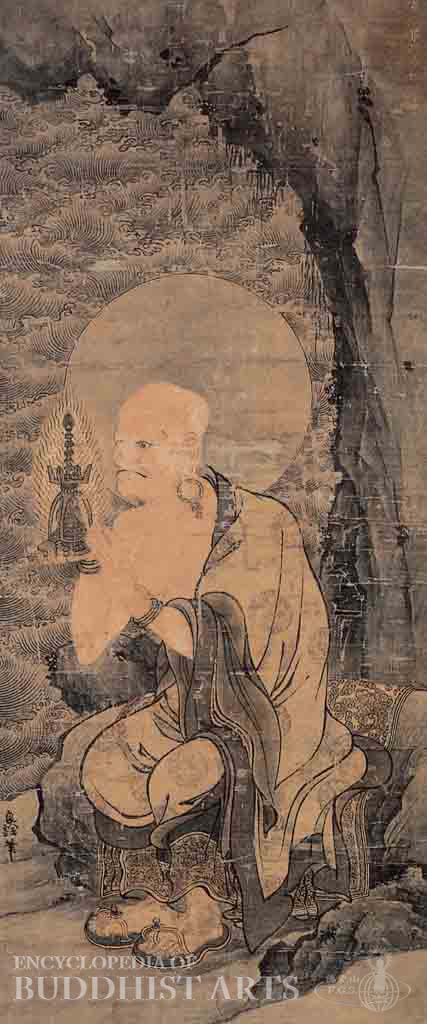
Tofukuji Temple: Sixteen Arhats - Pindola
Ink and color on silk
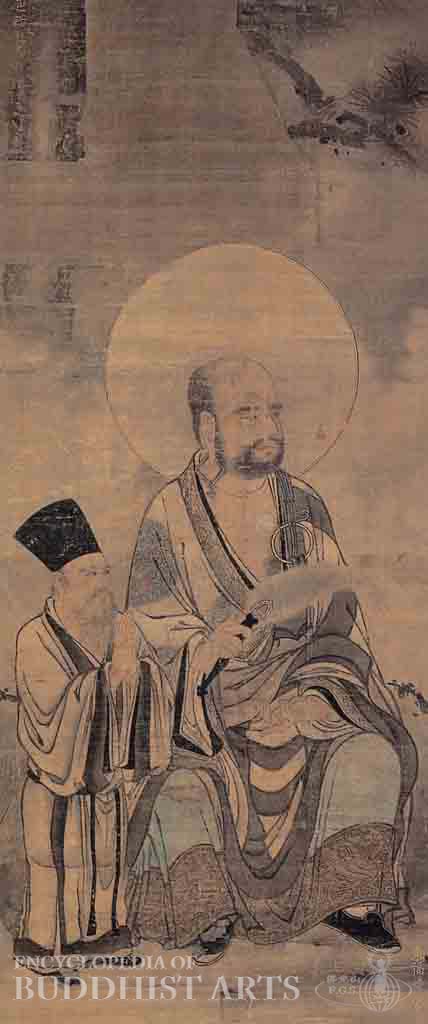
Tofukuji Temple: Sixteen Arhats - Kanakavatsa
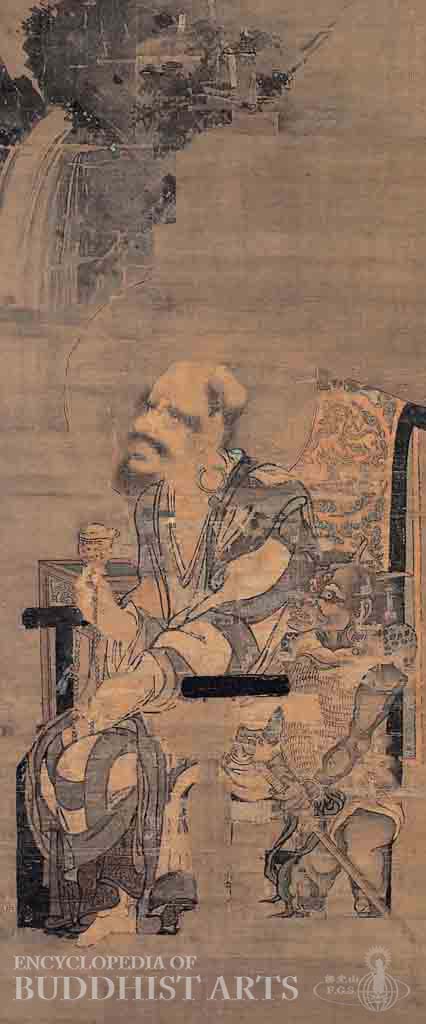
Tofukuji Temple: Sixteen Arhats - Kanakabharadraja
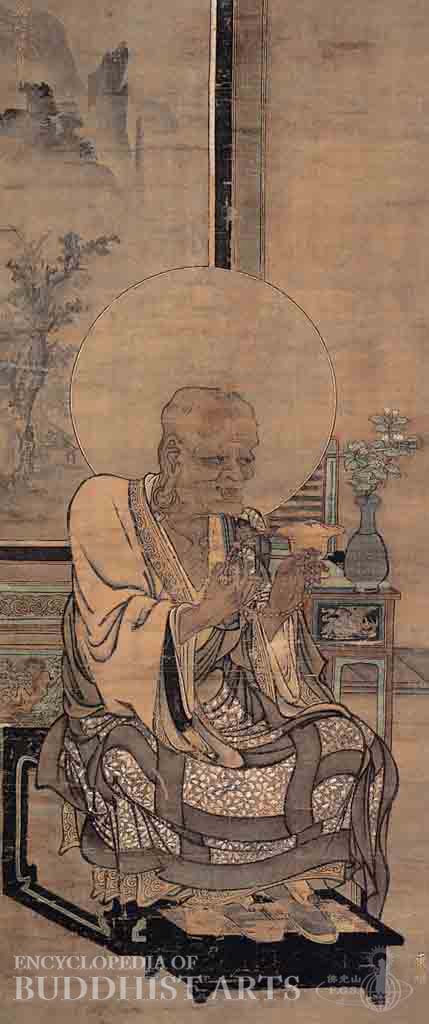
Tofukuji Temple: Sixteen Arhats - Bhadra
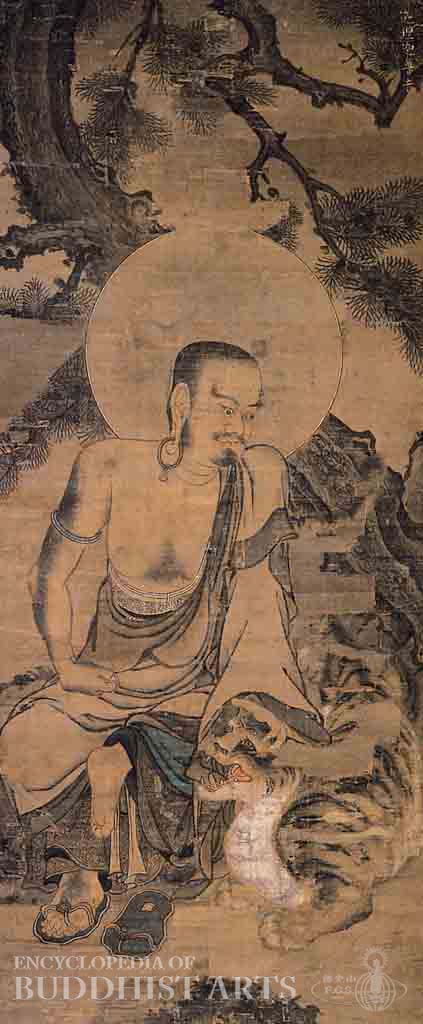
Tofukuji Temple: Sixteen Arhats - Kalika
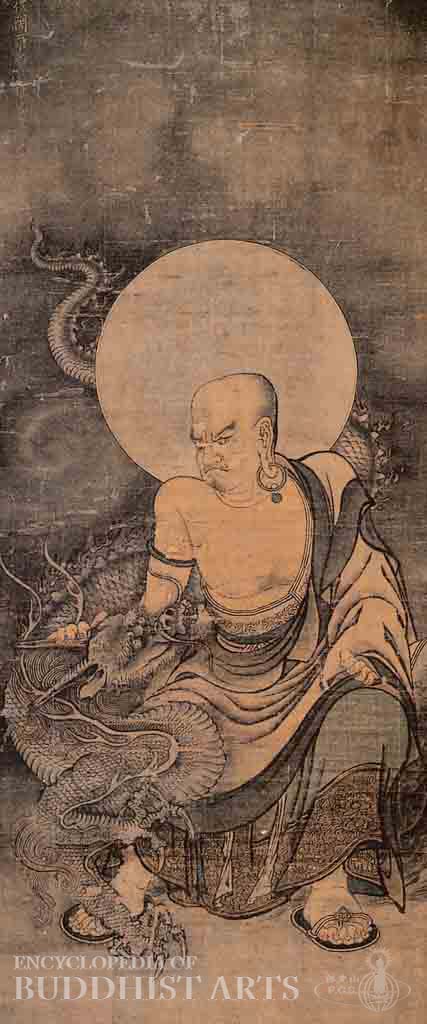
Tofukuji Temple: Sixteen Arhats - Vajraputra
Tofukuji Temple: Sixteen Arhats
JAPAN, Kyoto; Nanbokucho period
Paintings of the Sixteen Arhats became popular during the Heian (794–1185) and Kamakura (1185–1333) periods among followers of Tendai and Zen schools of Buddhism. This set of 16 paintings, each 143.1 cm high and 59.6 cm wide, is made up of 14 originals along with two additional images that were added during the Edo period (1615–1868). An inscription written with gold characters on each painting states the name of the Arhat and declares that the paintings are the “Property of Tofukuji,” indicating that the paintings originated from Tofukuji Temple in Kyoto. The first painting in the set is signed by the artist, Ryozen. According to the Records of Tofukuji Temple, Abbot Kenpo Shidon raised funds to paint the Sixteen Arhats in 1348. This group of paintings may be the result of his efforts. These paintings are now part of the collection of Kenninji Temple in Kyoto. They were listed as an Important Cultural Property in 1907.
Paintings of the Arhats were traditionally done in two main styles: the Zengetsu style, which depicted the Arhats with exaggerated features, and the style pioneered by Li Longmian, who gave them a more natural appearance. These paintings are done in the latter style. Each Arhat is depicted with earrings and a nimbus, and faces slightly to the side. They each have distinct facial features, some with high foreheads and long earlobes, and others with large eyes, long noses, and bulging foreheads. They are shown in a variety of indoor and outdoor scenes. Some are alone, while others have next to them a figure making an offering, a dragon, a tiger, or a heavenly being. Exuding calmness and serenity, some of the Arhats hold objects including a fan, a pagoda, and praying beads. Cliffs, waterfalls, mountains, trees, and clouds are painted in the backgrounds. The fine lines tracing the figures and the background elements painted with broad strokes suggest that these paintings were inspired by Arhat images from Ningbo, China.
For more details, go to the Encyclopedia of Buddhist Arts: Painting P-Z, page 918.
Cite this article:
author = Hsingyun and Youheng and Youlu and Wilson, Graham and Manho and Mankuang and Huntington, Susan,
booktitle = {Encyclopedia of Buddhist Arts: Painting P-Z},
pages = 918,
title = {{Tofukuji Temple: Sixteen Arhats}},
volume = 16,
year = {2016}}