
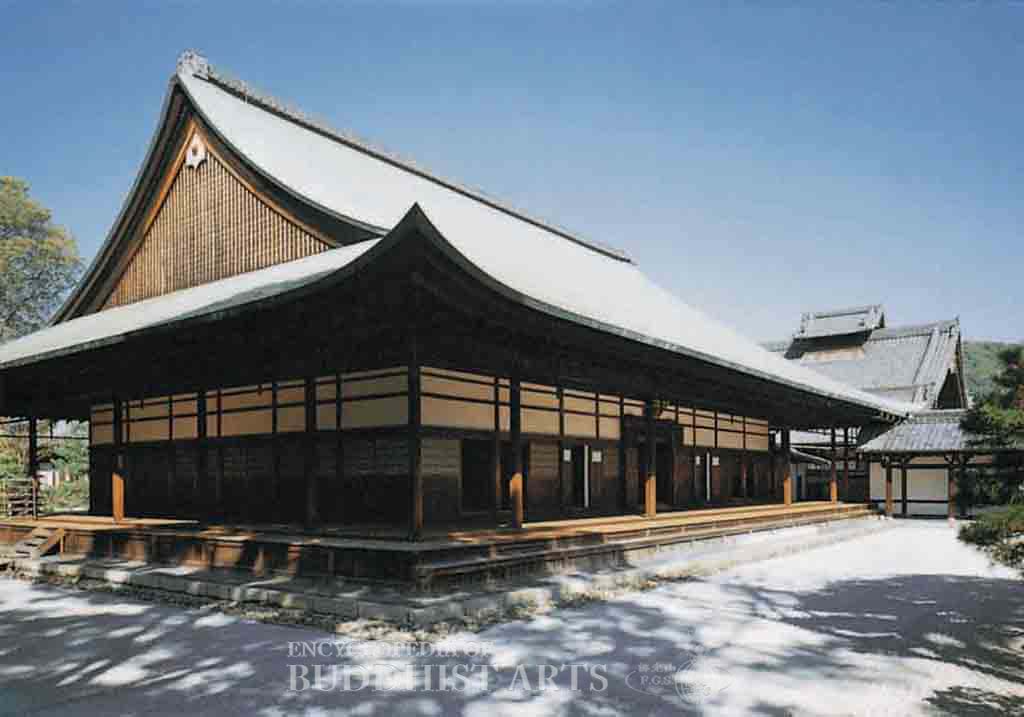
Kenninji Temple: Abbot's Quarters
Kenninji Temple
JAPAN, Kyoto
This temple is the head temple of the Rinzai school of Buddhism and is ranked third among the Five Major Temples of Kyoto. Zen Master Eisai started building the temple in 1202 and completed it three years later. It was modeled on the temple on Baizhangshan in China, and was named after the Kennin era, during which construction started. It is the oldest Zen Buddhist temple in Kyoto. It was burned down in 1552 during the Muromachi period. The present structures were built during the late 16th century by Ekei from Ankokuji Temple.
The temple buildings include the Imperial Messenger Gate, abbot’s quarters, Buddha Hall, bell tower, and founder’s hall. The abbot’s quarters have a hip-and-gable roof covered with copper sheets. The building is 28 m wide by 21 m deep and has a wide veranda. It is divided into six rooms. There is a Japanese rock garden in front of the abbot’s quarters. The founder’s hall was erected in memory of Master Eisai.
The temple houses a pair of two-fold screens entitled Wind Deity and Thunder Deity by Tawaraya Sotatsu; an illustration of the Sixteen Arhats by Ryozen; Landscape, Clouds and Dragons, and Seven Sages of the Bamboo Grove by Kaiho Yusho; and the calligraphy of Yishan Yining.
For more details, go to the Encyclopedia of Buddhist Arts: Architecture G-L, page 600.
Cite this article:
author = Hsingyun and Youheng and Johnson, Peter and Mankuang and Lancaster, Lewis,
booktitle = {Encyclopedia of Buddhist Arts: Architecture G-L},
pages = 600,
title = {{Kenninji Temple}},
volume = 2,
year = {2016}}