
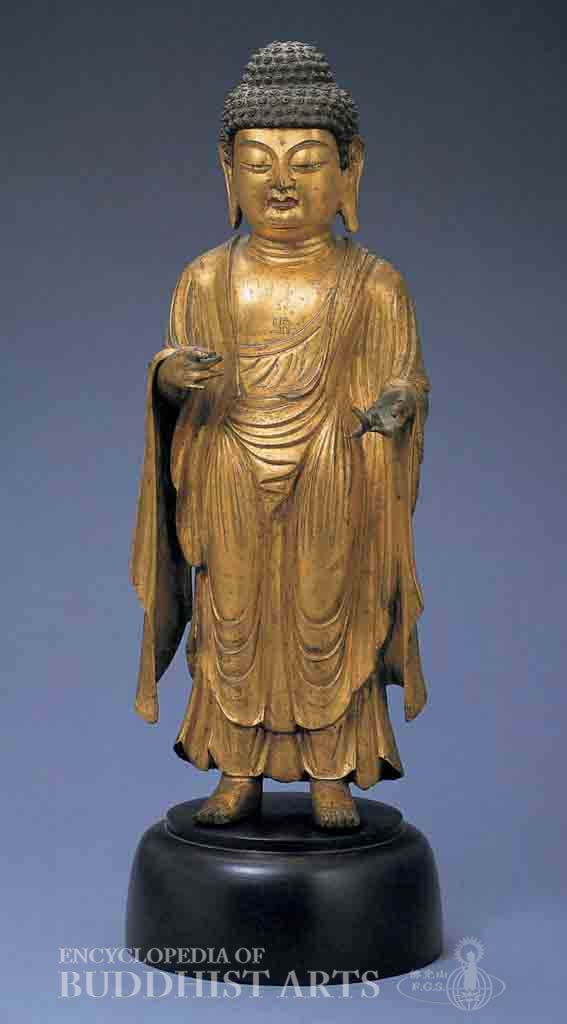
Medicine Buddha
Gilt bronze
Medicine Buddha
KOREA; Unified Silla dynasty
Faith in the Medicine Buddha had become popular in Korea during the 8th century and after. The statue is typical of figures from the Unified Silla period (668–935). It was created using the lost-wax method.
The Buddha stands with the right hand in a mudra, while the palm of the left hand faces upward and originally might have held the medicine bowl that identifies the figure. The outer robe falls in vertical folds that divide over the legs, where the cloth clings to them in the wet look typical of the period. The overhanging fabric at the arms is pronounced and adds to the rhythmic downward pattern.
For more details, go to the Encyclopedia of Buddhist Arts: Sculpture G-M, page 714.
Cite this article:
Hsingyun, et al. "Medicine Buddha." Encyclopedia of Buddhist Arts: Sculpture G-M, vol. 11, 2016, pp. 714.
Hsingyun, Youheng, Yann Lovelock, Yuan Chou, Susan Huntington, Gary Edson, and Robert Neather. 2016. "Medicine Buddha" In Encyclopedia of Buddhist Arts: Sculpture G-M, 11:714.
Hsingyun, Youheng, Lovelock, Y., Chou, Y., Huntington, S., Edson, G., & Neather, R.. (2016). Medicine Buddha. In Encyclopedia of Buddhist Arts: Sculpture G-M (Vol. 11, pp. 714).
@misc{Hsingyun2016,
author = Hsingyun and Youheng and Lovelock, Yann and Chou, Yuan and Huntington, Susan and Edson, Gary and Neather, Robert,
booktitle = {Encyclopedia of Buddhist Arts: Sculpture G-M},
pages = 714,
title = {{Medicine Buddha}},
volume = 11,
year = {2016}}
author = Hsingyun and Youheng and Lovelock, Yann and Chou, Yuan and Huntington, Susan and Edson, Gary and Neather, Robert,
booktitle = {Encyclopedia of Buddhist Arts: Sculpture G-M},
pages = 714,
title = {{Medicine Buddha}},
volume = 11,
year = {2016}}