

Famen Temple Pagoda (1981)
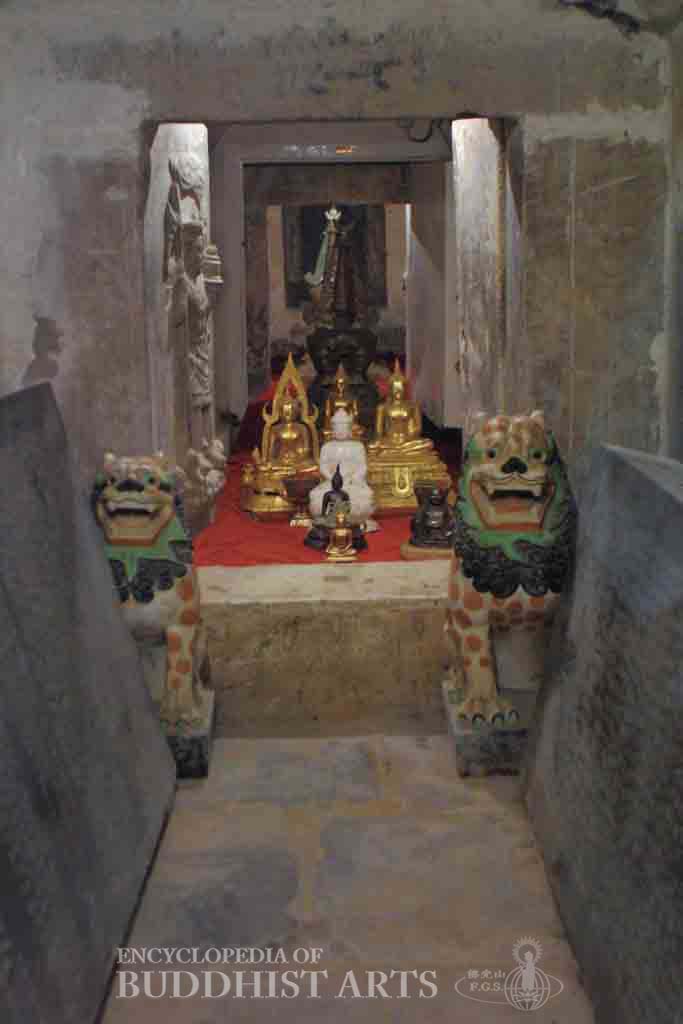
Famen Temple Pagoda: Underground Palace

Famen Temple Pagoda: Underground Palace Entrance
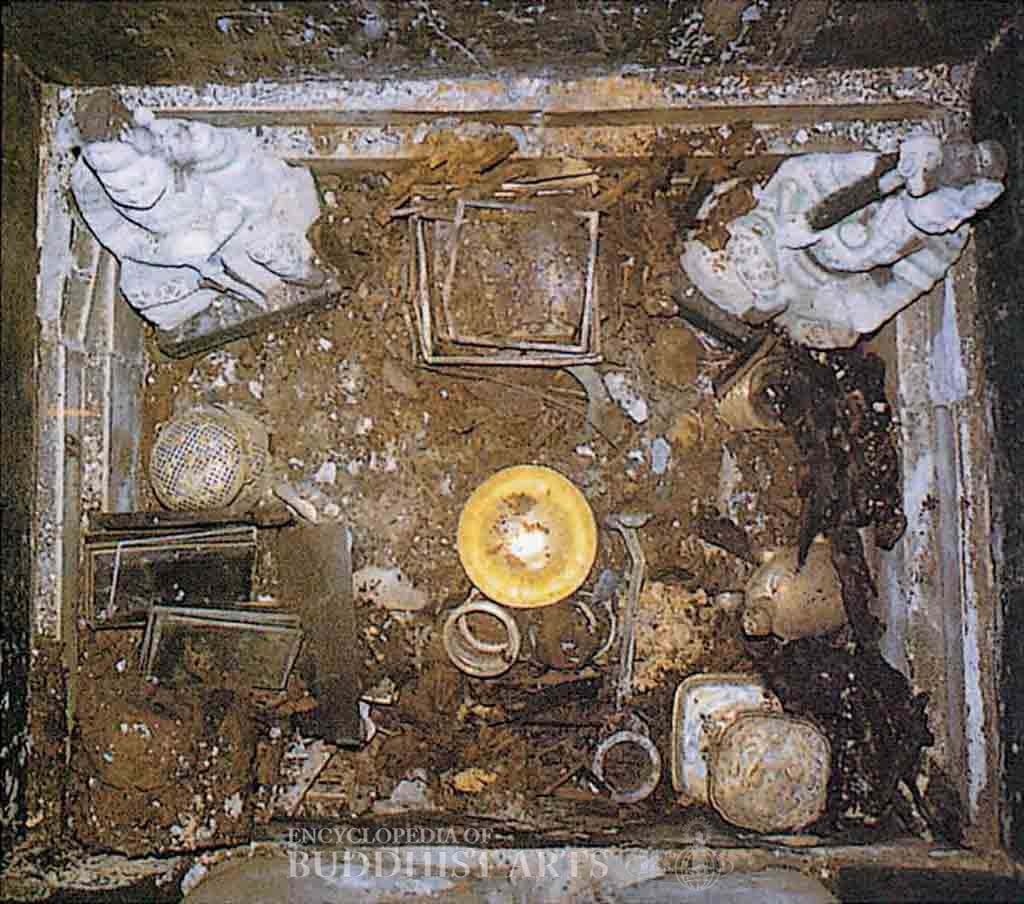
Famen Temple Pagoda: Underground Palace - Artifacts
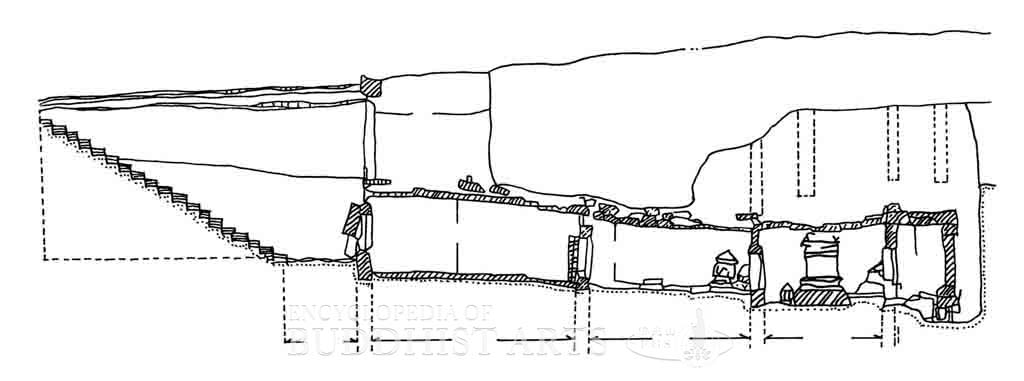
Famen Temple Pagoda: Underground Palace (section drawing)
Famen Temple Pagoda
CHINA, Shaanxi, Baoji
It was also known as the True Relic Pagoda. It is said that it was originally called Asoka Pagoda. It was constructed from wood and was damaged and rebuilt a number of times. During the rule of Emperor Longqing (reigned 1567–1572) of the Ming dynasty, the four-story wooden pagoda collapsed. Construction of a new thirteen-story, octagonal, brick pagoda with a height of 47 m was completed in 1609. The pagoda collapsed in 1981 and three years later the underground palace was discovered.
The present pagoda is a replica of the original structure while maintaining access to the underground palace. The palace is 21.1 m long and occupies 31.8 sq m. There are stairs leading down to a platform, followed by a corridor, front chamber, a central chamber, and a rear chamber. Beneath the north wall of the rear chamber, there is a secret niche where the Buddha’s finger bone relic was kept.
Other treasures that were unearthed include a gold alms bowl, a gilt-silver bowl, a silver robe embroidered with gold thread, a gilt-silver incense burner, a silver oil lamp, a gilt-silver statuette of Bodhisattva Holding a Relic, amber figurines of lions, a set of eight nested reliquaries, and another set of five nested reliquaries, as well as 600 other priceless treasures.
For more details, go to the Encyclopedia of Buddhist Arts: Architecture A-F, page 286.
Cite this article:
author = Hsingyun and Youheng and Johnson, Peter and Mankuang and Lancaster, Lewis,
booktitle = {Encyclopedia of Buddhist Arts: Architecture A-F},
pages = 286,
title = {{Famen Temple Pagoda}},
volume = 1,
year = {2016}}