
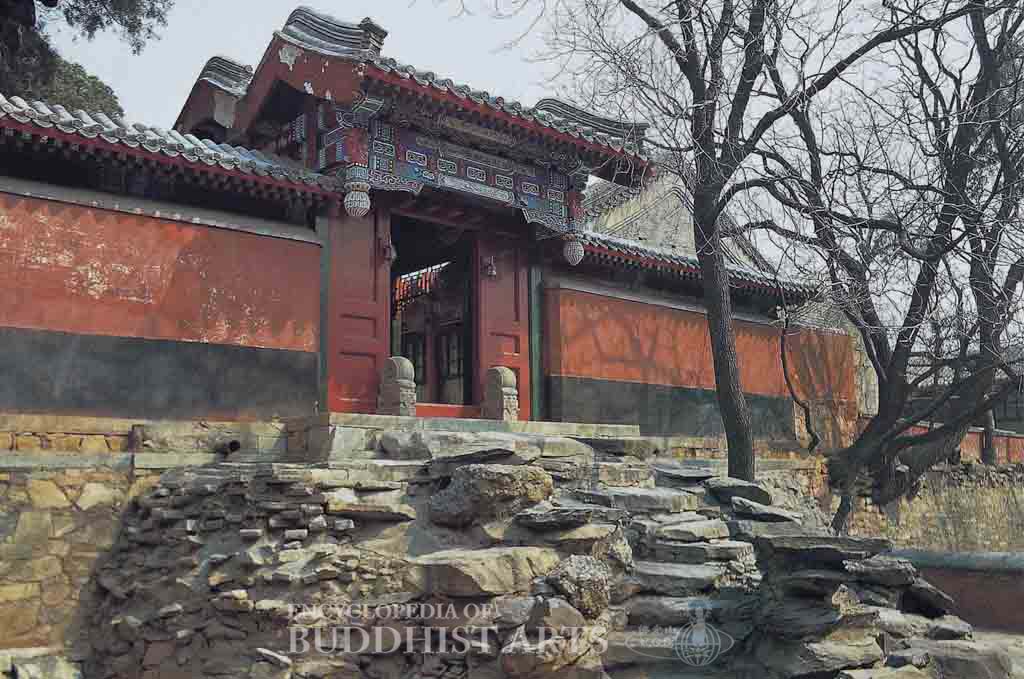
Xiangjie Temple: Imperial Lodge
Xiangjie Temple
CHINA, Beijing
Xiangjie means Fragrant World. It was founded in 758 during the Tang dynasty, and was reconstructed in 1425 during the Ming dynasty. It was badly damaged by war near the end of the Ming dynasty (1368–1644) and was rebuilt in 1678 during the Qing dynasty. It underwent further reconstruction in 1748. Most of the extant buildings are from the Ming and Qing (1644–1911) dynasties.
Built along the slope of the mountain, the temple buildings are dispersed along three paths. Along the central path is the main temple gate, Heavenly King Hall, Perfect Understanding Hall, Great Hero Hall, and the sutra repository. The west path leads to a courtyard and three viharas, while the east path goes to the Imperial Lodge, which Emperor Qianlong (reigned 1736–1795) used as a summer palace.
For more details, go to the Encyclopedia of Buddhist Arts: Architecture T-Z, page 1312.
Cite this article:
author = Hsingyun and Youheng and Johnson, Peter and Mankuang and Lancaster, Lewis,
booktitle = {Encyclopedia of Buddhist Arts: Architecture T-Z},
pages = 1312,
title = {{Xiangjie Temple}},
volume = 4,
year = {2016}}