
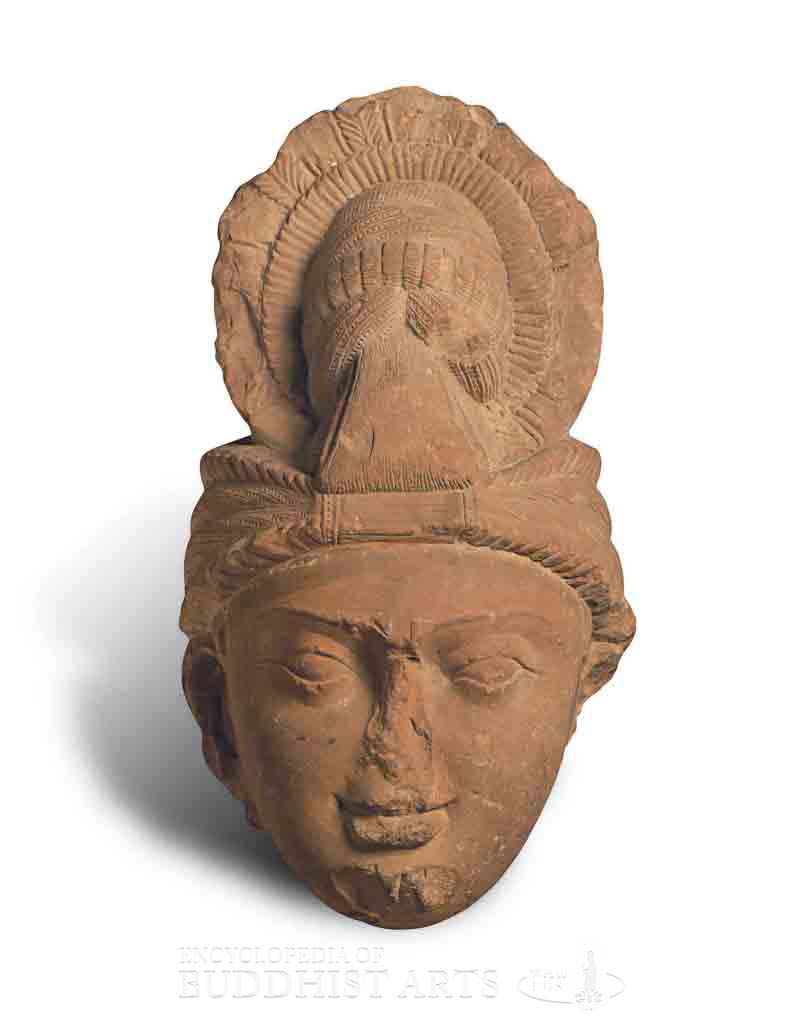
Mathura: Head of a Bodhisattva
Red sandstone
Mathura: Head of a Bodhisattva
INDIA, Uttar Pradesh, Mathura
Unearthed from Mathura and dated to the late 1st and early 2nd centuries, the sculpture is believed to be modeled on a young aristocrat from the Kushan period (circa 1st–3rd century), of which several portrait heads with elaborate head decorations survive.
The hair is caught up in an elaborate topknot that emerges from the turban that secures it. The turban is composed of two or three layers of different fabric that are buckled at the front. Additional cloth has been swept into the hair to create a radiating petal shape behind. A frilled outer layer has alternating foliar designs, almost giving the effect of a nimbus. The head beneath has meeting eyebrows, almond-shaped eyes and small mouth, which were to become familiar components of the maturing Mathura style.
For more details, go to the Encyclopedia of Buddhist Arts: Sculpture G-M, page 692.
Cite this article:
author = Hsingyun and Youheng and Lovelock, Yann and Chou, Yuan and Huntington, Susan and Edson, Gary and Neather, Robert,
booktitle = {Encyclopedia of Buddhist Arts: Sculpture G-M},
pages = 692,
title = {{Mathura: Head of a Bodhisattva}},
volume = 11,
year = {2016}}