
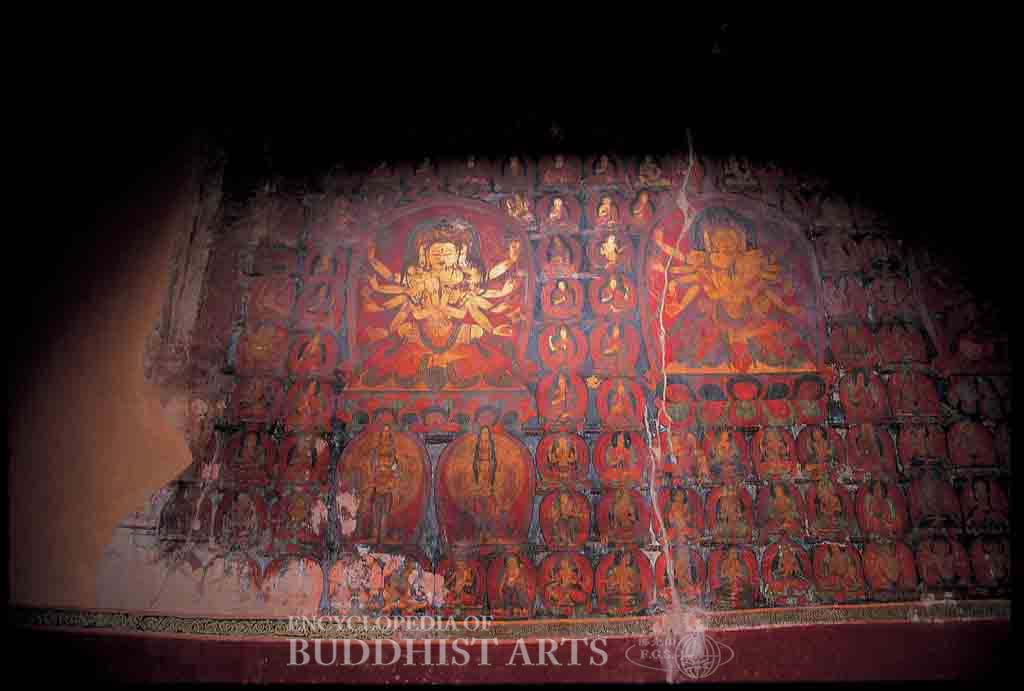
Guge Yamantaka Hall Murals
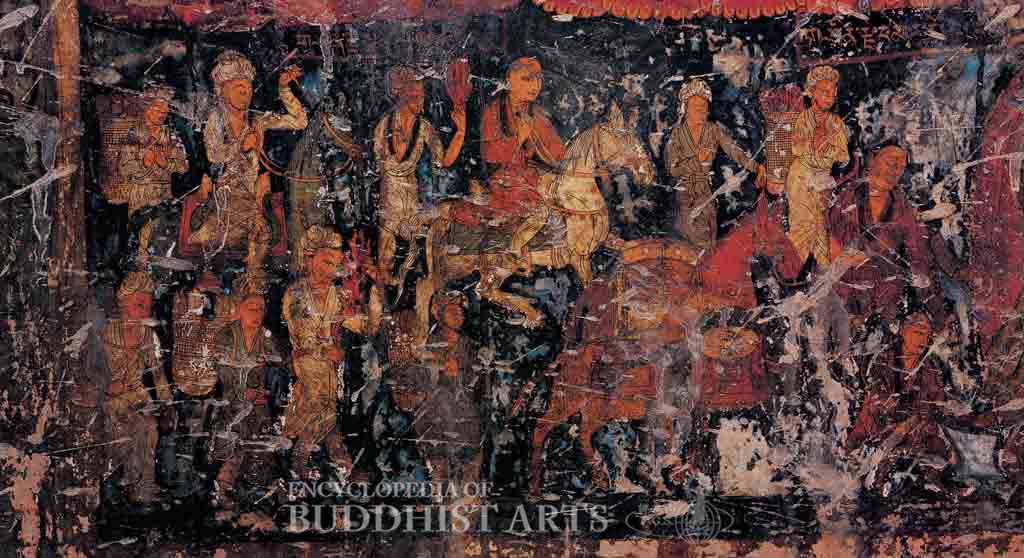
Guge Yamantaka Hall Murals: Travelers
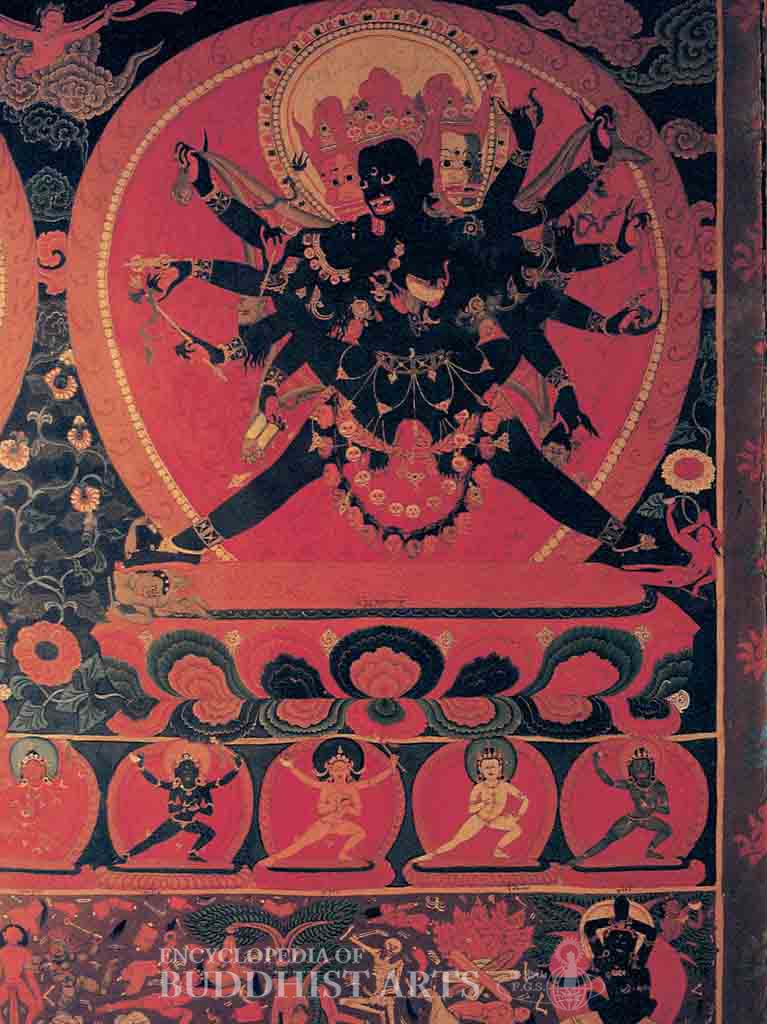
Guge Yamantaka Hall Murals: Yama
Guge Yamantaka Hall Murals
CHINA, Tibet, Ngari
The Yamantaka Hall is located to the southeast of the Red Temple. Statues of Yamantaka and other figures were once enshrined in the hall, but they have been destroyed, leaving only five empty Sumeru thrones. There are murals painted on all four walls of the hall as well as in the front chamber. These murals, painted in the 16th century, are divided into three distinct registers. The top register is patterned with animal faces holding draperies in their mouths. In the middle register, there are 18 groups of figures, composed of a central deity flanked by smaller attendants. Scrolling patterns are painted in the lower register.
On the south side of the east wall, there are images of two Dharma protectors and a group of travelers. On the north side, Vaisravana and Yama are depicted with a row of small deities beneath them and an image of hell at the bottom. On the south side of the west wall, there is an image of a guru flanked by two disciples, while on the north side, Sakyamuni Buddha is shown with two disciples. There are five groups of murals on the south wall, with Medicine Buddha, Kalacakra, Cakravamsara, Hevajra, and White Tara as the central figures. The north wall is also painted with five groups of figures, but one group is no longer visible due to damage. The remaining figures are Guhyasamaja, the red Guhyasamaja Manjuvajra, the green Guhyasamaja Aksobhyavajra, and a guru. A group of Tibetan-style buildings with flat roofs are painted on the west wall of the entrance chamber. They appear to be depictions of structures from the site of the Guge Kingdom (circa 10th–17th century).
For more details, go to the Encyclopedia of Buddhist Arts: Painting A-H, page 315.
Cite this article:
author = Hsingyun and Youheng and Youlu and Wilson, Graham and Manho and Mankuang and Huntington, Susan,
booktitle = {Encyclopedia of Buddhist Arts: Painting A-H},
pages = 315,
title = {{Guge Yamantaka Hall Murals}},
volume = 14,
year = {2016}}