
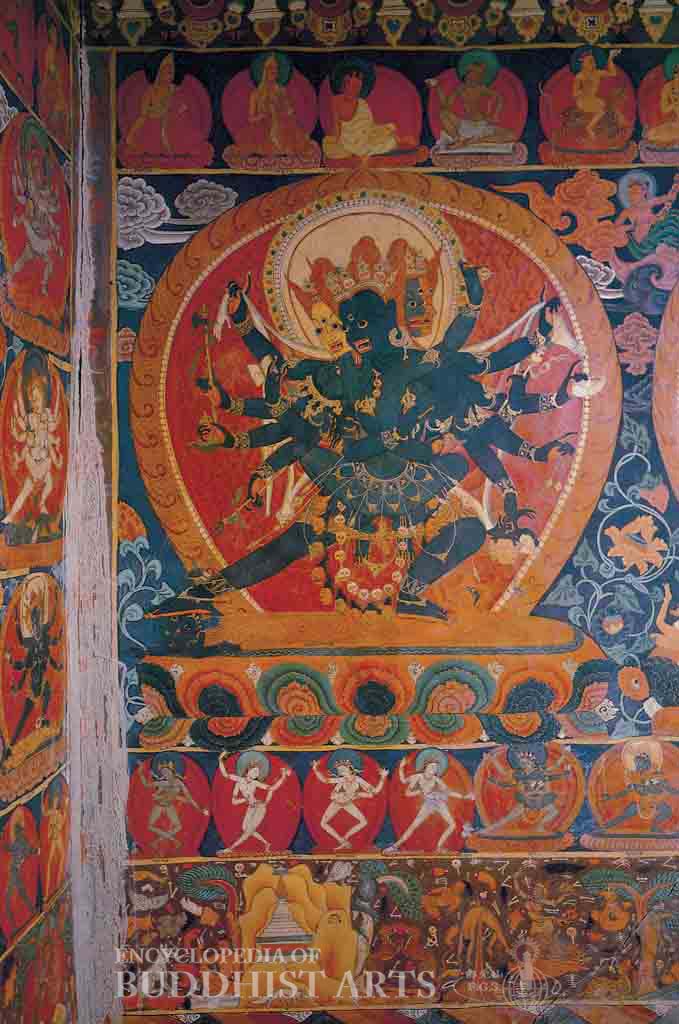
Guge Mandala Hall: Ten Herukas - Cakrasamvara
Guge Mandala Hall: Ten Herukas
CHINA, Tibet, Ngari
The walls of Mandala Hall are covered with murals divided into six distinct rows. The Ten Herukas, painted in the 16th century, are shown in the third row on the north and south walls. The ten figures have multiple heads with wrathful appearances. They wear headdresses and jewelry, and stand on subdued demons upon lotus pedestals with large, colorful petals. Their multiple arms hold objects and embrace wisdom consorts. The nimbuses and mandorlas are decorated with jewels and flame patterns.
Below the lotus pedestals, there are images of dancing heavenly beings with different skin colors. The heavenly beings wear crowns and have four hands that hold objects including vajras, bells, and conch shells. Their slender bodies are adorned with string ornaments. The images are painted on a blue background. Each of the manifestations is named by a Tibetan inscription within a cartouche at the bottom. Apsaras among colorful clouds, as well as plants and flowers are painted between the figures.
For more details, go to the Encyclopedia of Buddhist Arts: Painting A-H, page 304.
Cite this article:
author = Hsingyun and Youheng and Youlu and Wilson, Graham and Manho and Mankuang and Huntington, Susan,
booktitle = {Encyclopedia of Buddhist Arts: Painting A-H},
pages = 304,
title = {{Guge Mandala Hall: Ten Herukas}},
volume = 14,
year = {2016}}