
Guge Red Temple: White Tara
Guge Red Temple: White Tara
CHINA, Tibet, Ngari
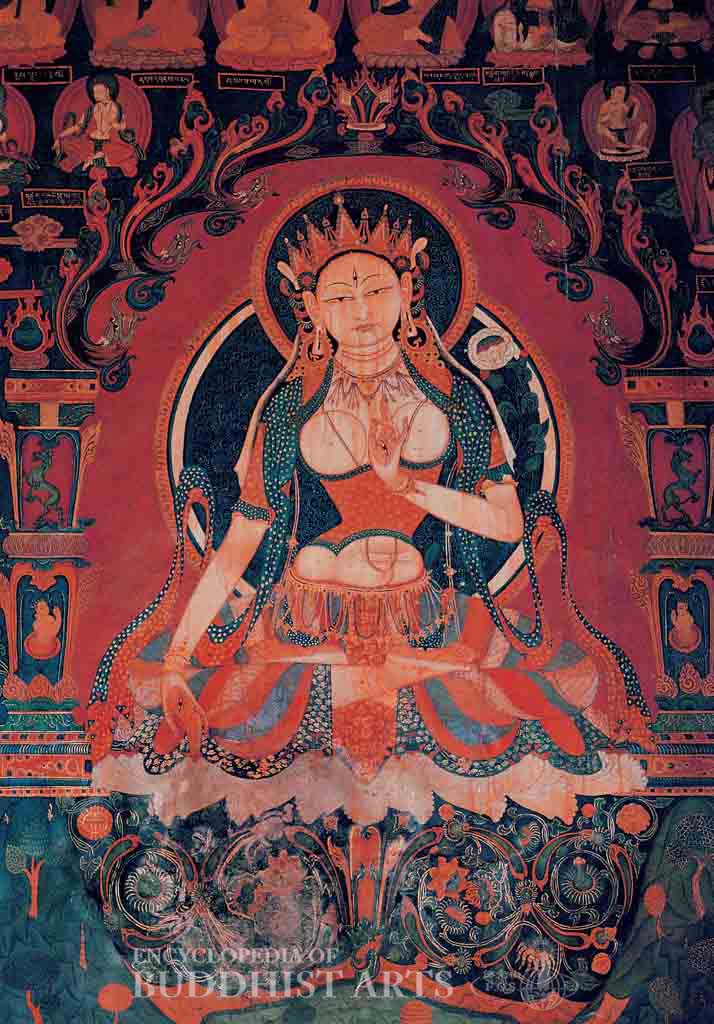
This mid-15th century image of White Tara is painted on the right side of the east wall of the Red Temple. The figure is also known as Seven-Eyed Tara for having five additional eyes: one between the eyebrows, and one on each of the palms of the hands and soles of the feet. White Tara has a slim waist and a full chest. She is dressed in a tight fitting top that exposes her breast and stomach, and she wears a pointed crown, earrings, a necklace, and bracelets. A stole is draped around her arms, and her lower body is covered with a dhoti. Tara is seated in lotus position on a white lotus throne, forming the varada (wish-granting) mudra with the right hand.
Tara’s nimbus, aureole, and clothing are decorated with fine patterns. Below the petals of the lotus throne, there are peonies and scrolling vines. An ornate niche surrounds Tara. The arch above her head is decorated with six makaras, whose tails form a unique pattern. This elegant, detailed image is considered to be one of the finest murals in the Red Temple.
For more details, go to the Encyclopedia of Buddhist Arts: Painting A-H, page 309.
Cite this article:
author = Hsingyun and Youheng and Youlu and Wilson, Graham and Manho and Mankuang and Huntington, Susan,
booktitle = {Encyclopedia of Buddhist Arts: Painting A-H},
pages = 309,
title = {{Guge Red Temple: White Tara}},
volume = 14,
year = {2016}}