
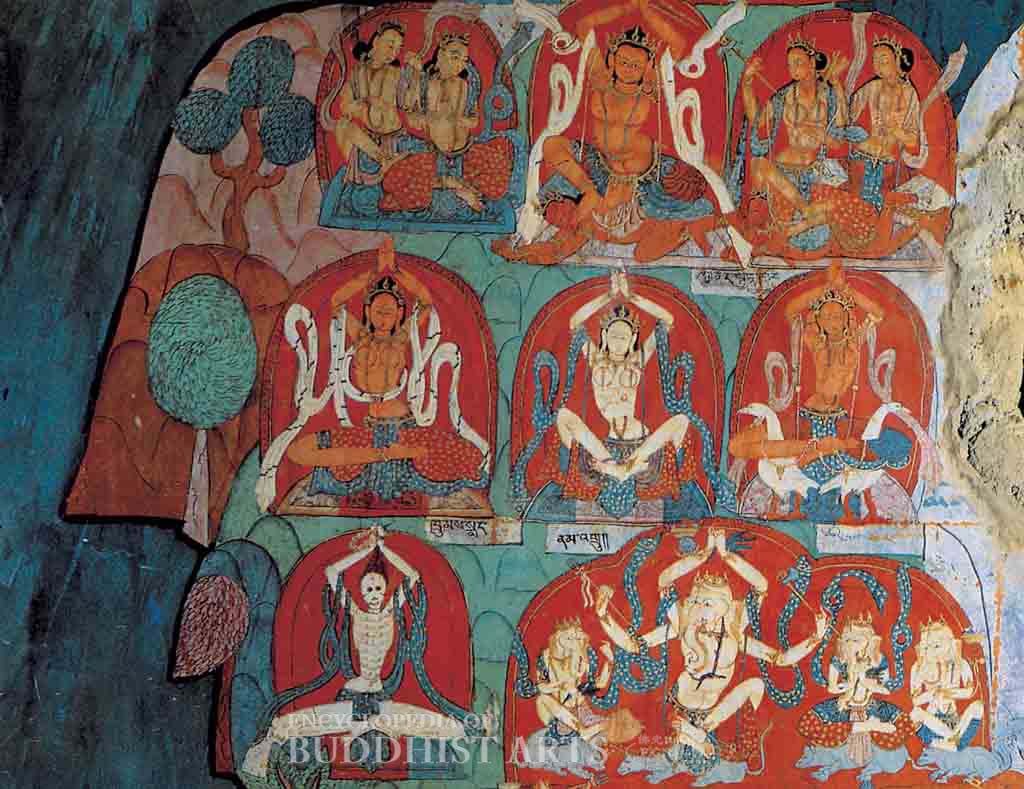
Guge White Temple: Tibetan Constellations and Heavenly Beings (7th to 9th rows, west wall)
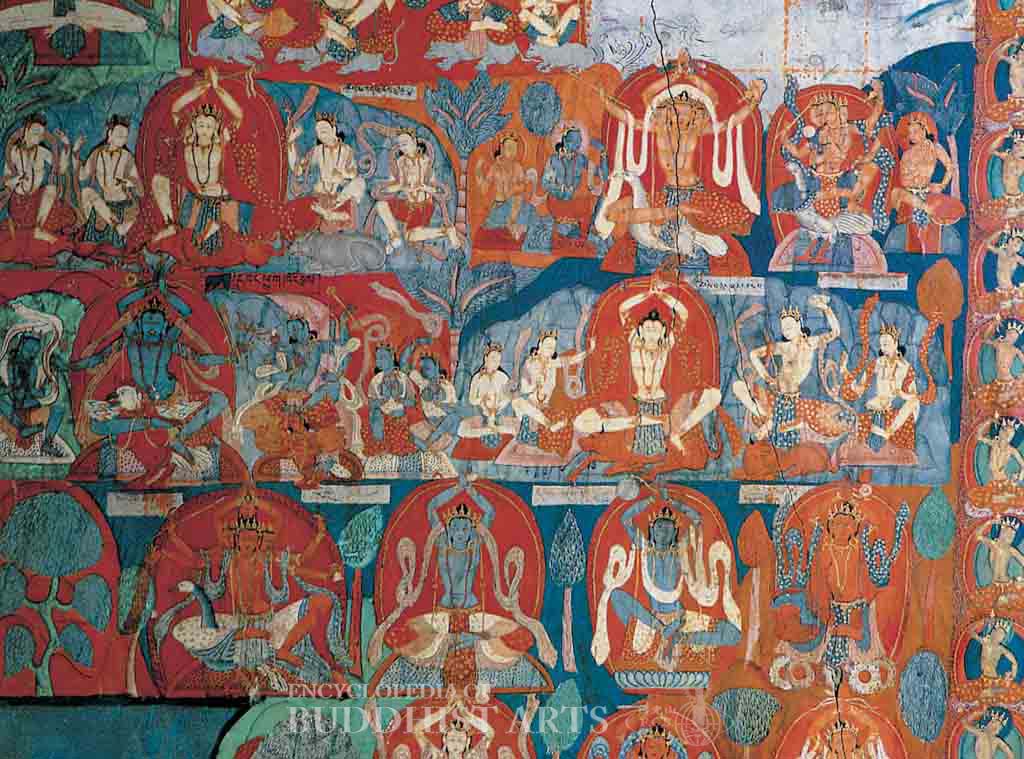
Guge White Temple: Tibetan Constellations and Heavenly Beings (10th to 12th rows, west wall)
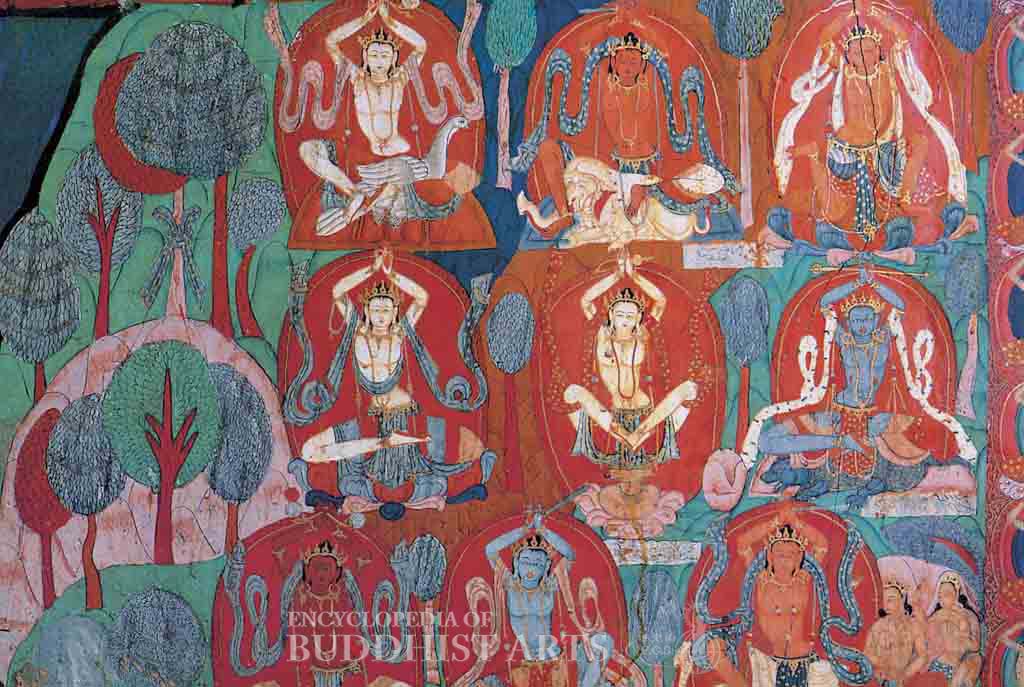
Guge White Temple: Tibetan Constellations and Heavenly Beings (13th to 15th rows, west wall)
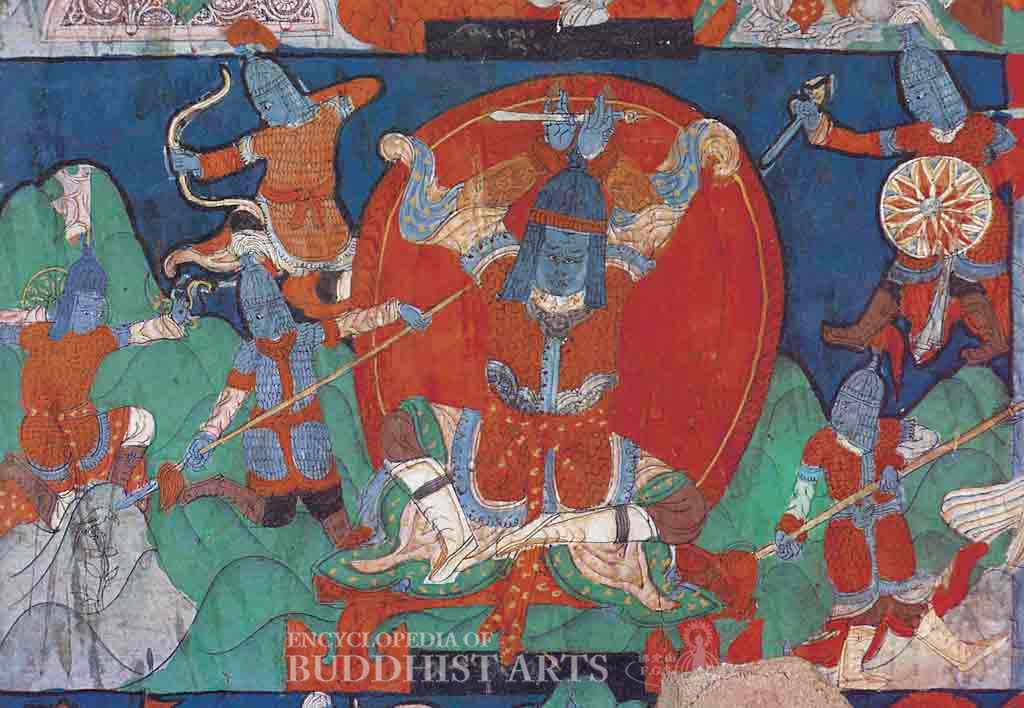
Guge White Temple: Tibetan Constellations and Heavenly Beings (detail)
Guge White Temple: Tibetan Constellations and Heavenly Beings
CHINA, Tibet, Ngari
These figures are painted on the west wall of the White Temple. There are depictions of the four families of the Kalacakra, the Twelve Heavenly Beings, and the Twenty-Seven Mansions personified as human and animal-headed figures, all arranged into rows against a forest background.
The central figure in the seventh row is Maharaja, with his two arms raised high. He is seated in a relaxed posture with his feet placed upon a demon. Two pairs of heavenly beings sit on either side of Maharaja. In the eighth row, from left to right, there are images of the Virgo constellation, the Root mansion constellation, and a heavenly being. All the figures have their arms raised high above their heads and wear a jeweled crown and flowing garments. There is a skeleton on the left in the ninth row, while on the right is the elephant-headed, four-armed Ganesa. He is seated on a rat and flanked by three followers. The figure on the left in the tenth row sits atop a bull, with two attendants on either side. The two figures on the right have four arms, multiple faces, and ride geese, accompanied by three attendants. A row down, on the left, the main figure and his consorts sit atop birds, while the figure on the right sits on a bull. There are four figures in the 12th row, possibly representing a group of constellations. From left to right, they sit on a goose, a cushion, a lotus, and wheels. In the 13th to 15th rows, there are figures representing the constellations seated on geese, elephants, a mongoose, lotus flowers, or a vase.
The Heavenly Kings are portrayed as warriors, carrying weapons and dressed in armor, helmets, and white boots. They hold weapons that resemble those that have been found in the Guge Kingdom’s ancient ruins. Although the inscriptions in Tibetan meant to identify the constellations are indecipherable, the mural is a fascinating example of the symbolic rendering of astronomical knowledge.
For more details, go to the Encyclopedia of Buddhist Arts: Painting A-H, page 313.
Cite this article:
author = Hsingyun and Youheng and Youlu and Wilson, Graham and Manho and Mankuang and Huntington, Susan,
booktitle = {Encyclopedia of Buddhist Arts: Painting A-H},
pages = 313,
title = {{Guge White Temple: Tibetan Constellations and Heavenly Beings}},
volume = 14,
year = {2016}}