
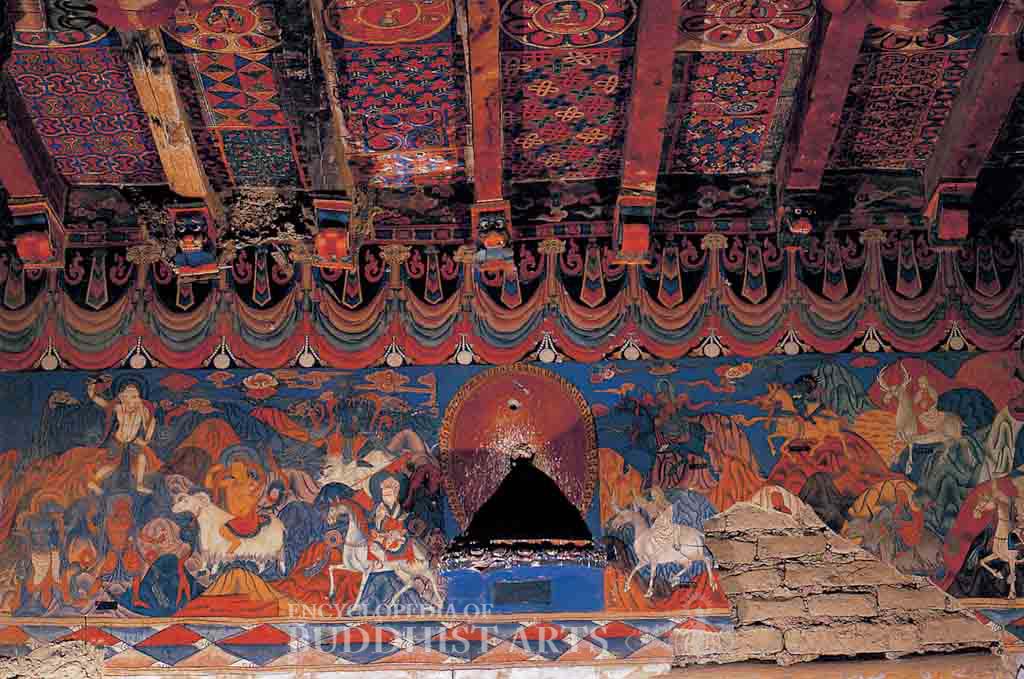
Guge Murals: White Temple (north wall, upper mural)
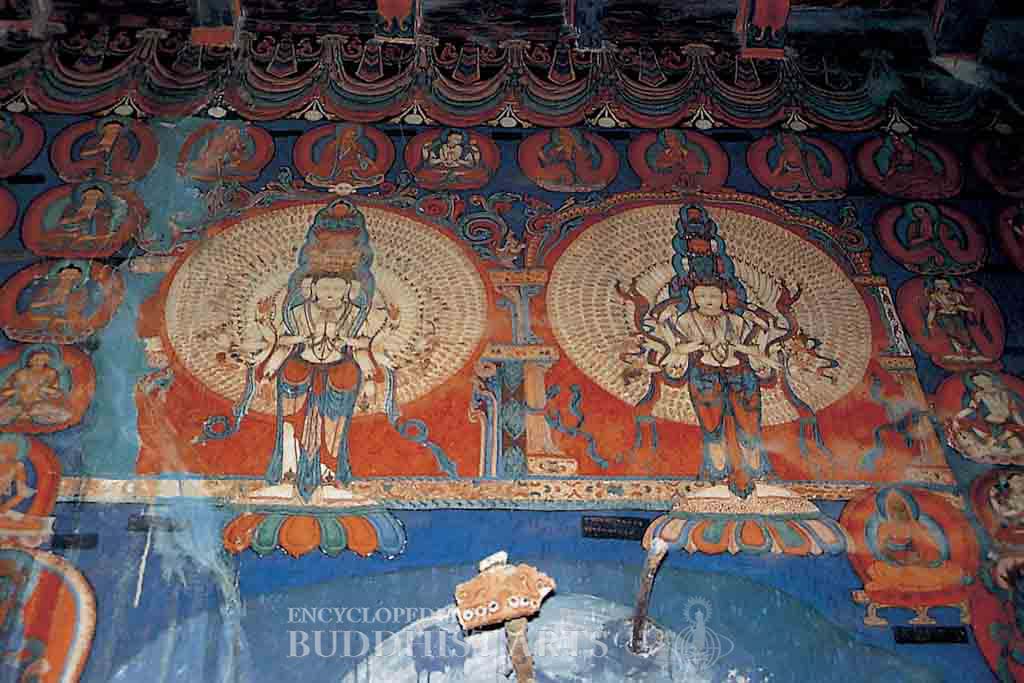
Guge Murals: White Temple - Thousand-Armed, Thousand-Eyed Avalokitesvara (south wall, upper right mural)
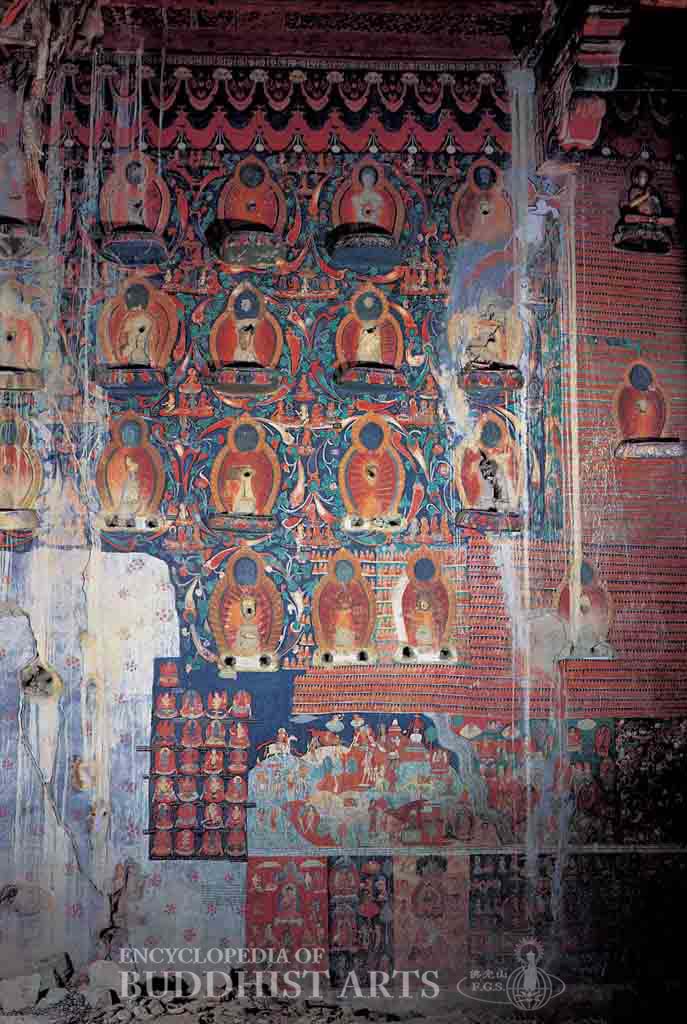
Guge Murals: White Temple Inner Shrine (east wall, left mural)

Guge Murals: Red Temple - Monastic Celebration (east wall)
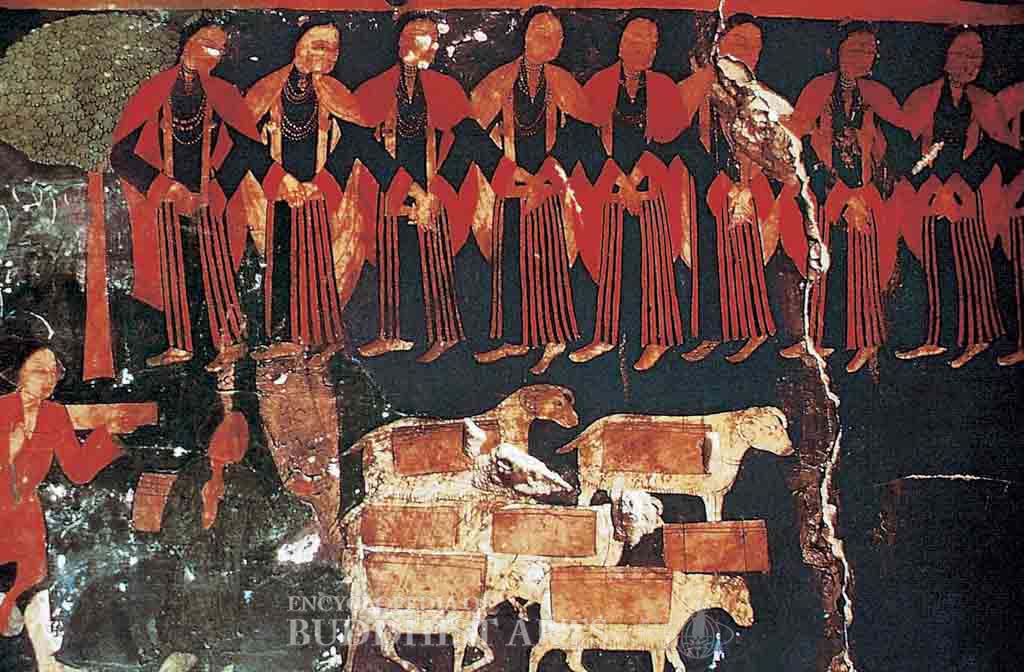
Guge Murals: Red Temple - Celebration for Completion of Temple (detail) (east wall)
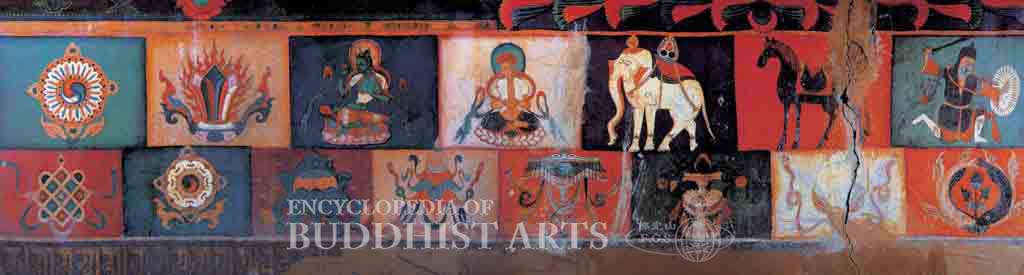
Guge Murals: Red Temple - Cakravartin (east wall, lower left mural)

Guge Murals: White Temple - Thousand-Armed, Thousand-Eyed Avalokitesvara (detail) (south wall, upper right mural)
Guge Murals
CHINA, Tibet, Ngari
These murals cover over 800 sq m of the walls in the various temples and halls within the site of the Guge Kingdom. The murals in Guge can be divided into early, middle, and late period artworks. The early period begins around the mid-15th century, and includes the murals in the White and Red Temples. The murals in the Mandala Hall, Yamantaka Hall, and Protector Hall belong to the middle period, encompassing the first half of the 16th century. Murals from the later period, which is after the 16th century, include those in the Tara Hall and in Cave 126.
The walls of the White Temple are painted with images of Buddhas, Bodhisattvas, Vajrasattva, Tara, eminent monks, and kings, bordered by an upper band of draperies and a lower band of diamond-shaped conch shell motifs. The Buddha on the right side of the north wall is flanked by illustrations of the successive generations of Khenpos of the Tibetan Empire (circa 7th–9th century) and monarchs of the Guge Kingdom. The details of the lineage of the monarchs and the vivid depictions of their clothing serve as valuable historical resources, and their position next to the Buddha indicates their importance within the society of the time. Moving from left to right on the west wall, there are depictions of heavenly beings and a diagram of the constellations. Stories from the Life of the Buddha are painted in the center of the west and east walls.
The Red Temple is located just below the White Temple, and has a similar architectural layout. The murals in the Red Temple are divided into distinct upper, middle, and lower registers. In the top register, there is a continuous pattern of beasts holding a drapery with their mouths. The middle register, which occupies two-thirds of the wall, is the main section of the mural. The north and south walls are painted with 12 large Buddha triads. On the east wall, there are images of Manjusri Bodhisattva, White Tara, Usnisavijaya, Hayagriva, Vajrapani, five Dharma protectors, seven Wisdom Kings, Usnisa Sitatapatra, Green Tara, and Four-Armed Avalokitesvara Bodhisattva. Each figure is almost 3 m high. Around these large figures, there are images of small Buddhas, Bodhisattvas, Guge monarchs, Khenpos, Indian yogis, eminent monks, and patriarchs.
A monastic celebration, with figures making offerings, musicians playing instruments, and dancing female figures, is portrayed in the lower register of the east wall. There is also a depiction of a Guge monarch and his royal companions, seated in full lotus position on cushions, paying respect to the Buddha. On the left side of the east wall, there are images of the eight stupas, seven treasures, and eight auspicious symbols. The lower registers of the north and south walls illustrate the Life of the Buddha.
In the Yamantaka Hall, there are 18 large images of Buddhas, Bodhisattvas, and Dharma protectors. There is also an image of a group of flat-roof Tibetan buildings that appears to be a depiction of Guge before it fell into ruin. Eighty-four Mahasiddhas, ten dakinis, and twenty-one heavenly beings making offerings are also shown. The Tara Hall is painted with murals, but most of them are damaged and unclear. Some of the best preserved murals are in the Protector Hall, and in Caves 126 and 35.
In most of the murals, the colors remain bright and the figures are clearly visible. Though the painting techniques, coloring, and the layout of the murals reflect the influence of neighboring kingdoms in India and Kashmir, a unique Guge style can still be seen, making them treasures of Tibetan Buddhist art.
For more details, go to the Encyclopedia of Buddhist Arts: Painting A-H, page 300.
Cite this article:
author = Hsingyun and Youheng and Youlu and Wilson, Graham and Manho and Mankuang and Huntington, Susan,
booktitle = {Encyclopedia of Buddhist Arts: Painting A-H},
pages = 300,
title = {{Guge Murals}},
volume = 14,
year = {2016}}