

Sigisan Legend - Deeds of Myoren - Yamazaki Choja Scroll (detail)
Ink and color on paper

Sigisan Legend - Deeds of Myoren - Yamazaki Choja Scroll (detail)

Sigisan Legend - Deeds of Myoren - Engi Kaji Scroll (detail)

Sigisan Legend - Deeds of Myoren - Engi Kaji Scroll (detail)
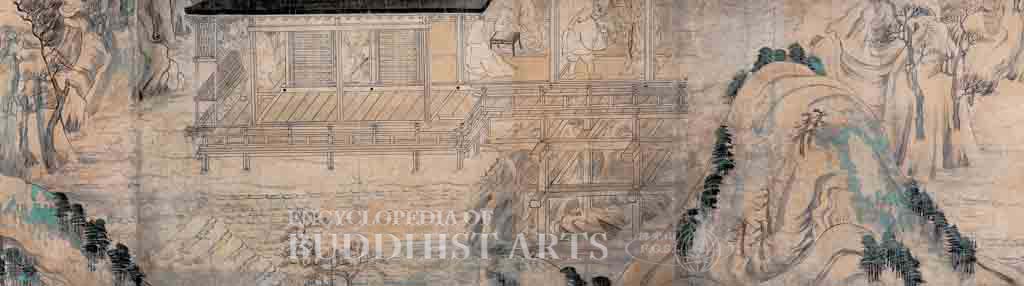
Sigisan Legend - Deeds of Myoren - Amagimi Scroll (detail)
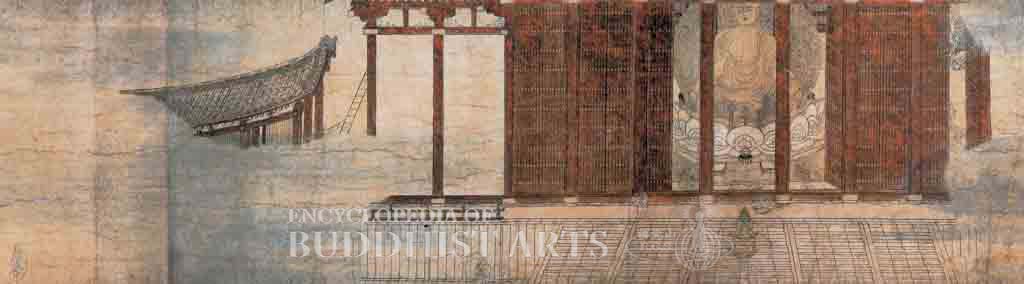
Sigisan Legend - Deeds of Myoren - Amagimi Scroll (detail)
Sigisan Legend - Deeds of Myoren
JAPAN, Nara, Ikoma; Heian period
These three 12th century scrolls depict the miraculous deeds of the monk Myoren, who lived in Sigisan, Nara, during the early 10th century. The second and third scrolls contain both text and images, but the inscriptions on the first scroll are missing. The set was listed as a National Treasure in 1951.
The first scroll, known as the Yamazaki Choja, illustrates the story of Myoren’s magic rice bowl. The bowl would fly through the air, begging for alms on Myoren’s behalf. One day, the bowl arrived at the house of Yamazaki, a rich man who refused to share his wealth. Annoyed by the request for alms, Yamazaki attempted to trap the bowl inside his granary. However, the bowl caused the entire granary to rise up into the air and fly back to Myoren. Distraught, Yamazaki came to ask for the return of his goods. Myoren consented, and the rice bowl once again flew through the sky, leading a line of rice bales behind it. In the upper left section of the first picture, the alms bowl levitates in the air with the wooden granary floating above it. Below on the right, astonished onlookers look up in amazement or run after the granary as it flies away. In the second picture, a line of rice bales follows behind the alms bowl as it returns to the home of Yamazaki.
The second scroll is known as the Engi Kaji because it depicts the healing of the Engi Emperor Daigo (reigned 897–930). When the emperor became seriously ill, a messenger was sent to Myoren, who had become known for his supernatural powers. Though he was asked to travel to the palace, Myoren said that there was no need, and promised to cure the emperor without leaving his mountain home. He summoned a sword-wielding Dharma protector who flew to the palace and appeared before the emperor in a dream. After waking, the emperor immediately felt his strength return. In the first picture, the Dharma protector is shown following a Dharma wheel, running along a trail of clouds above a hilly landscape. In the next scene, the Dharma protector, now standing upon the wheel, arrives at the palace.
The third scroll illustrates the story of the nun Amagimi, Myoren’s older sister, who journeyed from Nagano to search for her brother. She spent the night at Todaiji Temple in front of the large Buddha statue, and had a dream in which the statue spoke and told her where her brother could be found. In the first picture, Amagimi is sketched in various positions around the colossal golden statue. In the second image, she is shown meeting her brother Myoren and presenting him with a robe.
The figures in the illustrations are dramatically portrayed. The buildings are finely outlined and the backgrounds contain hills, trees, and water. Bright colors are sparingly used but stand out in each scene. The artwork shows influence from the Chinese Tang dynasty (618–907). These are some of the finest examples of narrative scrolls that became popular during the Heian period (794–1185).
For more details, go to the Encyclopedia of Buddhist Arts: Painting P-Z, page 834.
Cite this article:
author = Hsingyun and Youheng and Youlu and Wilson, Graham and Manho and Mankuang and Huntington, Susan,
booktitle = {Encyclopedia of Buddhist Arts: Painting P-Z},
pages = 834,
title = {{Sigisan Legend - Deeds of Myoren}},
volume = 16,
year = {2016}}