
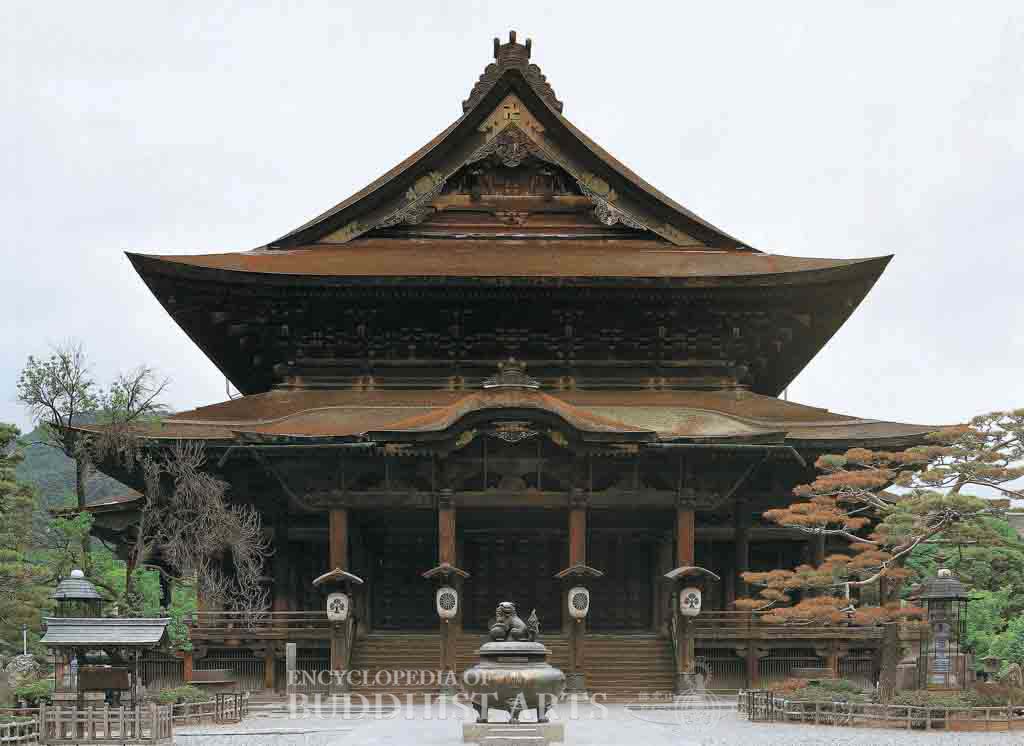
Zenkoji Temple: Main Hall
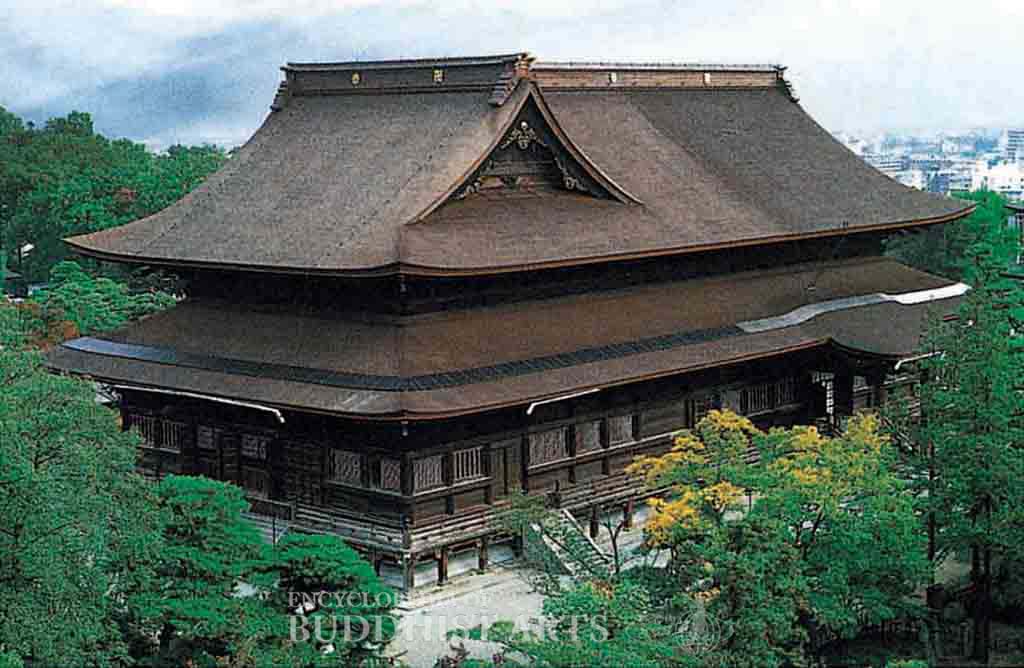
Zenkoji Temple: Main Hall
Zenkoji Temple
JAPAN, Nagano
According to the temple records, it was built in 642 to enshrine the Buddha statue presented by King Seong (reigned 523–554) of Baekje. Later, with the patronage of Minamoto no Yorimoto and the Hojo clan, the temple expanded to become a full monastic compound. Both Master Shinran and Master Ippen visited and worshipped at this temple. The temple became popular as a major temple for the worship of Amitabha Buddha in Nagasaki. The temple was damaged and repaired many times before assuming its present appearance. The temple belongs to both the Tendai and Pure Land schools of Japanese Buddhism.
Zenkoji Temple occupies 5.9 ha and the main buildings include the Gate of Benevolent Kings, temple gate, main hall, sutra repository, and bell tower. The Gate of Benevolent Kings was rebuilt in 1918. It is approximately 13 m wide, 7 m deep, and 14 m high. The two-story temple gate was completed in 1750 during the Edo period. It has a double-eave hip-and-gable roof covered with cypress bark. It is approximately 20 m wide, 8 m deep, and 20 m high. A statue of Manjusri Bodhisattva riding a lion and statues of the Four Heavenly Kings are enshrined within the upper story.
The main hall was built in 1707 during the Edo period. It is approximately 24 m wide, 54 m deep, and 30 m high, and occupies 1,425 sq m. It is the largest main hall in eastern Japan. The roof is covered with cypress bark and the ridge is in a T-shape. The hall is a model of mid-Edo period architecture with a gable wall facing the front, an extended worship area, curved bargeboards, and complex bracket sets that are used to support the large roof. The floor of the hall is covered with tatami mats. The architraves and circular columns are painted red. The upper sections of the columns are decorated with gilt images of the Twenty-Five Bodhisattvas and a monk riding on clouds. The lower sections have foldable partition doors. The Amitabha Buddha Triad is enshrined within the main hall. The sutra repository was built in 1759 during the Edo period. It has a square pyramidal roof and houses an octagonal revolving sutra case storing the Tetsugen Tripitaka.
For more details, go to the Encyclopedia of Buddhist Arts: Architecture T-Z, page 1388.
Cite this article:
author = Hsingyun and Youheng and Johnson, Peter and Mankuang and Lancaster, Lewis,
booktitle = {Encyclopedia of Buddhist Arts: Architecture T-Z},
pages = 1388,
title = {{Zenkoji Temple}},
volume = 4,
year = {2016}}