
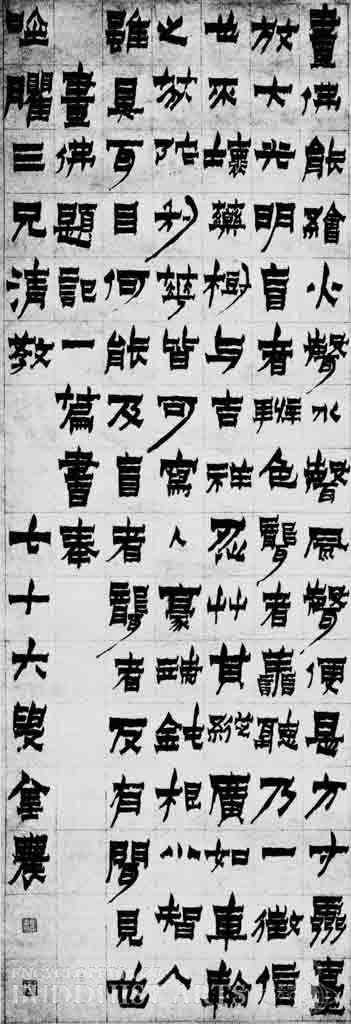
Painting the Buddha
Ink on paper
Painting the Buddha
CHINA; Qing dynasty
This calligraphy, written in seven lines, is the work of Jin Nong at the age of 76. It contains his opinions regarding the art of painting the Buddha, as he felt an image of the Buddha should be painted such that it connects with the viewer and invokes inspiration.
Jin Nong was a calligrapher, painter, and poet of the Qing dynasty (1644–1911). He was especially well-versed in clerical and regular scripts. Jin conceived the unusual style seen here after studying the Stele of Heavenly Augury and the Stele of Changuoshan from the Eastern Wu period (222–280). Each character is written in large format, and every stroke ends in a stunted way, similar to the way a coat of paint is applied by brush, hence the name “lacquer script.” Clerical style is seen in the articulations, where bold and long horizontal strokes contrast with vertical strokes that are short and thin. Characters appear in a variety of sizes, which contributes to the quaint configuration. Many oblique strokes with sharp ends, a distinctive feature of the Stele of Heavenly Augury, are also employed here, clearly indicating Jin’s source of reference. Jin was able to inventively adapt this style of writing to the clerical script, and thus this work is considered a unique achievement.
For more details, go to the Encyclopedia of Buddhist Arts: Calligraphy, page 173.
Cite this article:
author = Hsingyun and Youheng and Youlu and Pokorski, Stefanie and Mankuang and Edson, Gary,
booktitle = {Encyclopedia of Buddhist Arts: Calligraphy },
pages = 173,
title = {{Painting the Buddha}},
volume = 17,
year = {2016}}