
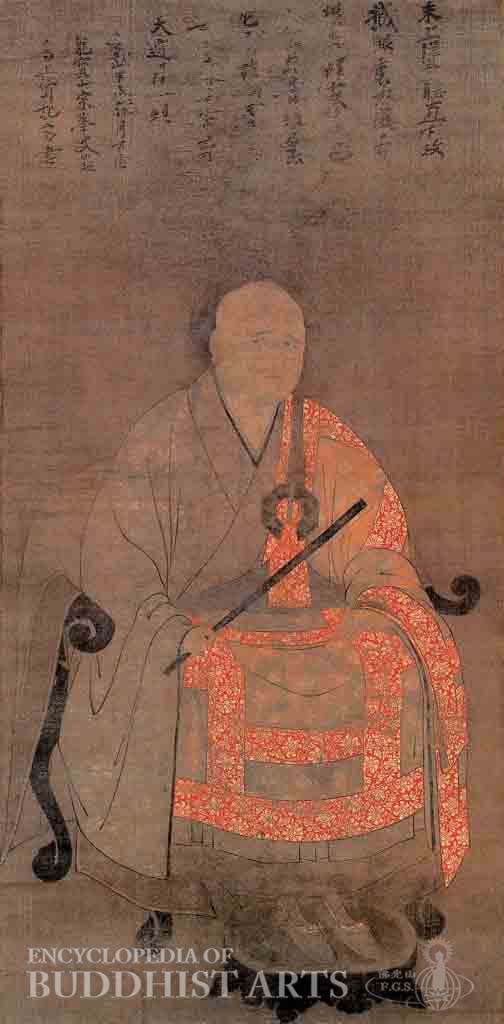
Daitokuji Temple: Master Shuho Myocho
Ink and color on silk
Daitokuji Temple: Master Shuho Myocho
JAPAN, Kyoto; Nanbokucho period
Master Shuho Myocho was born in 1282 and died in 1337. He learned the Dharma from Master Shomyo, and went on to become a great master in his own right, spreading and developing the Rinzai Zen school in Japan. He founded Daitokuji Temple in Kyoto, and converted Emperor Hanazono (reigned 1308–1318) and Emperor Go-Daigo (reigned 1318–1339) to Buddhism. After his death, he was granted the posthumous title of “National Master Daito.” This portrait was made in 1334, when Master Shuho was 53 years old. He wrote the inscription at the top, and gave the portrait to one of his disciples as a gift. In 1953, the painting was listed as a National Treasure.
Shuho has an enigmatic, serious expression on his finely drawn face. He sits in a wooden chair, holding a stick in his right hand. His shoes are placed on a stool in front of him. The robe is accented with red strips that are covered with gold patterned flowers. These patterns stand out brightly, while the rest of the clothing blends with the brown background. There is an octagonal clasp on the left shoulder that holds the robe in place. This chinso, or figurative painting of monks, shows a distinct Japanese style that evolved from those influenced by the Chinese Song dynasty (960–1279).
For more details, go to the Encyclopedia of Buddhist Arts: Painting A-H, page 183.
Cite this article:
author = Hsingyun and Youheng and Youlu and Wilson, Graham and Manho and Mankuang and Huntington, Susan,
booktitle = {Encyclopedia of Buddhist Arts: Painting A-H},
pages = 183,
title = {{Daitokuji Temple: Master Shuho Myocho}},
volume = 14,
year = {2016}}