
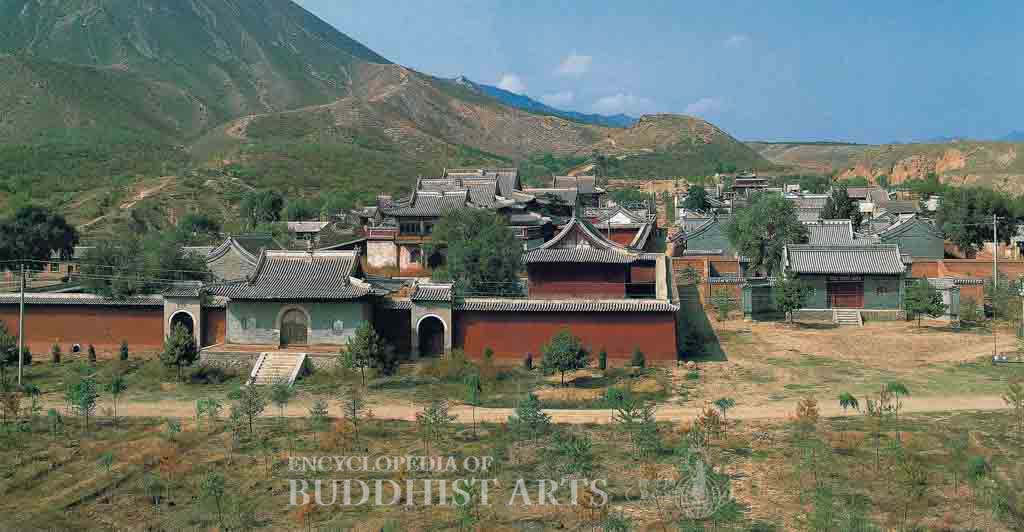
Wusutu Monastery
Wusutu Monastery
CHINA, Inner Mongolia, Hohhot
Wusutu in Mongolian means the Place with Water. It consists of the Guanyuan Temple, Qingyuan Temple, Changshou Temple, Faxi Temple, Luohan Temple, and Yaowang Temple. The Guangshou Temple was constructed between 1567 and 1572 during the Ming dynasty. The Qingyuan Temple is said to have been built in either 1583 or 1616 during the Ming dynasty. The Faxi Temple was constructed during the early rule of Emperor Yongzheng (reigned 1722–1735), and the Luohan Temple and Yaowang Temple during the rule of Emperor Qianlong (reigned 1736–1795) period.
Qingyuan Temple is the principal temple and the largest. Its central hall is constructed in Chinese and Tibetan styles, with double-eave hip-and-gable roofs. Faxi Temple is the best preserved temple and it houses 3,455 engraved wooden blocks of the Collected Works of Sumpa Khenpo, organized by the third incarnate lama of the temple, Lobsang Wangyal. The layout and architecture of the Luohan Temple are entirely Chinese in style, which makes it different from the other Buddhist temples.
For more details, go to the Encyclopedia of Buddhist Arts: Architecture T-Z, page 1281.
Cite this article:
author = Hsingyun and Youheng and Johnson, Peter and Mankuang and Lancaster, Lewis,
booktitle = {Encyclopedia of Buddhist Arts: Architecture T-Z},
pages = 1281,
title = {{Wusutu Monastery}},
volume = 4,
year = {2016}}