
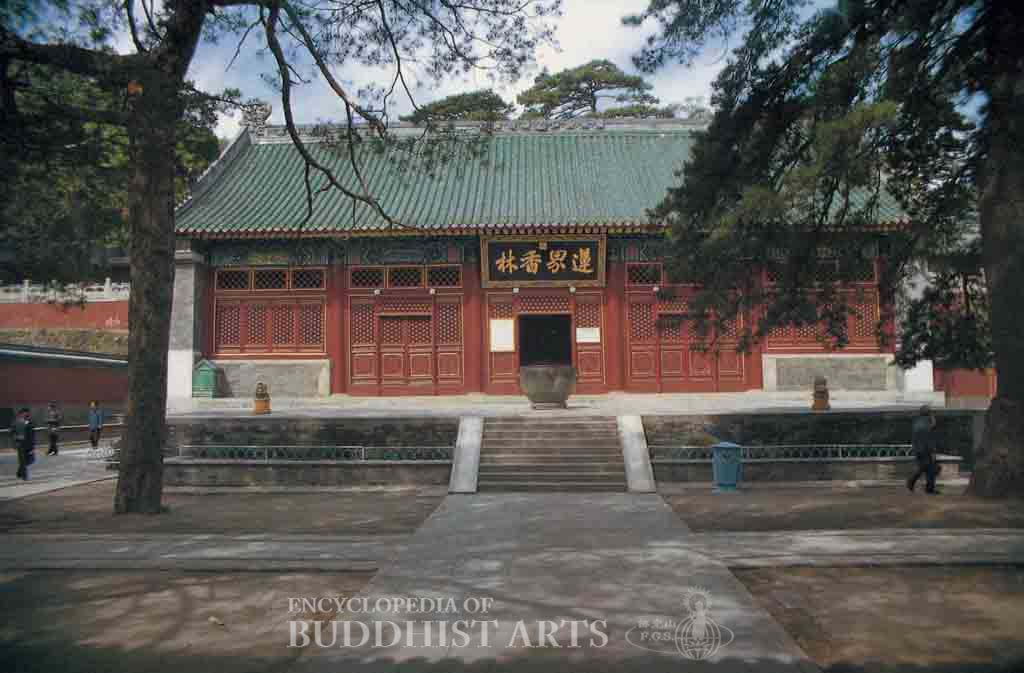
Jietai Temple: Great Hero Hall
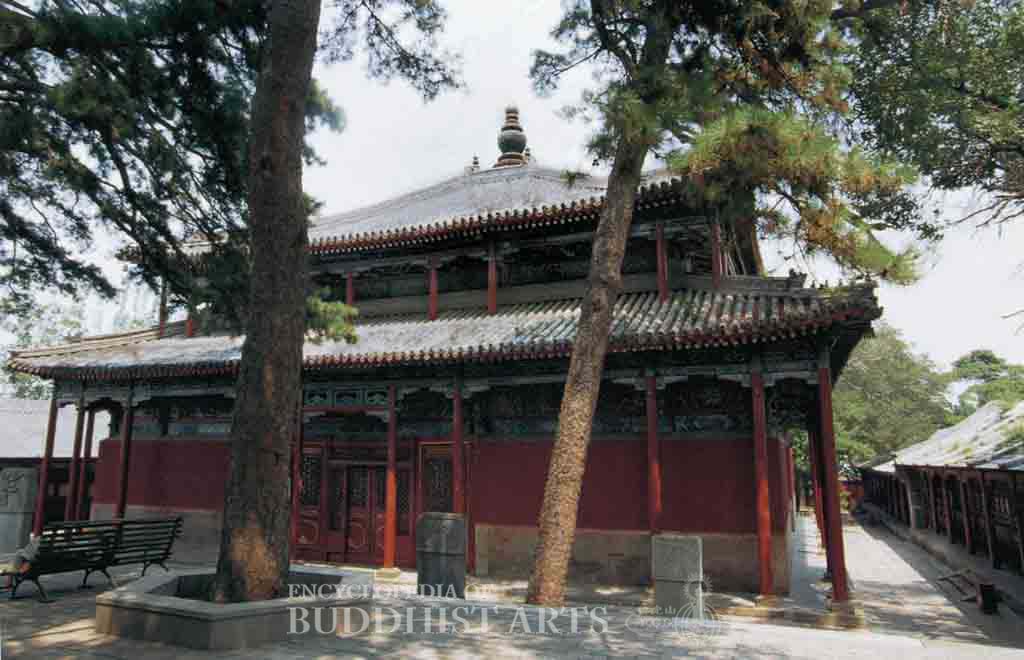
Jietai Temple: Ordination Hall
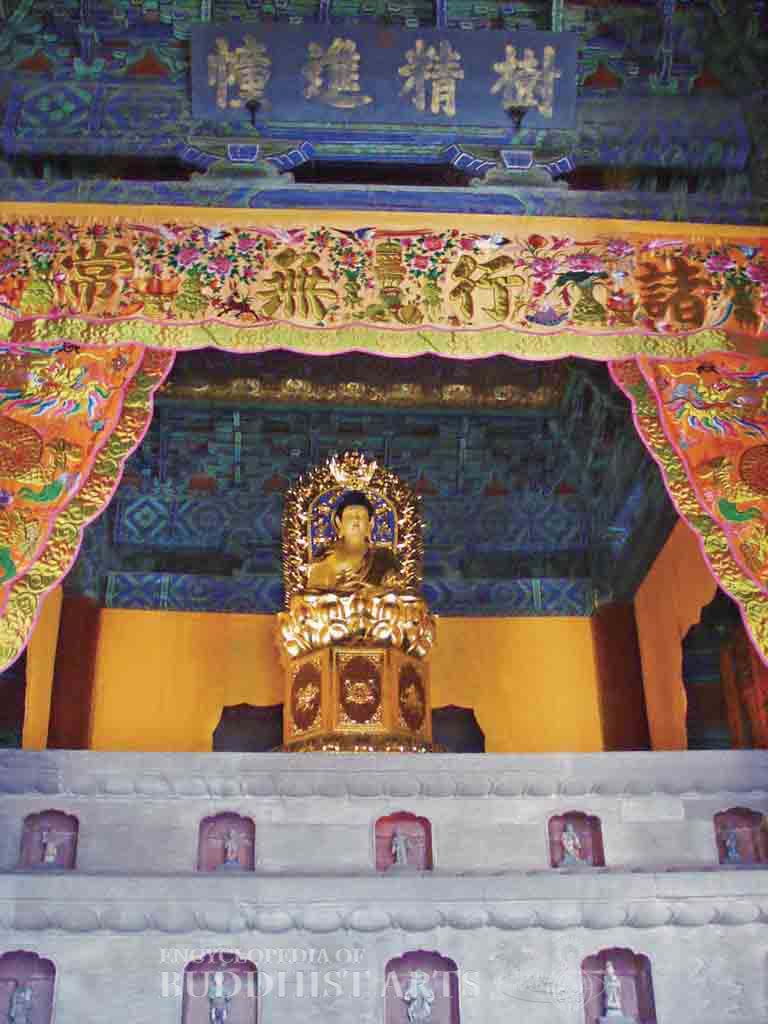
Jietai Temple: Ordination Hall (interior)
Jietai Temple
CHINA, Beijing
Jietai means Ordination Platform. The temple was founded between 581 and 600 during the Sui dynasty, but it was not until the reign of Emperor Daozong (reigned 1055–1101) of the Liao dynasty that it underwent significant reconstruction and expansion. During this period an ordination platform was built. The temple was abandoned at the end of Yuan dynasty (1271–1368) due to war, but during the Ming dynasty (1368–1644) it underwent large-scale expansion with imperial support. It is one of the Three Major Ordination Halls in China, and is the largest among the three. The extant buildings date to the Qing dynasty (1644–1911). The temple was listed as a National Cultural Heritage Site in 1996.
The temple faces east and occupies 4.4 ha, of which over 8,392 sq m are taken up by buildings. Along the southern path there are the main temple gate, Heavenly King Hall, Great Hero Hall, the ruins of the Thousand Buddha Pavilion, and Avalokitesvara Hall. The north path has buildings such as the Wisdom King Hall, Arhat Hall, ordination hall, and the Great Compassion Hall. The stele pavilion, funerary pagodas and Dharani pillars are dispersed throughout the complex. The five-by-three bay Great Hero Hall has a flush gable roof. Statues of Sakyamuni Buddha, the Medicine Buddha and Amitabha Buddha are enshrined inside.
The ordination hall is square, measuring about 26 m on each side, and is 20 m high. It has a double-eave pyramidal roof, in the center of which there is a large gilt copper stupa surrounded by four smaller stupas that date back to 1477 during the Ming dynasty. The three-tier, square ordination platform inside was constructed during the Ming dynasty. It is made of white jade and is 3.3 m high. There are 113 niches with a Dharma protector inside each niche. At the top there is a copper statue of a seated Sakyamuni Buddha.
For more details, go to the Encyclopedia of Buddhist Arts: Architecture G-L, page 512.
Cite this article:
author = Hsingyun and Youheng and Johnson, Peter and Mankuang and Lancaster, Lewis,
booktitle = {Encyclopedia of Buddhist Arts: Architecture G-L},
pages = 512,
title = {{Jietai Temple}},
volume = 2,
year = {2016}}