
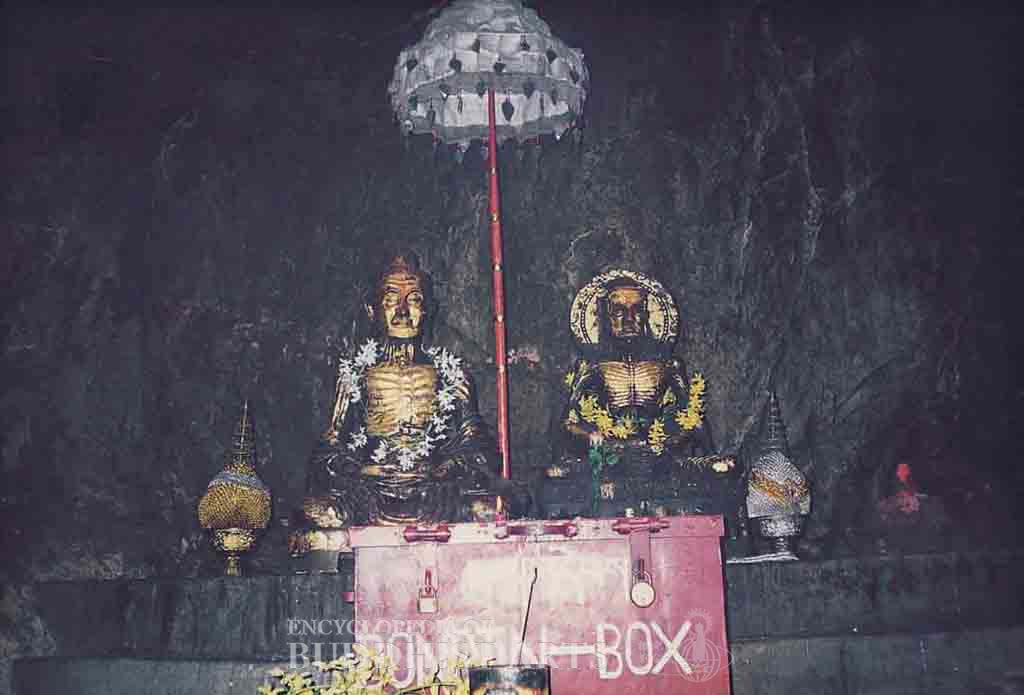
Pragbodhi: Cave (interior)
Pragbodhi
INDIA, Bihar
Pragbodhi means Prior to Enlightenment, and derives its name from the fact that Prince Siddhartha visited here before he attained enlightenment. Also known as Dhungeswara, it is a hill located near the Gaya district on the eastern bank of the Phalgu River, approximately 4.8 km northeast of Bodhgaya. According to the Great Tang Records on the Western Regions by Chinese pilgrim Master Xuanzang, after living as an ascetic for six years, Prince Siddhartha accepted a bowl of milk rice from a shepherdess and stopped briefly at this place before continuing on his journey to Bodhgaya. This site was discovered and identified by archaeologists in the 19th century.
Halfway up the western side of the hill there is a crescent-shaped natural cave. The entrance of the cave is about 1 m wide and 1.47 m high. The cave contains two ascetic Buddha statues. There are ruins of a large monastic complex below the cave, as well as ruins of several stupas atop the hill.
For more details, go to the Encyclopedia of Buddhist Arts: Architecture M-S, page 838.
Cite this article:
author = Hsingyun and Youheng and Johnson, Peter and Mankuang and Lancaster, Lewis,
booktitle = {Encyclopedia of Buddhist Arts: Architecture M-S},
pages = 838,
title = {{Pragbodhi}},
volume = 3,
year = {2016}}