
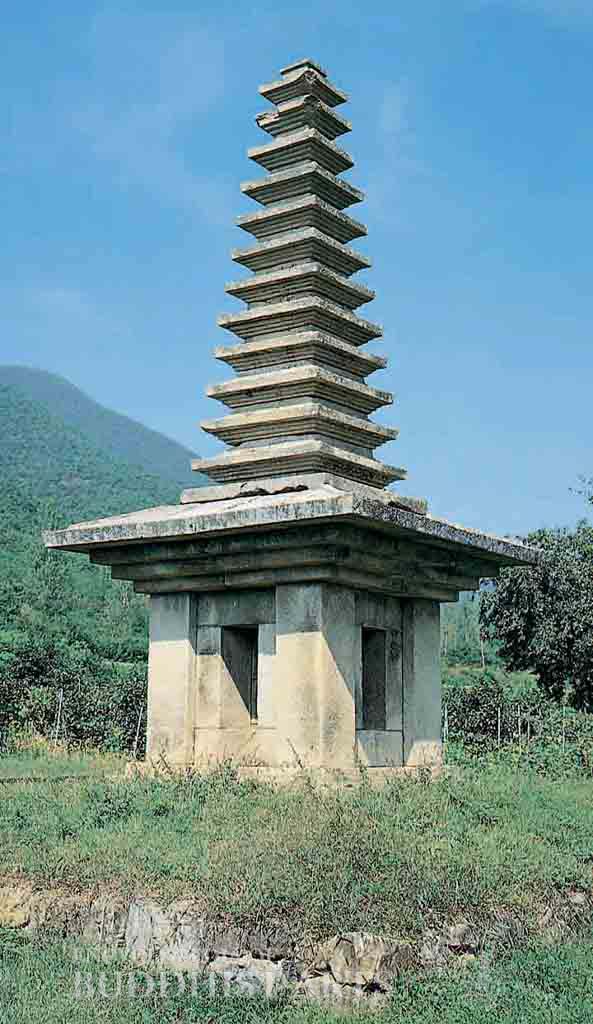
Jeonghyesa Temple Thirteen-Tier Pagoda
Jeonghyesa Temple Thirteen-Tier Pagoda
SOUTH KOREA, North Gyeongsang, Gyeongju
The pagoda is located at Jeonghyesa (Temple of Pure Benefits). It is a unique stone pagoda built during the Unified Silla dynasty (668–935); its style is not found in any other pagodas from that period. It was listed as National Treasure No. 40 in 1962.
The 5.9 m high pagoda stands on a base platform made of clay. The pagoda body has 13 tiers. The first tier of the pagoda is exceptionally high compared with the other tiers, which gradually reduce in size from the second tier up. The first tier has square corner pillars and an opening on each face. The eaves are large and consist of corbeling. The roofs and corbeling are made from different stones. The eaves of the upper twelve tiers are close together, thus forming a sharp contrast with the first tier. Only the base of the spire is extant. This rare multi-tier pagoda is comparable with Prabhutaratna Pagoda at Bulguksa Temple and the three-tier stone pagoda supported by four lions at Hwaeomsa Temple, which together constitute three of the most precious stone pagodas in Korea.
For more details, go to the Encyclopedia of Buddhist Arts: Architecture G-L, page 503.
Cite this article:
author = Hsingyun and Youheng and Johnson, Peter and Mankuang and Lancaster, Lewis,
booktitle = {Encyclopedia of Buddhist Arts: Architecture G-L},
pages = 503,
title = {{Jeonghyesa Temple Thirteen-Tier Pagoda}},
volume = 2,
year = {2016}}