
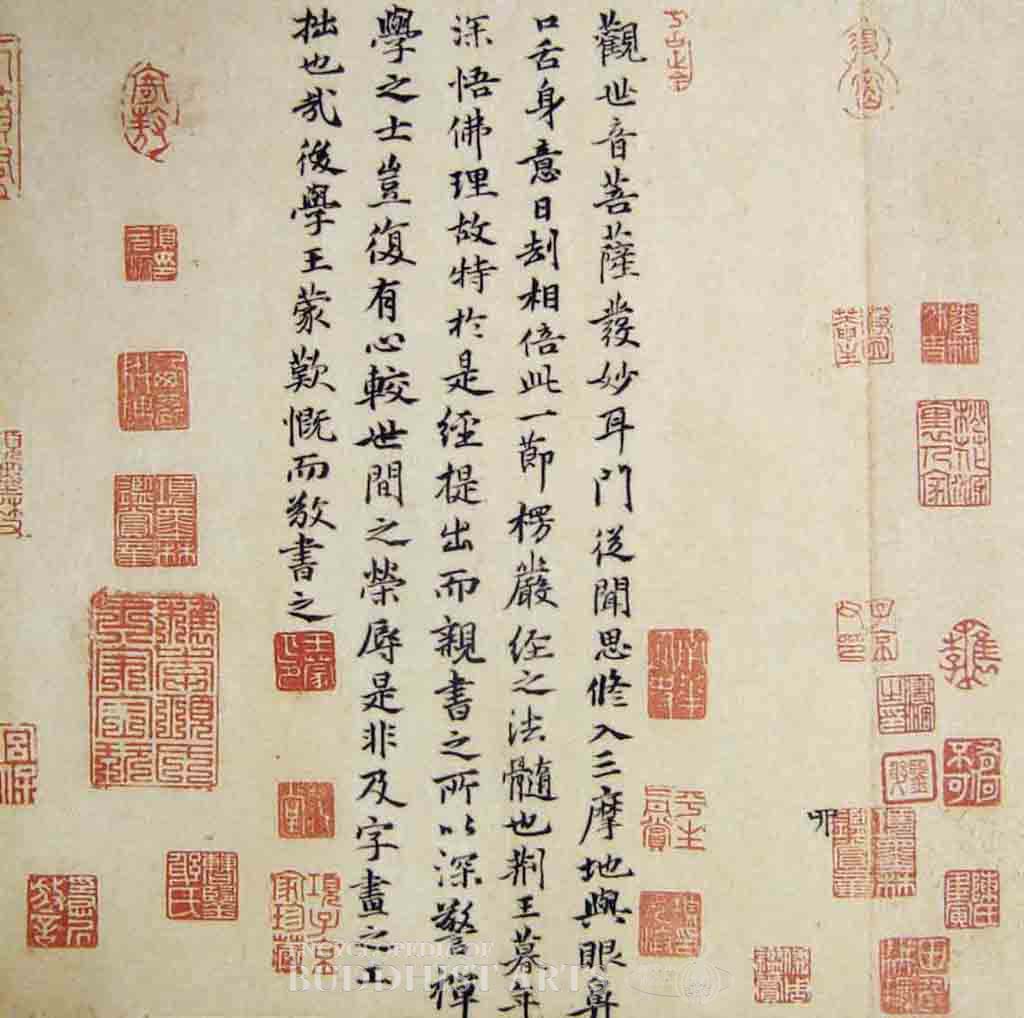
Postscript on Essential Points of the Surangama Sutra
Ink on paper
Postscript on Essential Points of the Surangama Sutra
CHINA; Yuan dynasty
This postscript by Wang Meng appears at the end of Wang Anshi’s Essential Points of the Surangama Sutra on the same stele. Using 95 characters in 5 lines, the postscript describes the author’s opinion of Wang Anshi’s work. Wang Meng observed that the most important passages in the sutra were selected, and offered his thoughts on why they may have been chosen to be on the stele. Because the sutra extract by Wang Anshi was originally untitled, it was often referred to as Essential Points.
Wang Meng was the grandson of the famous calligrapher, Zhao Mengfu. There is a strong family influence in his calligraphy, which can be seen in this elegant and skillful work. Finely articulated details comprise the work, suggesting that the postscript was probably one of Wang Meng’s earlier works.
For more details, go to the Encyclopedia of Buddhist Arts: Calligraphy, page 186.
Cite this article:
author = Hsingyun and Youheng and Youlu and Pokorski, Stefanie and Mankuang and Edson, Gary,
booktitle = {Encyclopedia of Buddhist Arts: Calligraphy },
pages = 186,
title = {{Postscript on Essential Points of the Surangama Sutra}},
volume = 17,
year = {2016}}