
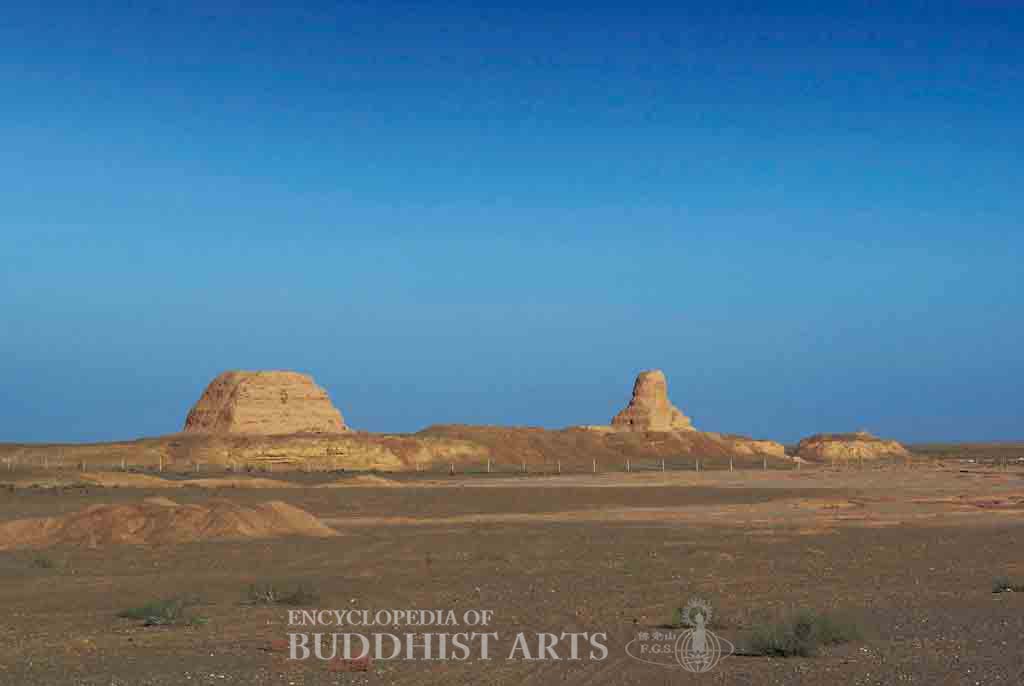
Mor Stupas

Mor Stupas: Southeastern Stupa
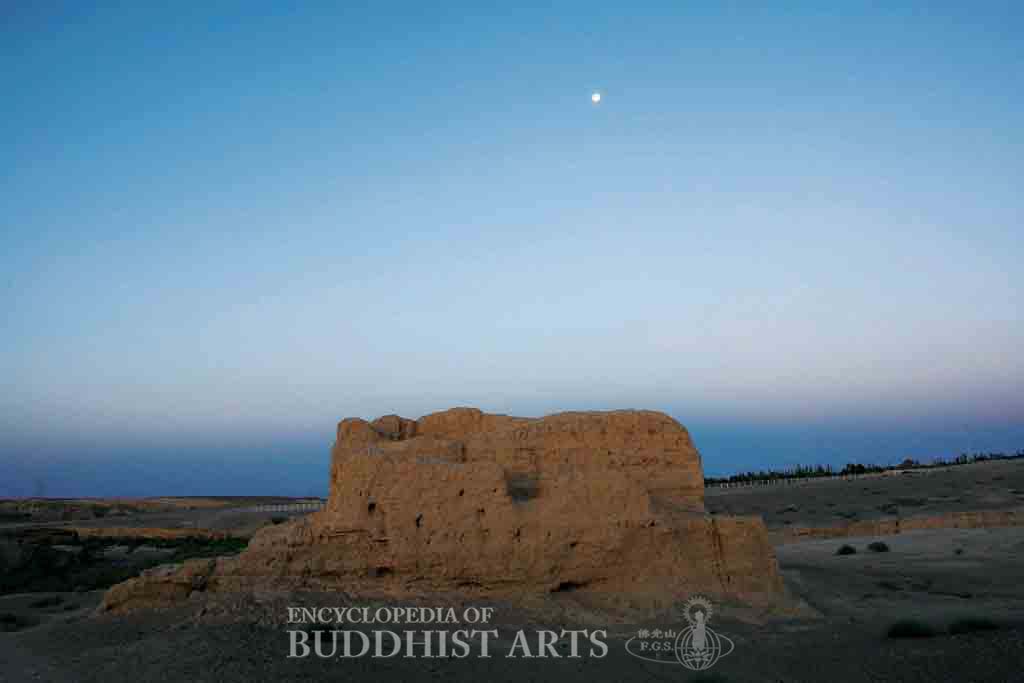
Mor Stupas: Northwestern Stupa
Mor Stupas
CHINA, Xinjiang, Kashgar
These stupas are located northeast of Shufu county in Kashgar. They were once part of a large Buddhist temple built during the Cao Wei Kingdom (220–265) and Jin dynasty (265–420). The temple was located near the capital of the Shule Kingdom. Buddhism was introduced into the kingdom in the 2nd century, and Kumarajiva studied in Shule during the mid-4th century. When Master Xuanzang from the Tang dynasty (618–907) traveled here, he described hundreds of temples and more than 100,000 monks. The site of these stupas is listed as a National Cultural Heritage Site in 2001.
There are two stupas left at the site, together with the ruins of buildings in the center and the surrounding areas. The southeastern stupa has a present height of 12.8 m. It is built from adobe bricks and is the earliest extant example of the Indian stupa form in China. It has a tapered square base, which is approximately 6.7 m high, and each side measures 12.6 m. The stupa body is cylindrical and is surmounted by an inverted bowl. There is a hole in the center which was used for installing the spire of stacked rings. The northwestern stupa is also built with adobe bricks. It measures approximately 25 m long and 23.6 m wide and has a present height of 7 m. This site is of great importance for the study and research into the spread of Buddhism to Xinjiang and the Shule Kingdom, as there are few surviving Buddhist sites from that time.
For more details, go to the Encyclopedia of Buddhist Arts: Architecture M-S, page 746.
Cite this article:
author = Hsingyun and Youheng and Johnson, Peter and Mankuang and Lancaster, Lewis,
booktitle = {Encyclopedia of Buddhist Arts: Architecture M-S},
pages = 746,
title = {{Mor Stupas}},
volume = 3,
year = {2016}}