
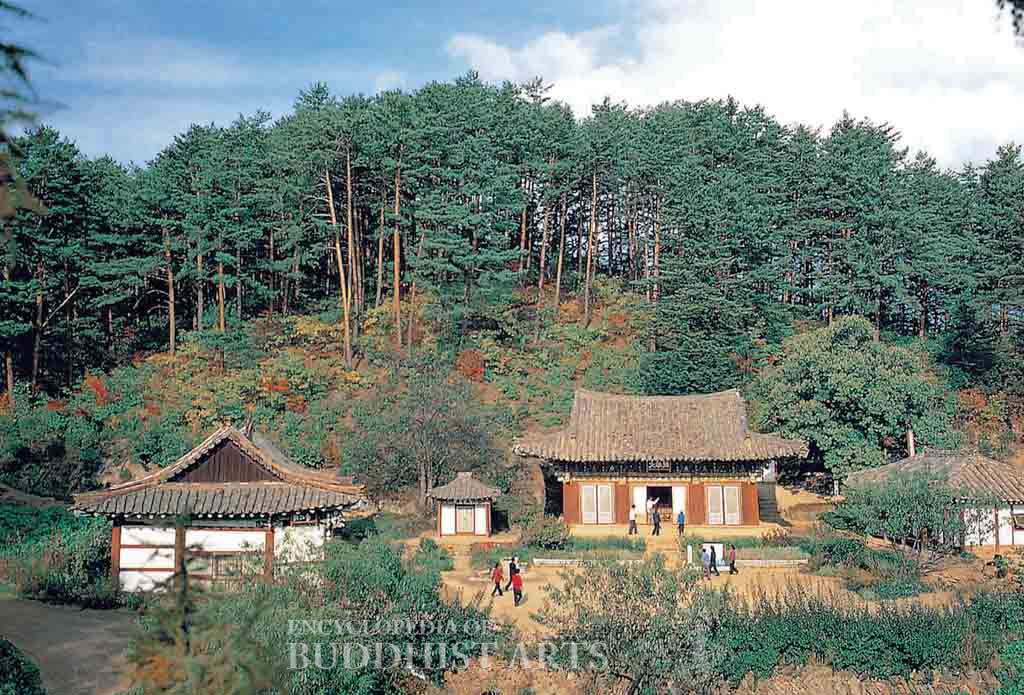
Kaesimsa Temple
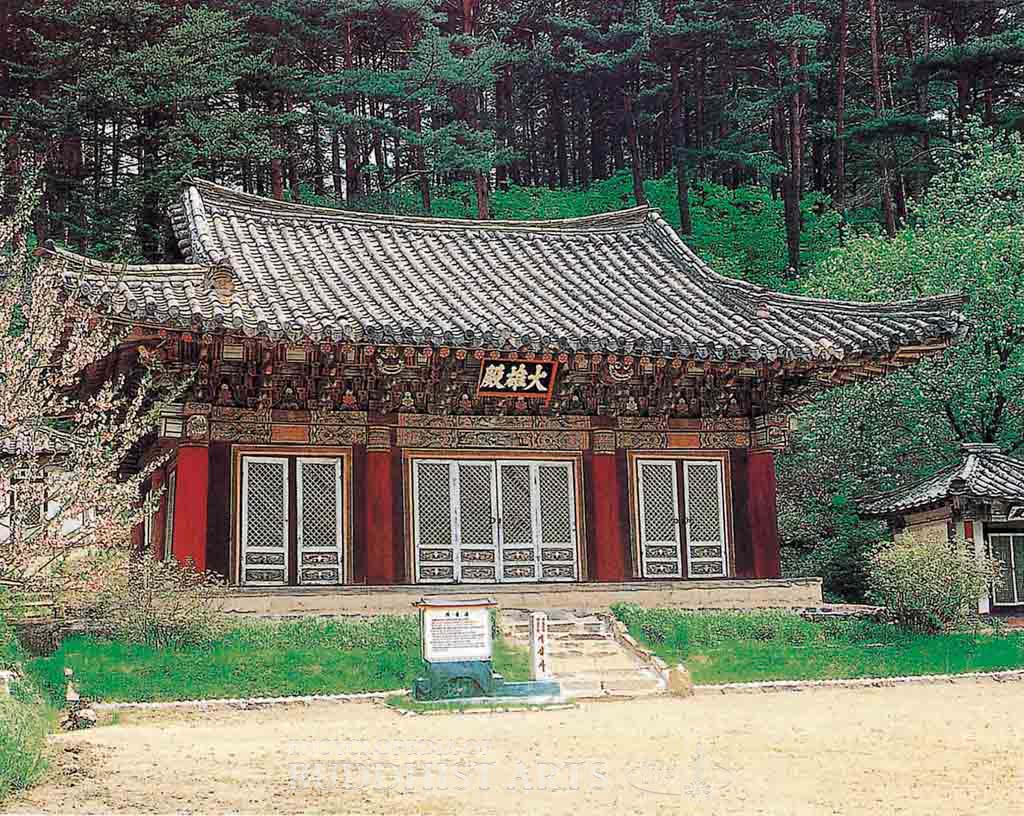
Kaesimsa Temple: Great Hero Hall
Kaesimsa Temple
NORTH KOREA, North Hamgyong, Myongchon
Kaesimsa, also spelled Gaesimsa, means Open Mind Temple. It was built in 827 during the Balhae Kingdom (698–926). It was subsequently reconstructed in 1948, and a wooden box containing a note stating the construction date of the temple was discovered underneath the floor of the Great Hero Hall. Kaesimsa Temple is listed as National Treasure No. 120.
In addition to the Great Hero Hall, the major structures within the temple compound include the Mind Sharpening Hall, the Sound Pavilion, the Mountain Deity Shrine, and the Avalokitesvara Hall.
According to records discovered during a renovation in 1963, the Great Hero Hall was extensively rebuilt in 1784 and 1853. The three-by-two bay structure has a single-eave hip-and-gable roof. The central bay is 1 m wider than the side bays, which have two doors. The columns are tapered and are surmounted by exquisitely decorated architraves. On the outside, the roof is supported by five-tier brackets sets, while on the inside seven-tier bracket sets are used.
The six-by-three bay Mind Sharpening Hall has a single-eave hip-and-gable roof. The front columns are round and slightly tapered, while the rear columns are square. Built on a slope, the heights of the columns are adjusted in order to achieve a horizontal roof. The temple’s charm results from its aesthetic balance and harmony with the natural environment.
For more details, go to the Encyclopedia of Buddhist Arts: Architecture G-L, page 567.
Cite this article:
author = Hsingyun and Youheng and Johnson, Peter and Mankuang and Lancaster, Lewis,
booktitle = {Encyclopedia of Buddhist Arts: Architecture G-L},
pages = 567,
title = {{Kaesimsa Temple}},
volume = 2,
year = {2016}}