
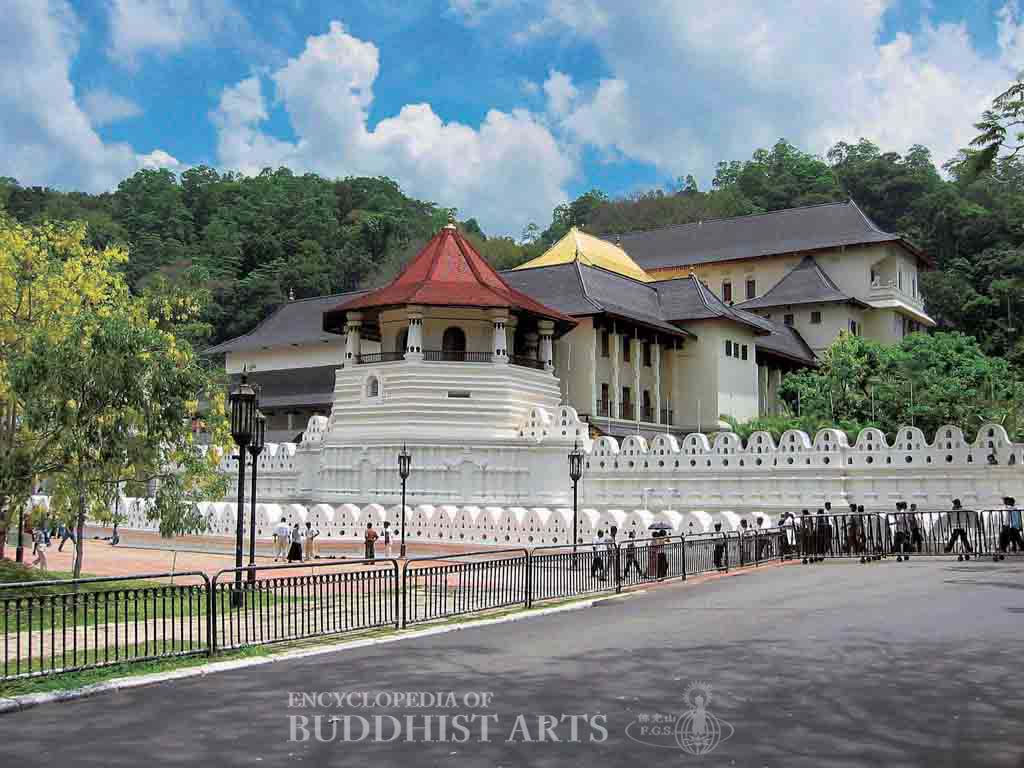
Dalada Maligawa
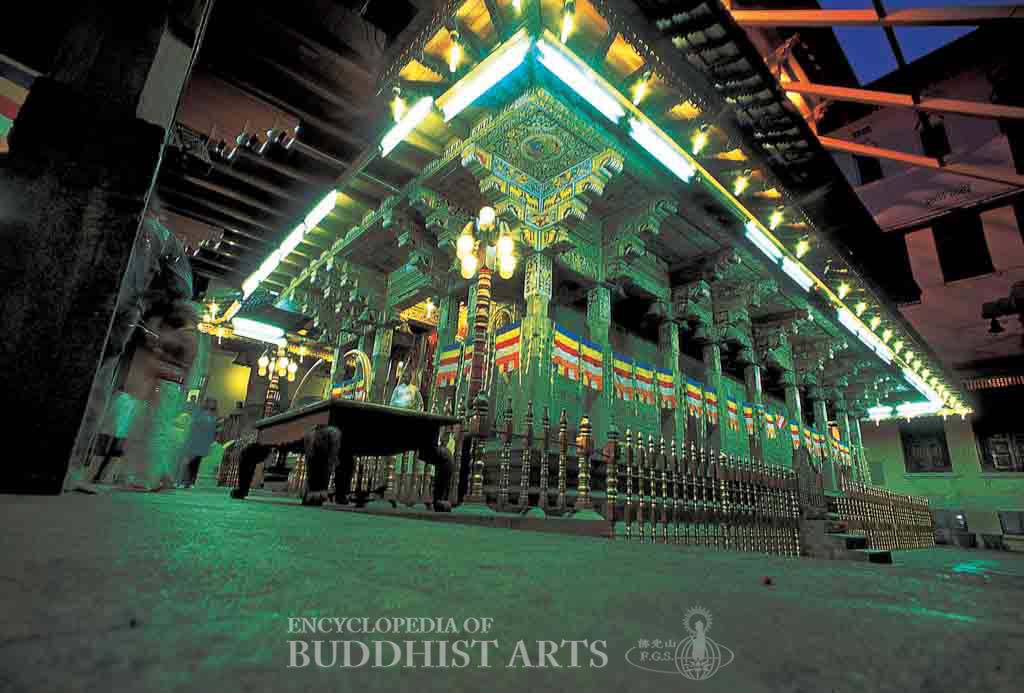
Dalada Maligawa (interior)
Dalada Maligawa
SRI LANKA, Central Province, Kandy
It is also called the Temple of the Tooth Relic and was founded by King Vimaladharmasurya I (reigned 1591–1604) of the Kandy Kingdom. The temple is located on the north shore of Kandy Lake and faces the old royal palace of the Kandy Kingdom. During the 4th century, when Dantapura, the capital of Kalinga, fell in battle, Princess Hemamala and Prince Dantakumara secretly transported the Buddha’s tooth relic to Sri Lanka by hiding it in the princess’s hair. The relic was presented to the Sinhalese King Sirimeghavanna (reigned 301–328) and was first enshrined at Anuradhapura. This was documented by Faxian, a Chinese monk, in his Record of Buddhist Kingdoms, which mentioned a temple housing the Buddha’s tooth relic in the city. The tooth relic became the symbol of sovereignty for kings of later generations and a shrine to worship the relic was built within the royal palace. In 1505, when the Portuguese invaded Sri Lanka, the tooth relic was moved to Kandy. The tooth relic became the source of spiritual refuge for the island’s inhabitants during times of war and colonial rule. As part of the Sacred City of Kandy, it was listed as a UNESCO World Heritage Site in 1988.
The temple faces west, and the principal buildings include the two-story Tooth Relic Shrine, the Buddha Hall, the drum hall, the Long Hall, the Sri Dalada Museum, chanting hall, and the palm leaf manuscript repository and library. On the outside the buildings appear quite plain but the interiors are elaborately decorated with carvings, wood veneer panels, filigree work, lacquer, and ivory. The tooth relic is enshrined on the second story of the Tooth Relic Shrine. It is kept in a gold casket on a gold lotus platform. The temple still houses many murals from the 18th century. During the month of Esala (July or August), Kandy continues to hold the Esala Perahera, which is a grand festival that includes the procession of the tooth relic.
For more details, go to the Encyclopedia of Buddhist Arts: Architecture A-F, page 207.
Cite this article:
author = Hsingyun and Youheng and Johnson, Peter and Mankuang and Lancaster, Lewis,
booktitle = {Encyclopedia of Buddhist Arts: Architecture A-F},
pages = 207,
title = {{Dalada Maligawa}},
volume = 1,
year = {2016}}