
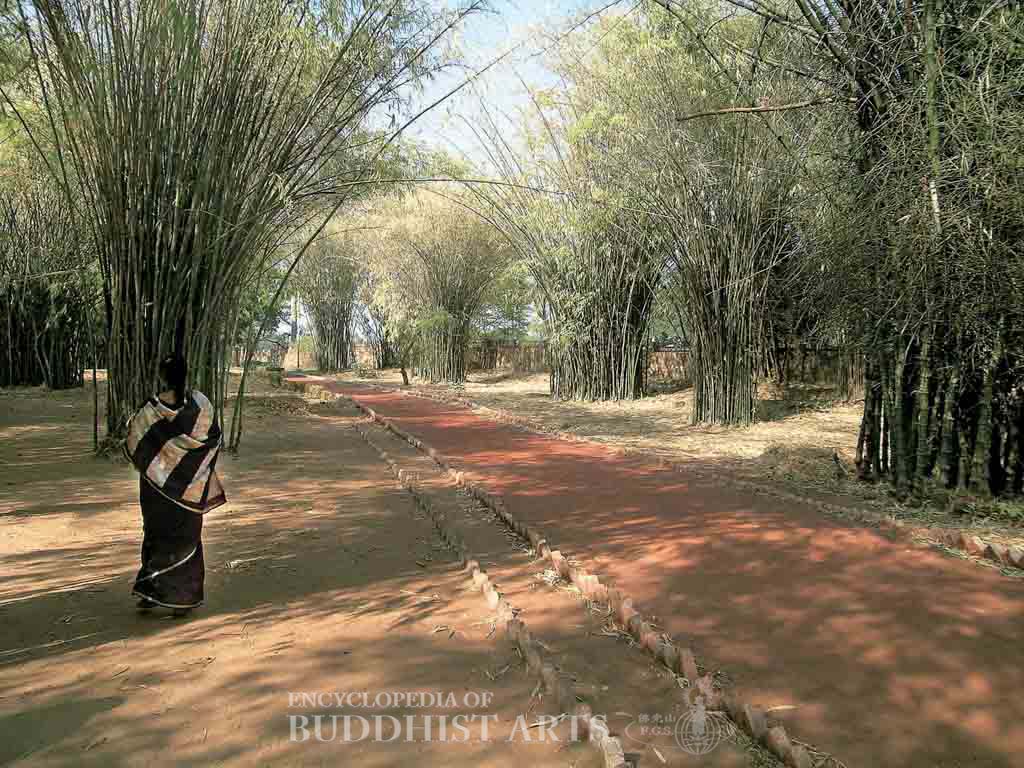
Venuvana Monastery
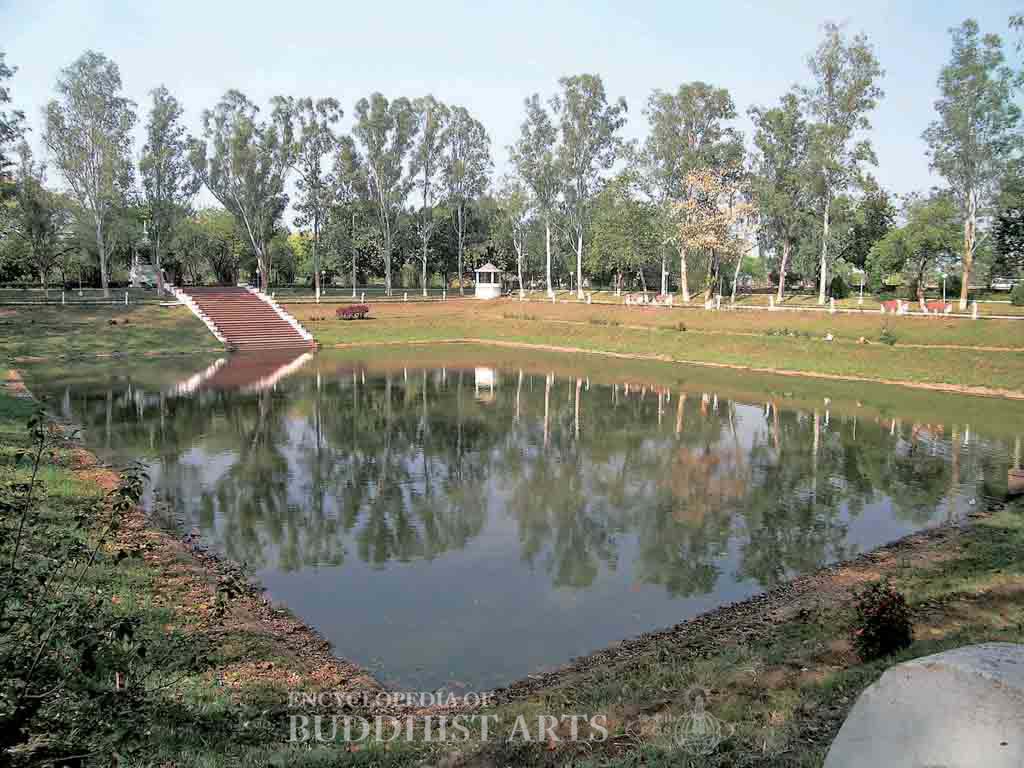
Venuvana Monastery: Kalanda Tank
Venuvana Monastery
INDIA, Bihar, Rajgir
Venuvana means Bamboo Grove. It is also known as Kalanda Kanivasa, Bamboo Garden, and Venuvana Vihara. It is situated on a hill in Bihar, near Vulture Peak in Rajagriha, the capital of the ancient kingdom of Magadha. Along with Jetavana Monastery in the north, it is one of the two greatest monasteries established during the time of the Buddha. There are two references to its origin: according to some sutras, King Bimbisara (reigned circa 543–491 BCE) donated his royal bamboo grove and built the Venuvana Monastery as accommodation for the Buddha and his disciples; according to other Buddhist texts, the monastery was donated by a wealthy elder named Kalandaka.
After the Buddha’s parinirvana, King Ajatasatru (reigned circa 491–459 BCE) built two stupas in Venuvana, one for enshrining the Buddha’s relics, and the other for Ananda’s remains. In the 3rd century BCE, King Asoka (reigned circa 269–232 BCE) built a stupa and a pillar at this site. According to Great Tang Records on the Western Regions by Chinese Master Xuanzang, who traveled to India in the 7th century, the Venuvana Monastery was made of brick and stone. In close proximity to the monastery there were monuments such as stupas and a stone house. To the north of the monastery there was the Kalanda Pond where the Buddha gave many of his teachings. The pond was later made into a tank and acquired its present name of Kalanda Tank. The original structures and landscape of Venuvana were destroyed by Muslims in the 13th century. In the early 20th century, British archaeologist John Marshall identified the site as Venuvana from the discovery of the Kalanda Tank. Subsequently the tank was excavated by the Archaeological Survey of India.
Venuvana has now been tidied up and landscaped, and is a pleasant park. Bamboo plants were brought from Nepal by a Japanese Buddhist organization to recreate the scene of the bamboo grove. Kalanda Tank is a large pool with two flights of stairs going down to the water. A newly built pavilion stands near the pool and it is enshrined with a 3 m statue of the seated Buddha. The tank is also surrounded by other pavilions, as well as Asoka and Bodhi trees. On the hill at Venuvana there are remnants of some brick stupas.
Venuvana Monastery is often mentioned in Buddhist texts as the location where the Buddha gave teachings and is the site of the first Buddhist monastery. After the Buddha attained enlightenment and gave his first teaching at Sarnath, he led his disciples to Vulture Peak, where he taught the Dharma to King Bimbisara. It is said that the king was so delighted that he offered land and built a monastery for the Buddha and his disciples. At that time, practicing ascetics in India moved around and did not stay in fixed dwellings. Therefore this monastery marks the establishment of a peaceful dwelling place for the sangha.
For more details, go to the Encyclopedia of Buddhist Arts: Architecture T-Z, page 1166.
Cite this article:
author = Hsingyun and Youheng and Johnson, Peter and Mankuang and Lancaster, Lewis,
booktitle = {Encyclopedia of Buddhist Arts: Architecture T-Z},
pages = 1166,
title = {{Venuvana Monastery}},
volume = 4,
year = {2016}}