
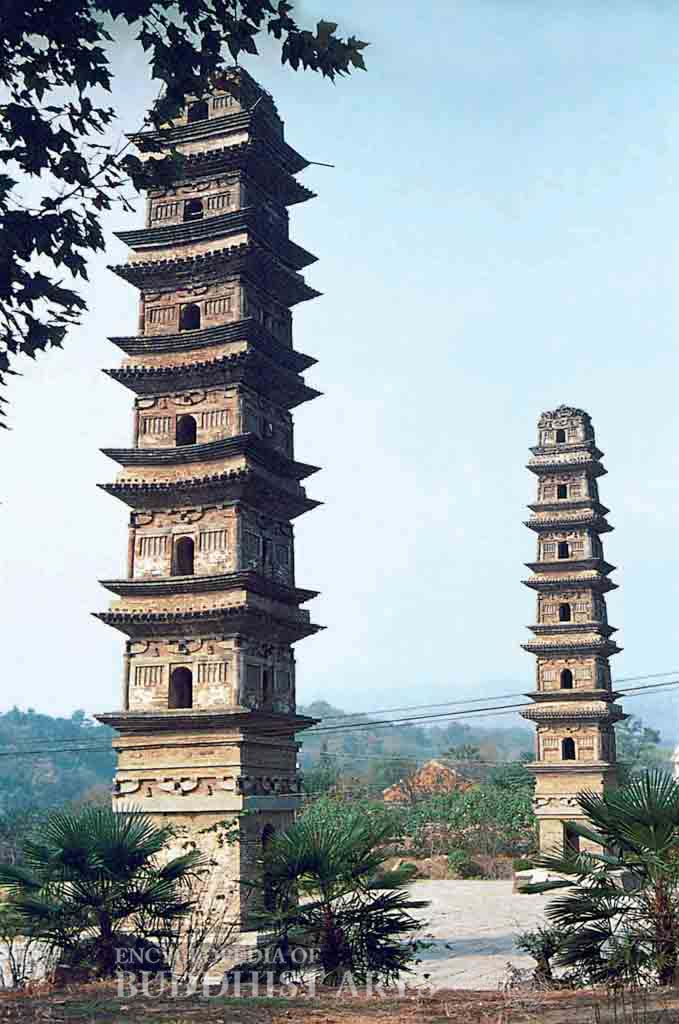
Guangjiao Temple Twin Pagodas
Guangjiao Temple Twin Pagodas
CHINA, Anhui, Xuancheng
Based on inscriptions inside the twin pagodas, it has been established that they were built in 1096 during the Northern Song dynasty. The local gazetteer states that the temple was constructed in 849 during the Tang dynasty. The temple is no longer extant. The twin pagodas were listed as a National Cultural Heritage Site in 1988.
The pagodas stand 26.9 m apart on an east-west axis. The seven-story, square, hollow, brick pagodas have a similar design and are built in imitation of a wooden structure. The tops of the pagodas have been damaged and their present height is just over 17 m. The length of the base of the east pagoda is 2.7 m, while that of the west pagoda is 2.4 m. There are three doorways on the first story, while each subsequent story has doorways on all four sides. Every side of the pagodas, except for the first story, is divided into three bays by pilasters. The central bays contain doorways, while the side bays have fake vertical bar windows. The eaves are in the form of either corbeling or courses of dogtooth bricks. Initially, bricks with Buddha images decorated the exterior of the pagoda body, but they have been badly damaged. Only four pairs of statues located on the fifth story of the east pagoda are well-preserved.
Even though both pagodas have suffered some structural damage, they still retain their original architectural design from the Northern Song dynasty (960–1127). This type of Tang-style square pagoda built during the Song dynasty is rare.
For more details, go to the Encyclopedia of Buddhist Arts: Architecture G-L, page 392.
Cite this article:
author = Hsingyun and Youheng and Johnson, Peter and Mankuang and Lancaster, Lewis,
booktitle = {Encyclopedia of Buddhist Arts: Architecture G-L},
pages = 392,
title = {{Guangjiao Temple Twin Pagodas}},
volume = 2,
year = {2016}}