
Ajanta Cave 10: Buddhas
Ajanta Cave 10: Buddhas
INDIA, Maharashtra, Aurangabad
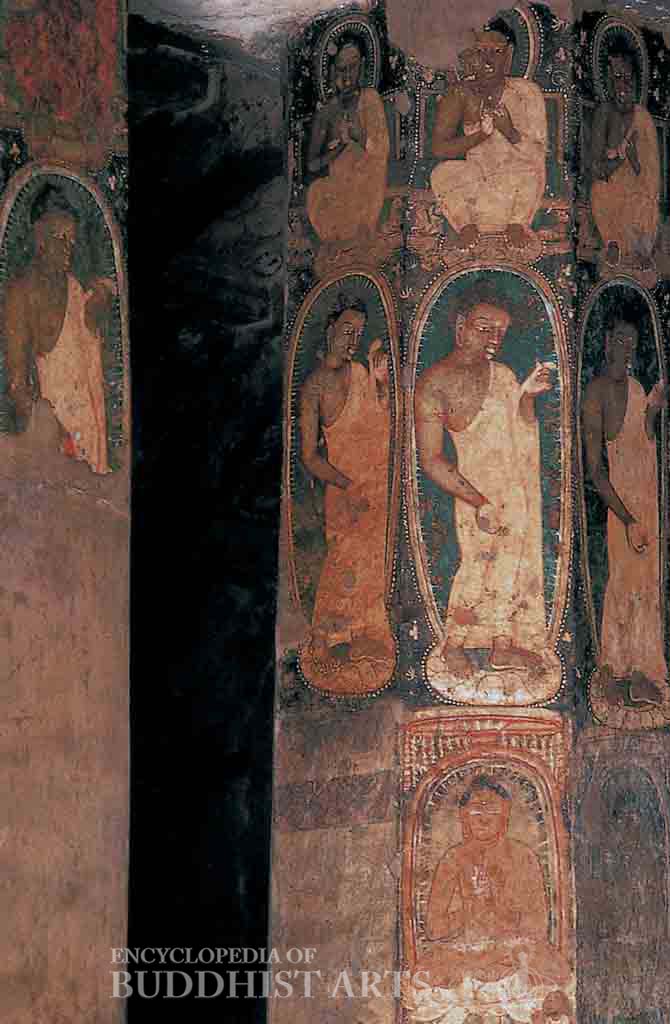
These Buddha images are found on the columns in the main hall. Cave 10 was the first caitya hall at Ajanta, built sometime during the 2nd to the 1st century BCE. The main hall has an apsidal layout and a stupa stands at the rear of the cave. Thirty-nine octagonal columns form a colonnade around the hall. The murals are from two periods, the first roughly during the 1st century BCE and the second in the mid-to-late 5th century, when Mahayana Buddhism was flourishing in the region. These Buddha images are all from the later period.
The walking Buddhas all have oval mandorlas and are turned to their left. They appear to be taking a step. In each image, the left hand clasps the corner of the robe, the right hand forms the varada (wish-granting) mudra, and they walk on lotus pedestals. Above the walking Buddhas are Buddhas seated with legs pendent on lion thrones, and below are Buddhas seated in full lotus position on lotus thrones. All the seated Buddhas form the Dharmacakra (Dharma wheel) mudra.
For more details, go to the Encyclopedia of Buddhist Arts: Caves A-E, page 33.
Cite this article:
author = Hsingyun and Youheng and Johnson, Peter and Mankuang and Huntington, Susan and Edson, Gary and Neather, Robert,
booktitle = {Encyclopedia of Buddhist Arts: Caves A-E},
pages = 33,
title = {{Ajanta Cave 10: Buddhas}},
volume = 5,
year = {2016}}