
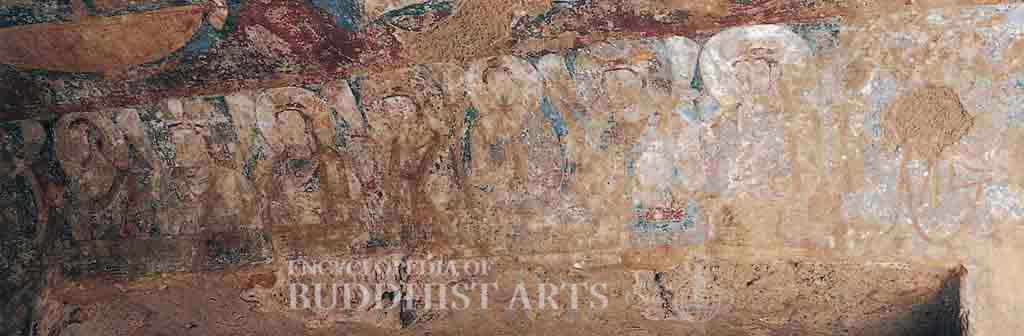
Bamiyan East Buddha Niche: Paying Respect to the Buddha (east wall) (prior to destruction)
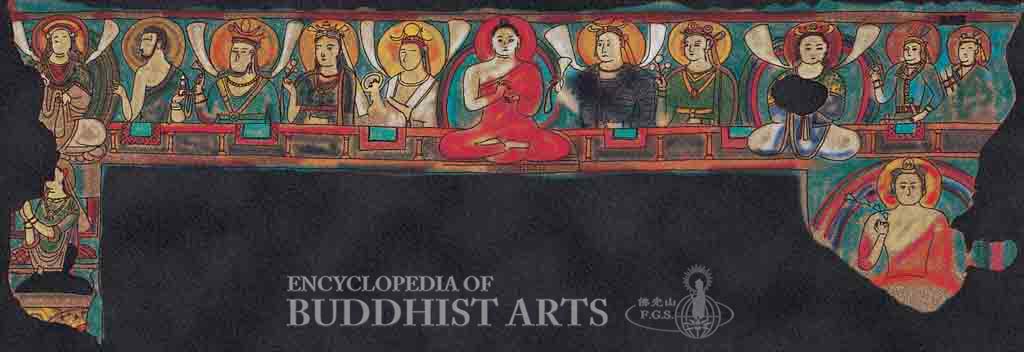
Bamiyan East Buddha Niche: Paying Respect to the Buddha (copy)
Bamiyan East Buddha Niche: Paying Respect to the Buddha
AFGHANISTAN, Bamiyan
These murals were located on the two sides at the top of the East Buddha Niche in the Bamiyan Valley but were destroyed in 2001 by the Taliban. The mural on the east side wall depicted figures aligned in a row, making offerings to a seated Buddha. The center of the mural featured a seated Sakyamuni Buddha teaching the Dharma. Various figures with nimbuses, each painted in bright colors on a blue background, were located on either side of Sakyamuni.
These offering figures included a king, queen, consort, duke, duchess, prince, and princess, each with offerings in their hands. The king was the largest figure and wore a headdress capped with a sun and moon, a symbol of the king of the Sassanid Empire (circa 224–651). The king, adorned with a necklace and wearing a jeweled mirror on his chest, was depicted holding a whisk in his right hand, and wearing a golden ring. The queen also wore a headdress surmounted by a sun and moon, and was adorned with a richly ornamented necklace. The other royalty wore lapelled robes with various accessories, all of which were distinctive of Sassanid attire.
For more details, go to the Encyclopedia of Buddhist Arts: Caves A-E, page 99.
Cite this article:
author = Hsingyun and Youheng and Johnson, Peter and Mankuang and Huntington, Susan and Edson, Gary and Neather, Robert,
booktitle = {Encyclopedia of Buddhist Arts: Caves A-E},
pages = 99,
title = {{Bamiyan East Buddha Niche: Paying Respect to the Buddha}},
volume = 5,
year = {2016}}