
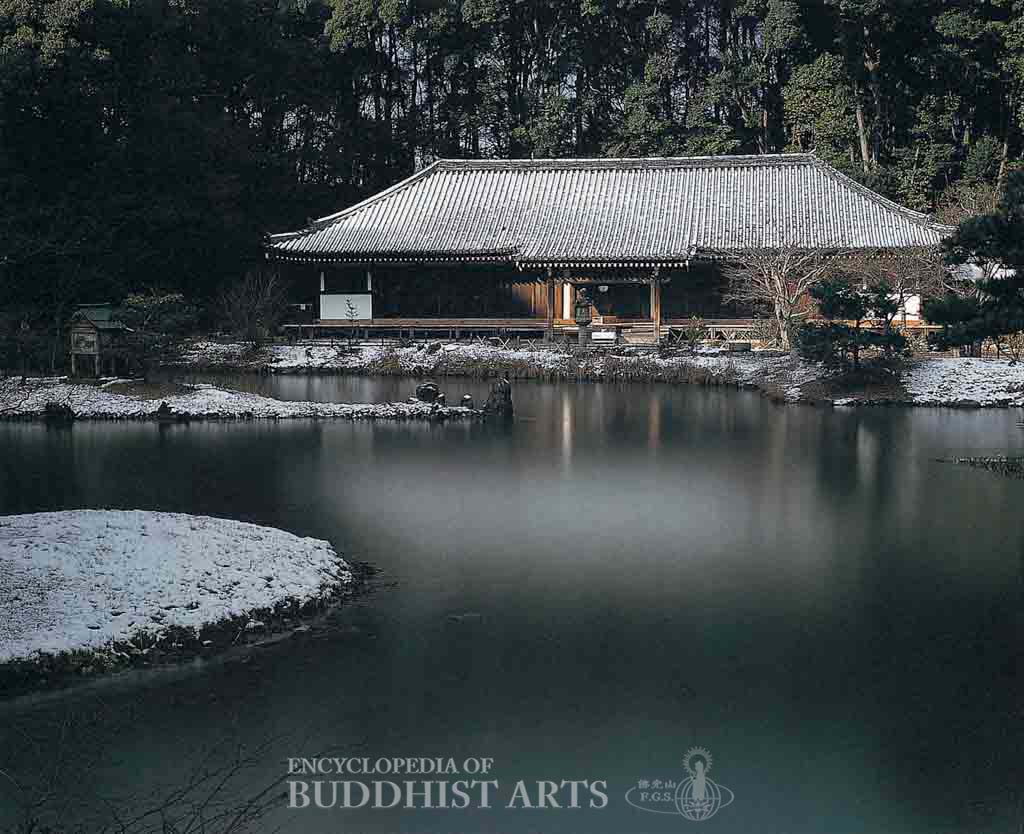
Joruriji Temple: Main Hall
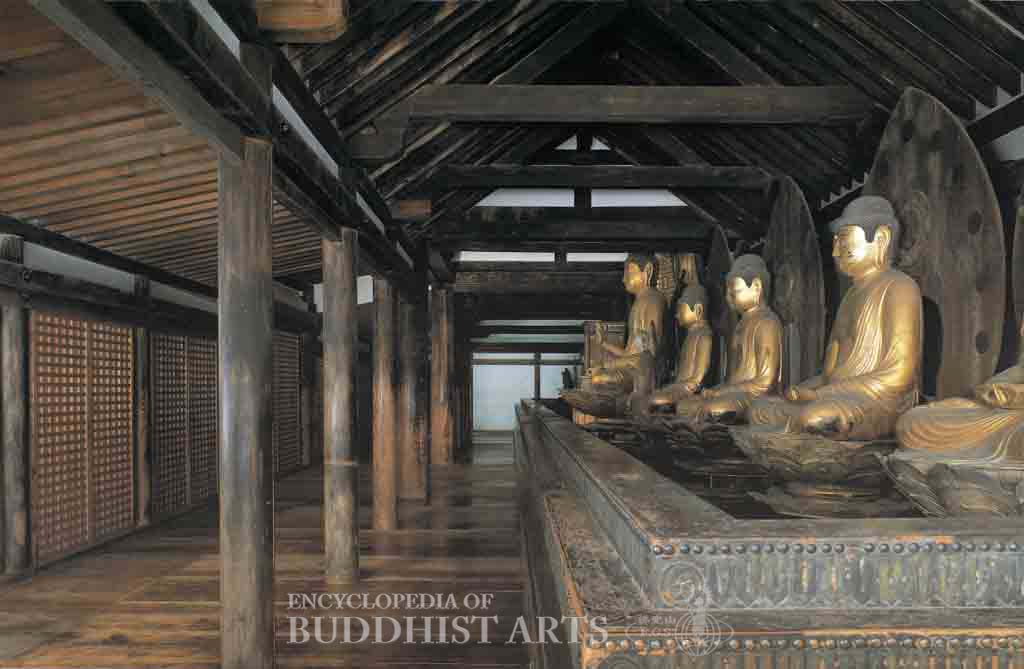
Joruriji Temple: Main Hall (interior)
Joruriji Temple
JAPAN, Kyoto, Kizugawa
Joruriji means Pure Glass Temple and it belongs to the Shingon Ritsu school of Buddhism. Temple records show that it was established in 1047 during the Heian period by monk Gimyo. In 1107, also during the Heian period, a hall was built to enshrine nine wooden Amitabha Buddha statues and was given the name Nine Amitabha Hall.
The temple buildings include the temple gate, initiation hall, bell tower, as well as the Nine Amitabha Hall and three-story pagoda, which were listed as National Treasures in 1952. The eleven-by-four bay Nine Amitabha Hall has a single-eave hip roof, seven door panels in its center, and mullioned windows on both sides. An extension at the front serves as a worship area. The hall is the only existing structure built during the Heian period (794–1185). The nine wooden statues of the seated Amitabha Buddha are enshrined on a Sumeru platform. The hall also houses statues of Ksitigarbha Bodhisattva, the Four Heavenly Kings, and Mahadevi.
The pond in front of the hall reflects the images of the nine Amitabha Buddha statues within. A pair of stone lanterns in the garden is listed as an Important Cultural Property.
For more details, go to the Encyclopedia of Buddhist Arts: Architecture G-L, page 555.
Cite this article:
author = Hsingyun and Youheng and Johnson, Peter and Mankuang and Lancaster, Lewis,
booktitle = {Encyclopedia of Buddhist Arts: Architecture G-L},
pages = 555,
title = {{Joruriji Temple}},
volume = 2,
year = {2016}}