
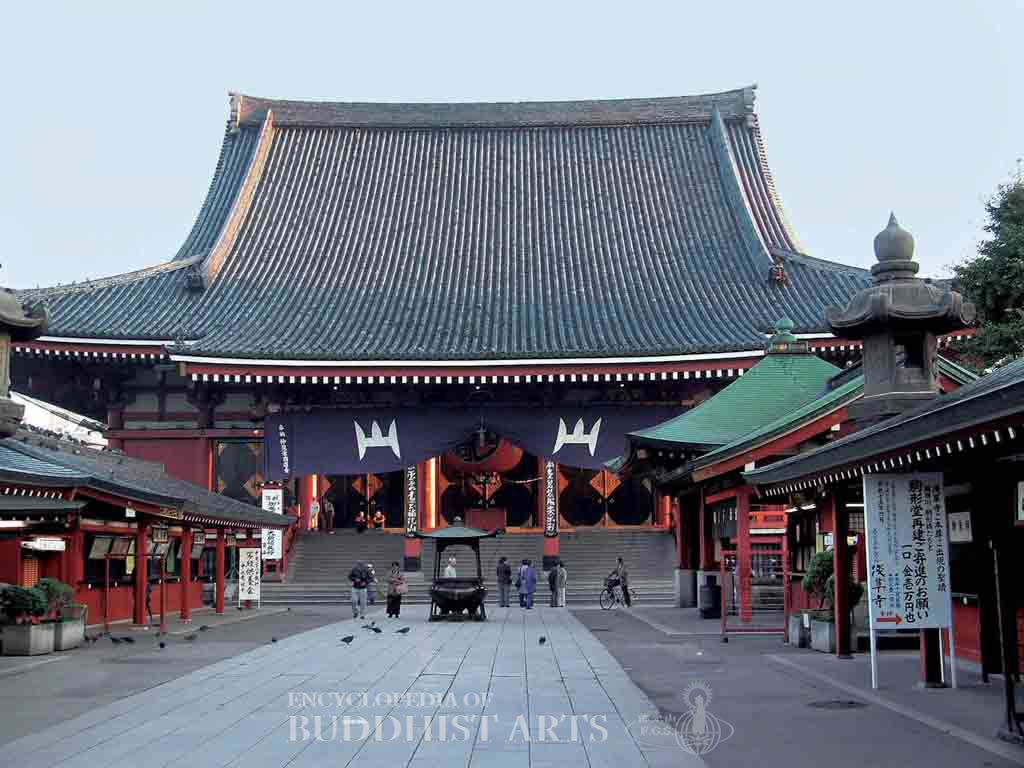
Sensoji Temple: Main Hall
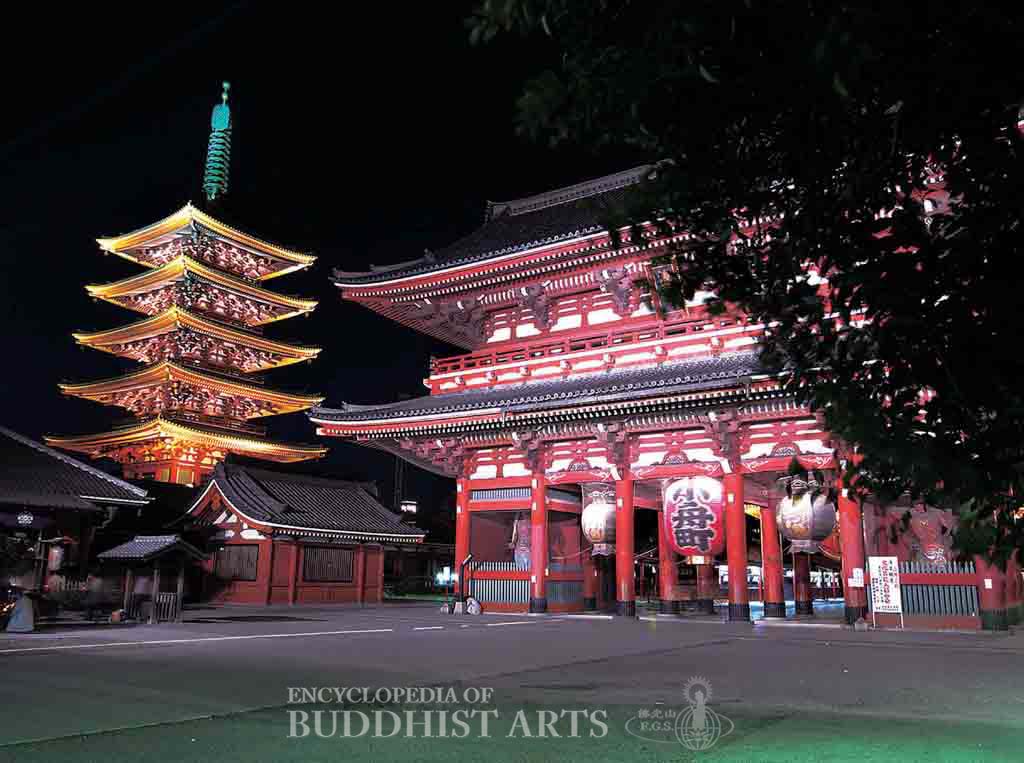
Sensoji Temple: Five-Story Pagoda and Treasure House Gate
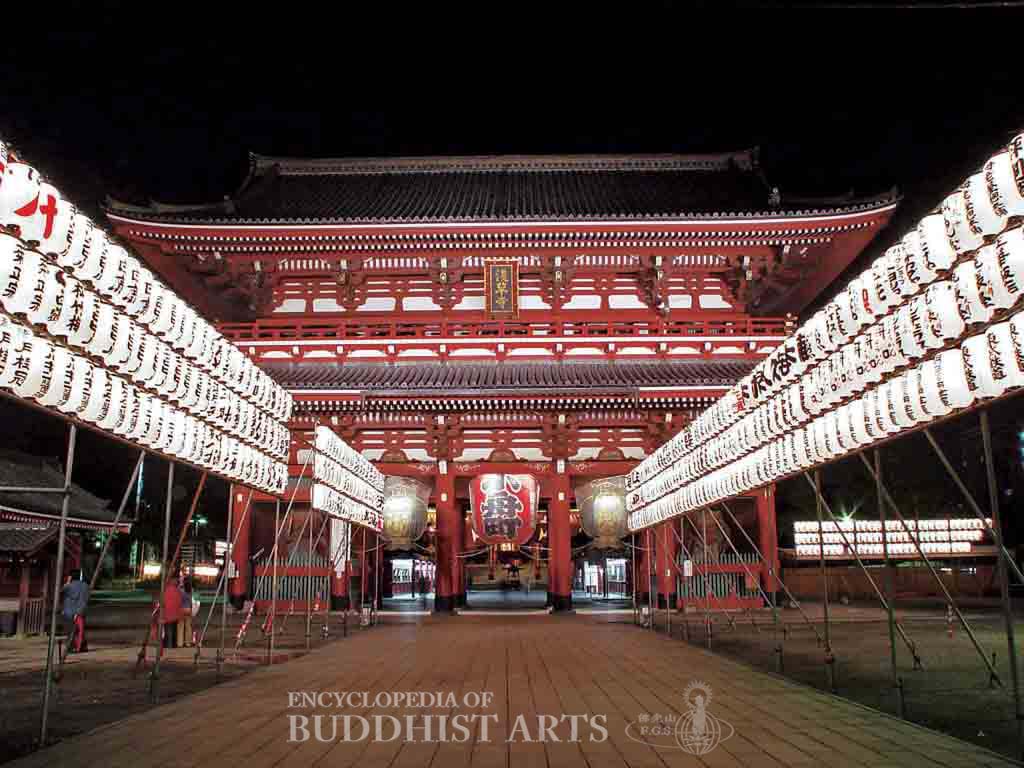
Sensoji Temple: Treasure House Gate
Sensoji Temple
JAPAN, Tokyo
Commonly known as Asakusa Kannon Temple, Sensoji is Tokyo’s oldest temple. It is the 13th of the 33 Avalokitesvara temples of the Saigoku Kannon Pilgrimage of southern-central Japan. It used to belong to the Tendai school, and is now the head temple of the Shokannon school of Japanese Buddhism. It was founded by Master Shokai in 645 during the Hakuho period, and was expanded by Master Ennin in 857 and by Taira no Kinmasa in 942 during the Heian period. The temple thrived with the support of Minamoto no Yoritomo and Hojo Ujitsuna. During the Edo period (1615–1868) it underwent further expansion.
The principal structures include the Thunder Gate, Treasure House Gate, Avalokitesvara Hall, five-story pagoda, Dharma Transmission Hall, Gate of Two Heavenly Kings, and Medicine Buddha Hall. The Thunder Gate was rebuilt in 1960. It measures 11.4 m wide and 11.7 m high. The three-bay wide gate enshrines the Wind Deity and Thunder Deity in the side bays. Hanging from the center is a large lantern which measures 4 m high and weighs 670 kg. The Treasure House Gate is the main temple gate and was rebuilt in 1964. It is five bays wide and has a height of 22.7 m. There are doors in the three central bays, while the outer bays house statues of the Heavenly Kings. On the second level there is a copy of the Yuan Tripitaka. A pair of prominent 4.5 m long straw sandals hangs in the gateway.
The Avalokitesvara Hall, which is the main hall, has a steep hip-and-gable roof covered with cylindrical tiles. It is made of steel and concrete, with a width of 34.5 m, depth of 32.7 m, and height of 29 m. A well-known statue of Avalokitesvara Bodhisattva, or Asakusa Kannon, is enshrined on a Sumeru throne within the hall.
For more details, go to the Encyclopedia of Buddhist Arts: Architecture M-S, page 954.
Cite this article:
author = Hsingyun and Youheng and Johnson, Peter and Mankuang and Lancaster, Lewis,
booktitle = {Encyclopedia of Buddhist Arts: Architecture M-S},
pages = 954,
title = {{Sensoji Temple}},
volume = 3,
year = {2016}}