
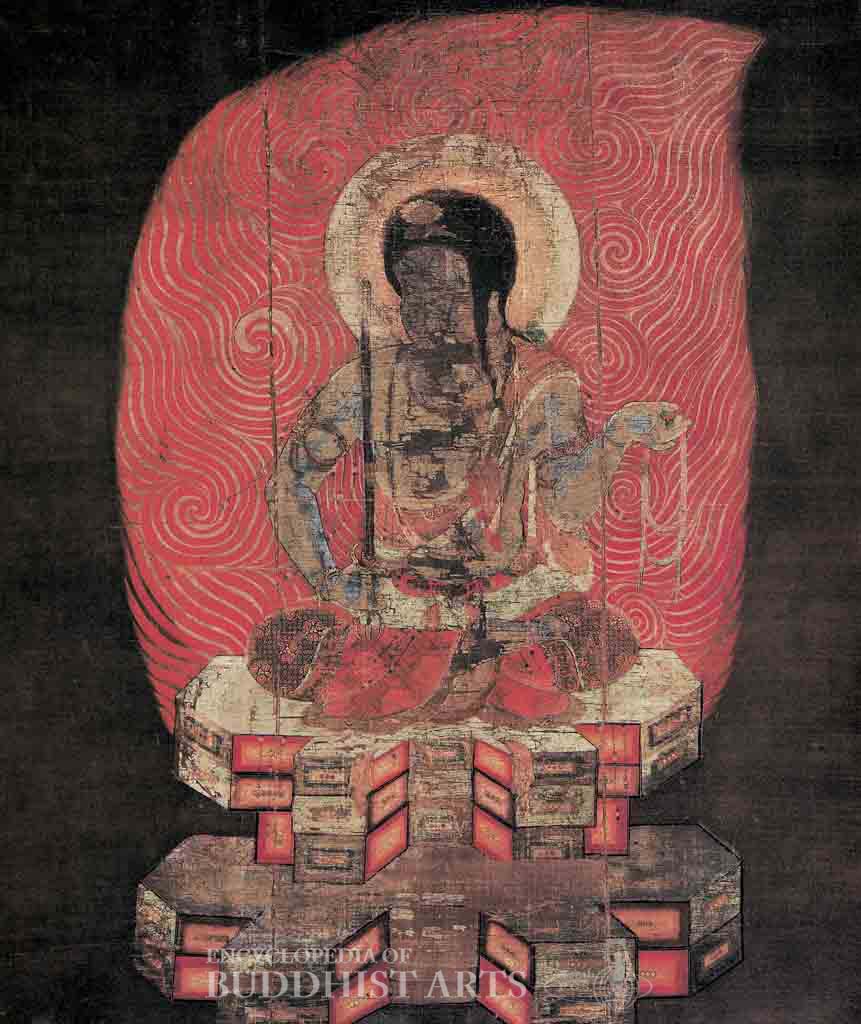
Toji Temple: Five Wisdom Kings - Acala
Ink and color on silk
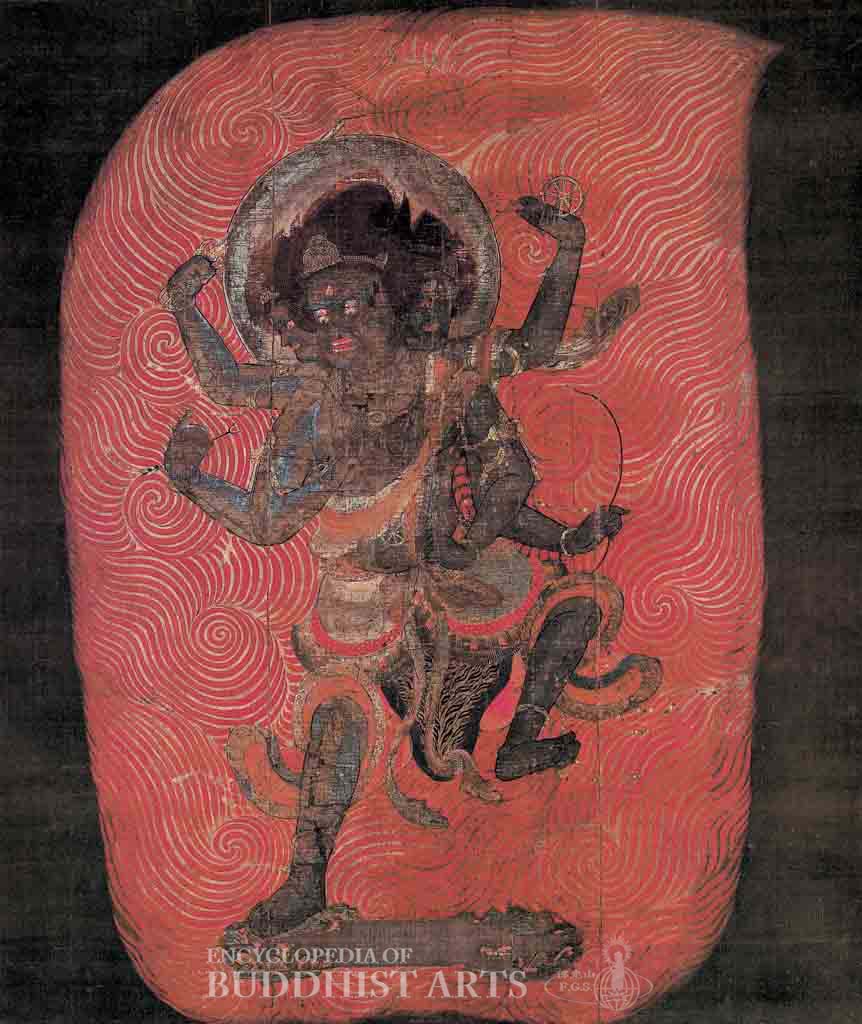
Toji Temple: Five Wisdom Kings - Vajrayaksa
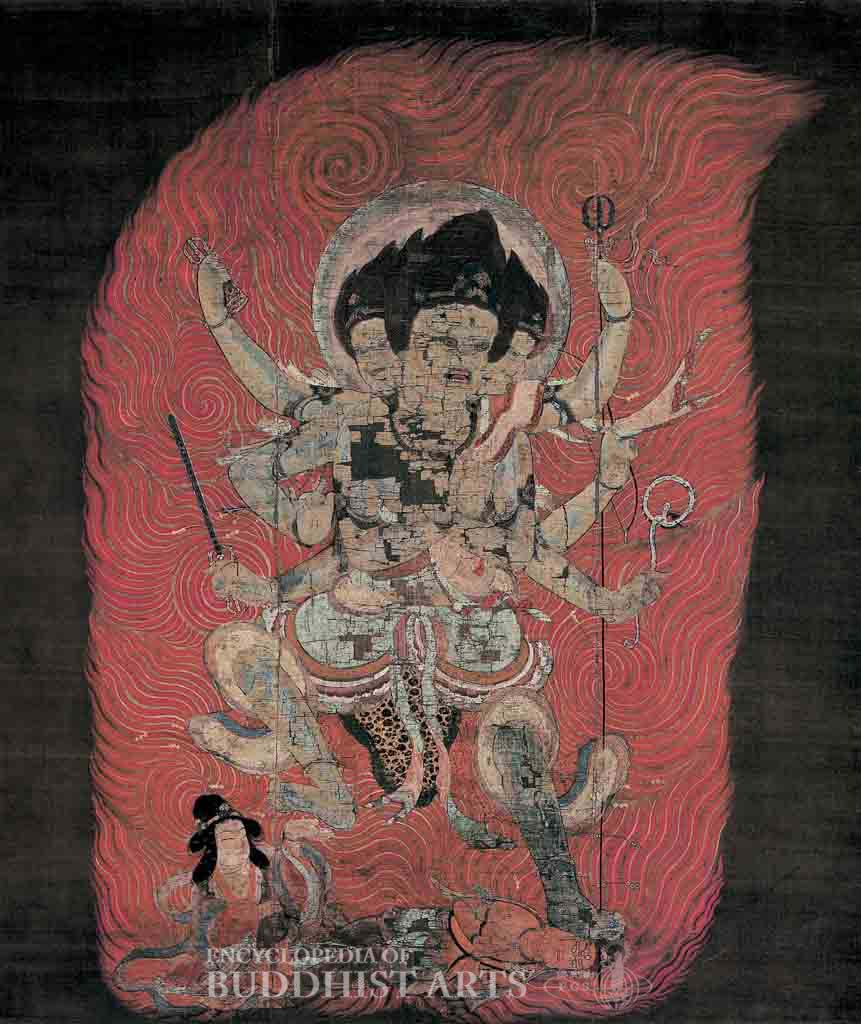
Toji Temple: Five Wisdom Kings - Trailokyavijaya
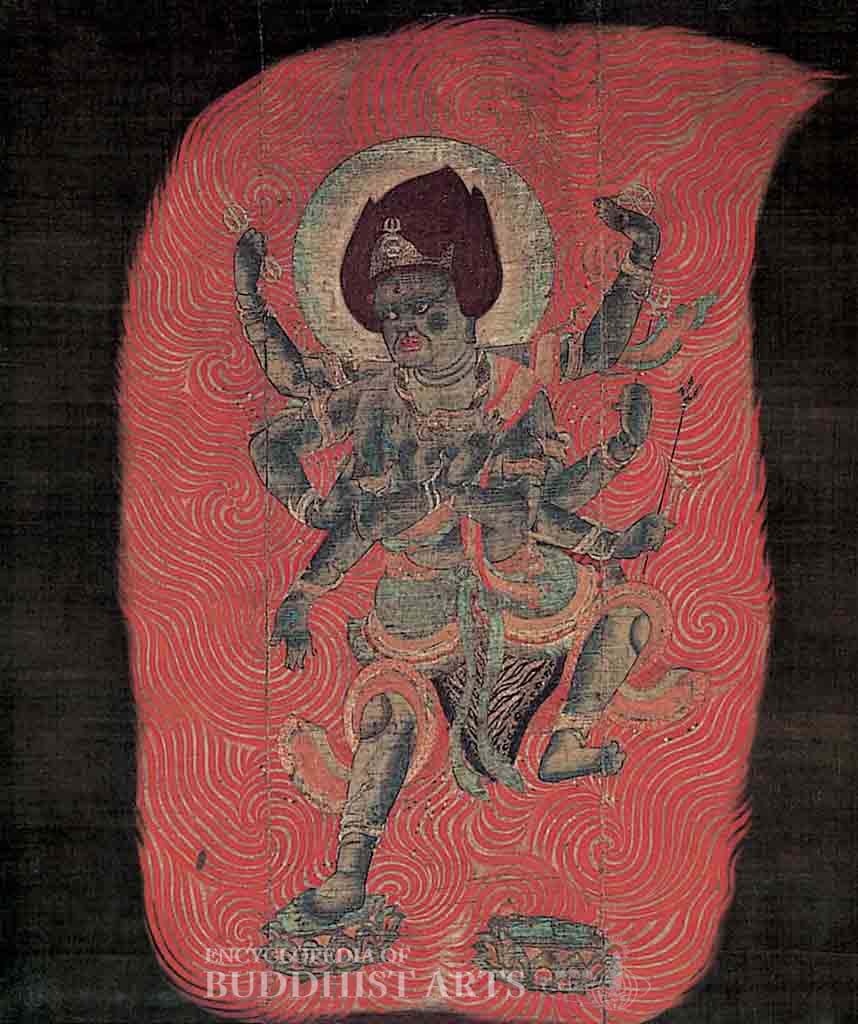
Toji Temple: Five Wisdom Kings - Kundali
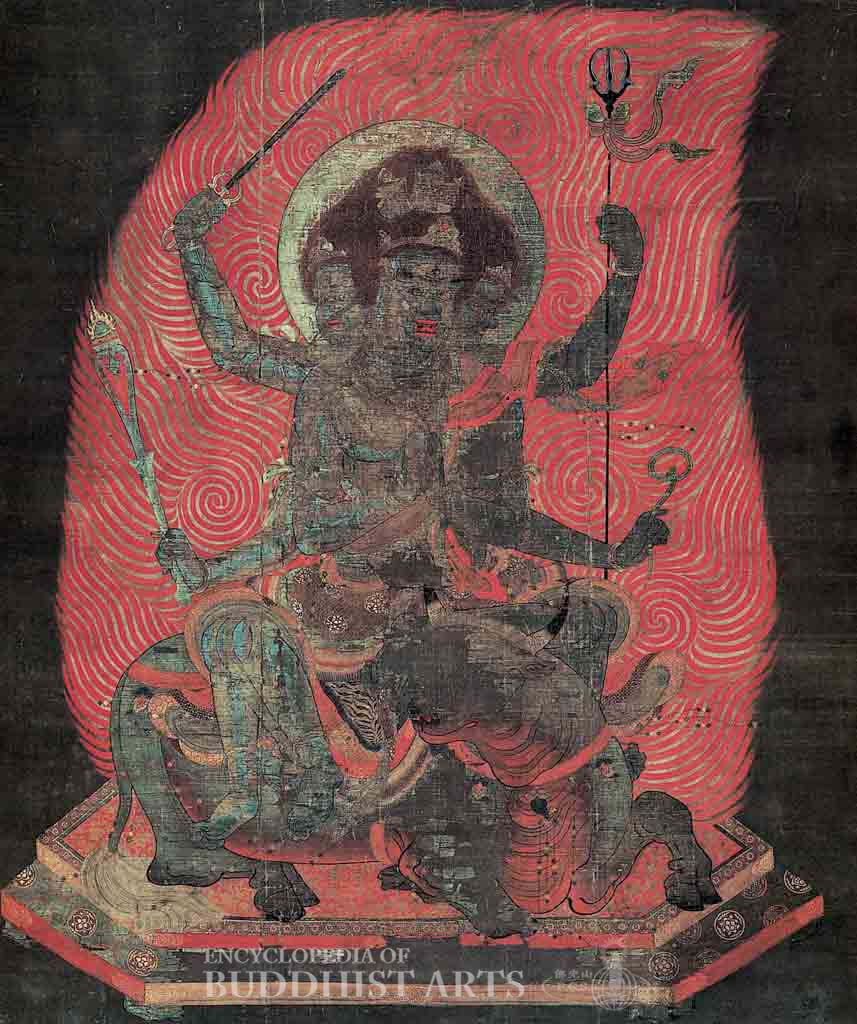
Toji Temple: Five Wisdom Kings - Yamantaka
Toji Temple: Five Wisdom Kings
JAPAN, Kyoto; Heian period
These paintings of the Five Wisdom Kings are used during the Homa Fire Ritual that is part of the annual Shingon Buddhist prayers during the first month of the New Year. They were painted in 1127 of the Heian period by Shokaku, an elderly monk, who modeled them after the murals on the rear wall of Endo Hall in Ninnaji Temple, Kyoto. The oldest surviving paintings of the Five Wisdom Kings in Japan, they were listed as a National Treasure in 1952.
The Wisdom Kings each have multiple arms and are surrounded by spiraling flame patterns. Their heads are backed by bright nimbuses and their hands hold Dharma instruments. Acala sits in full lotus position on a tall throne. The Three-Headed Trailokyavijaya’s left foot tramples on the head of Mahesvara, an attendant deity, and his right foot is supported by the palm of Uma, the consort of Mahesvara. Yamantaka is shown sitting on the back of an ox. Kundali and Vajrayaksa have similar appearances; they stand with their right feet on lotus pedestals and their left feet raised. The pale-bodied figures stand out from the vivid red and white flames in the background.
For more details, go to the Encyclopedia of Buddhist Arts: Painting P-Z, page 920.
Cite this article:
author = Hsingyun and Youheng and Youlu and Wilson, Graham and Manho and Mankuang and Huntington, Susan,
booktitle = {Encyclopedia of Buddhist Arts: Painting P-Z},
pages = 920,
title = {{Toji Temple: Five Wisdom Kings}},
volume = 16,
year = {2016}}