
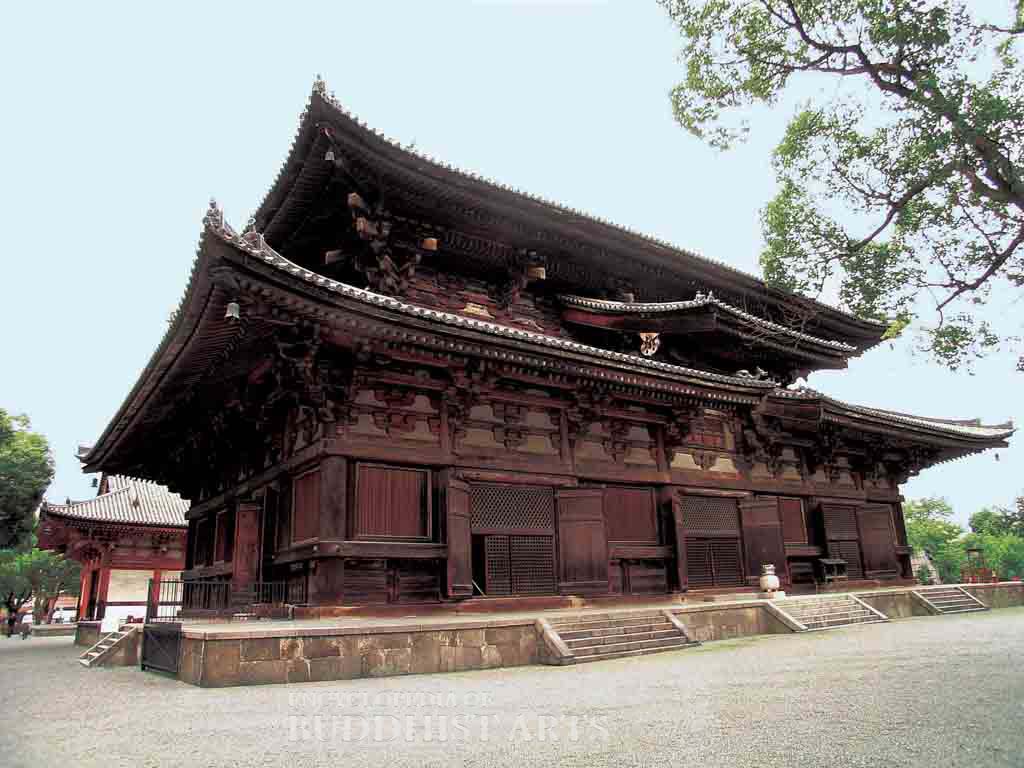
Toji Temple: Golden Hall
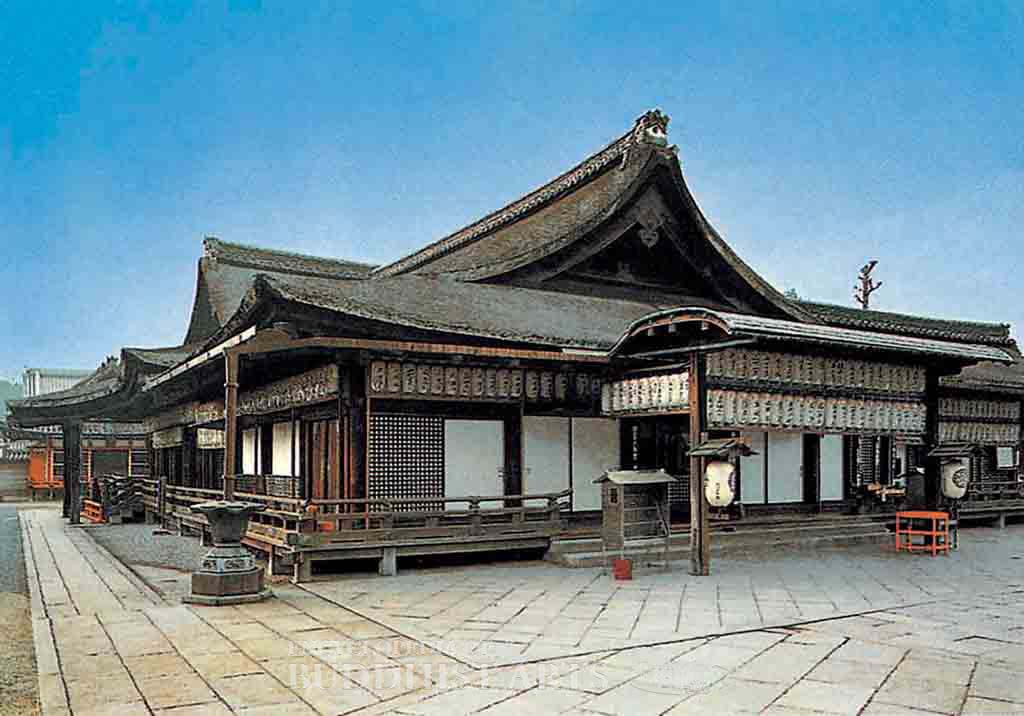
Toji Temple: Great Master Hall
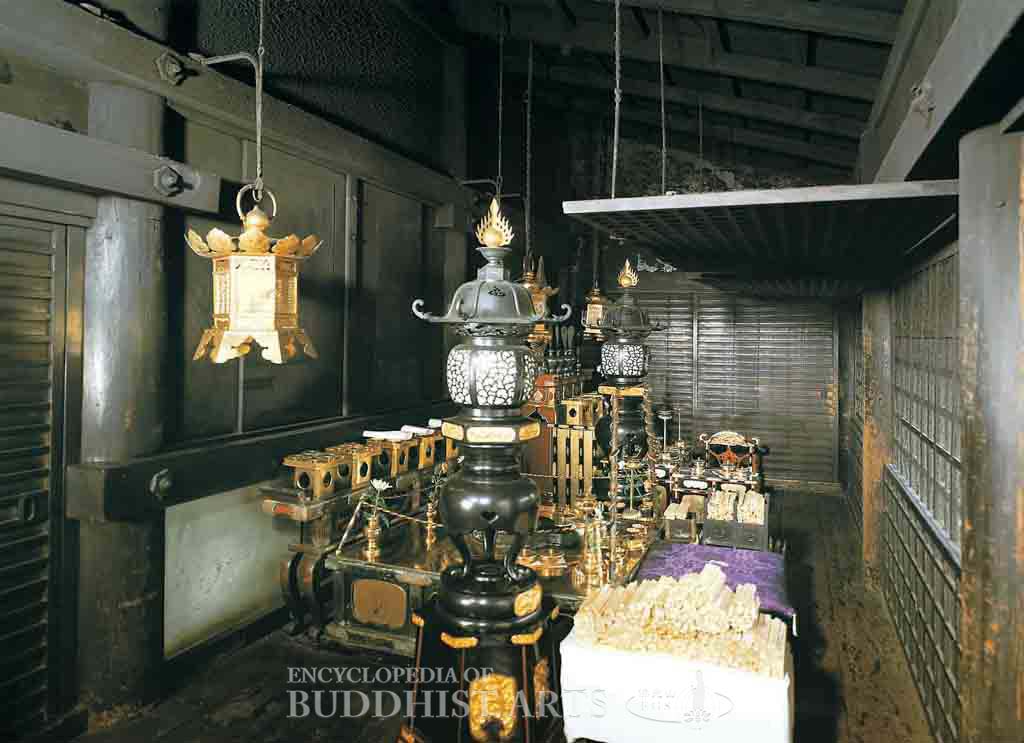
Toji Temple: Great Master Hall (interior)
Toji Temple
JAPAN, Kyoto
Toji, or East Temple, is the head temple of the Toji Shingon school of Japanese Buddhism. It was built in 794 during the Heian period as one of two temples on either side of the castle gate. It was originally built for the protection of the nation. In 823 Emperor Saga (reigned 809–823) presented Toji Temple to Master Kukai, who had just returned from China. The emperor bestowed it the name Kyoogokokuji, meaning Temple of National Protection by the King of Doctrines. The temple witnessed a decline in the late Heian period (794–1185). It was revived by monk Mongaku in the early Kamakura period (1185–1333). The temple was destroyed and subsequently rebuilt by Toyotomi Hideyoshi and the Tokugawa Shogunate between 1596 and 1615 during the Momoyama period. As part of the Historic Monuments of Ancient Kyoto, it was listed as a UNESCO World Heritage Site in 1994.
The main temple buildings include the Golden Hall, Great Master Hall, lecture hall, dining hall, north gate, south gate, Lotus Gate, initiation hall, Vaisravana Hall, Great Sun Hall, five-story pagoda, and a museum.
The seven-by-five bay Golden Hall was completed in 1603 during the Momoyama period. It stands on a stone base and has a double-eave hip-and-gable roof covered in cylindrical tiles. There is a central window under the lower eaves which allows visitors to see the mandorla of the Medicine Buddha Triad.
The nine-by-four bay lecture hall has a single-eave hip-and-gable roof covered with cylindrical tiles. The hall houses 21 statues of Vajrayana Buddhist figures, and is regarded as a treasure house of Vajrayana Buddhist art. The Great Master Hall was completed in 1390 during the Nanbokucho period. It consists of a front hall and a rear hall. Such residential buildings are rarely seen in temple compounds. The five-story pagoda is the largest and highest pagoda in Japan with an overall height of 55 m. The Lotus Gate has an overhanging gable roof covered with cylindrical tiles. The eight-legged three-bay wide gate maintains its original appearance.
The temple houses a number of National Treasures including bronze ritual instruments, portraits of the seven Shingon patriarchs, the Twelve Heavenly Beings painted by Takuma Shoga, and portraits of the Five Akasagarbha Bodhisattvas.
For more details, go to the Encyclopedia of Buddhist Arts: Architecture T-Z, page 1141.
Cite this article:
author = Hsingyun and Youheng and Johnson, Peter and Mankuang and Lancaster, Lewis,
booktitle = {Encyclopedia of Buddhist Arts: Architecture T-Z},
pages = 1141,
title = {{Toji Temple}},
volume = 4,
year = {2016}}