
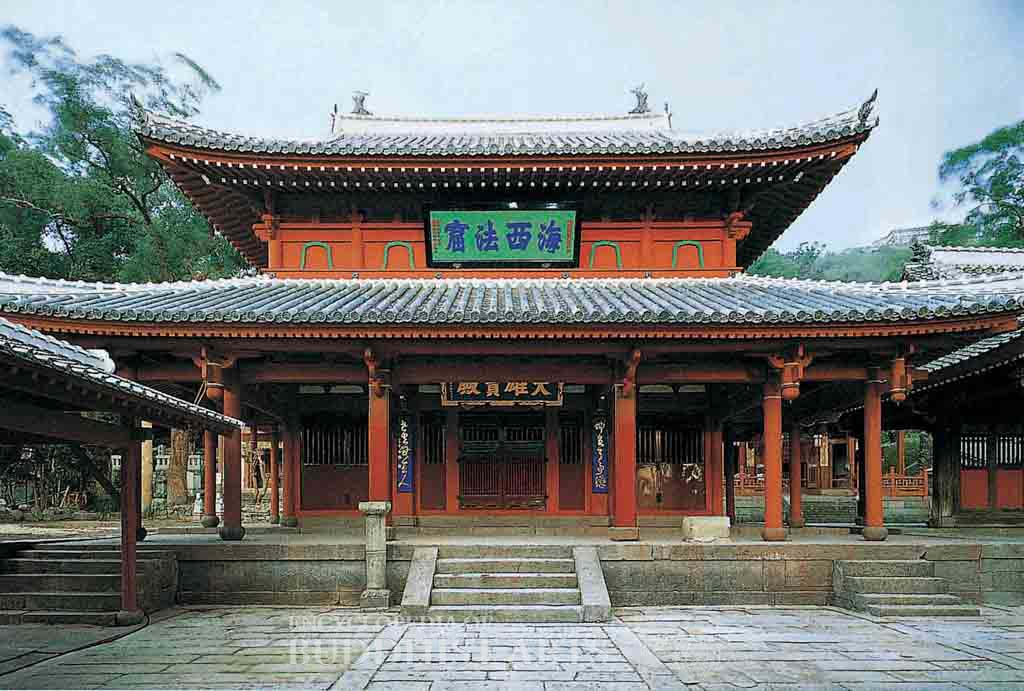
Sofukuji Temple: Great Hero Hall
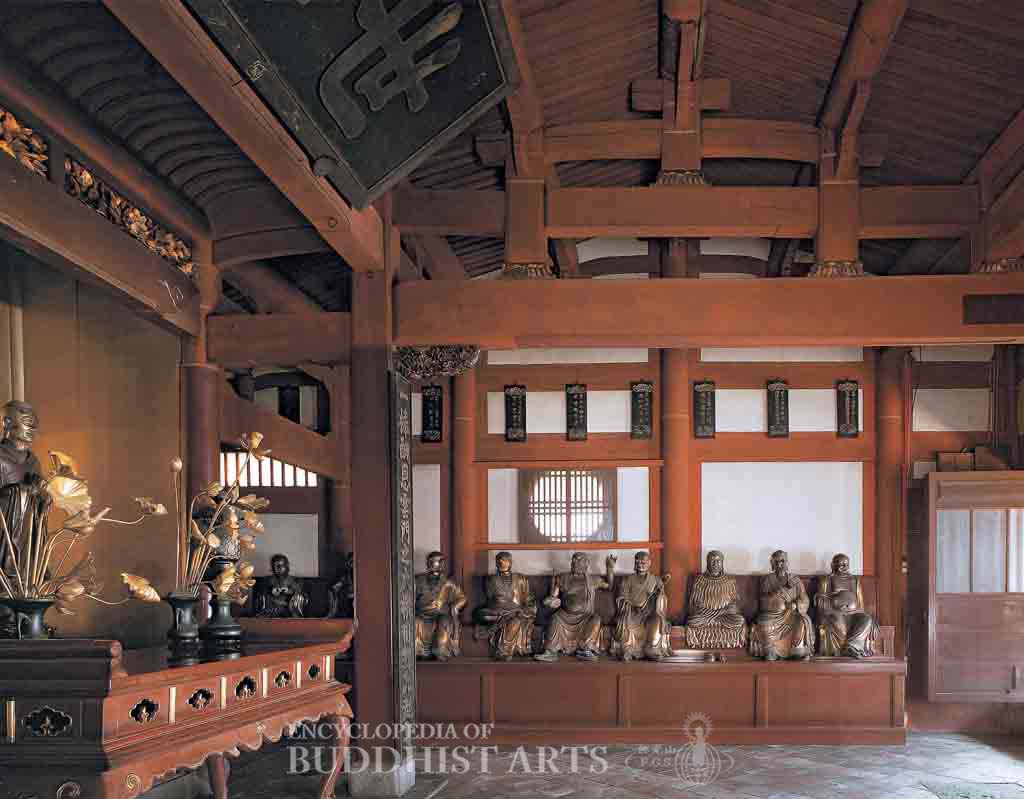
Sofukuji Temple: Great Hero Hall (interior)
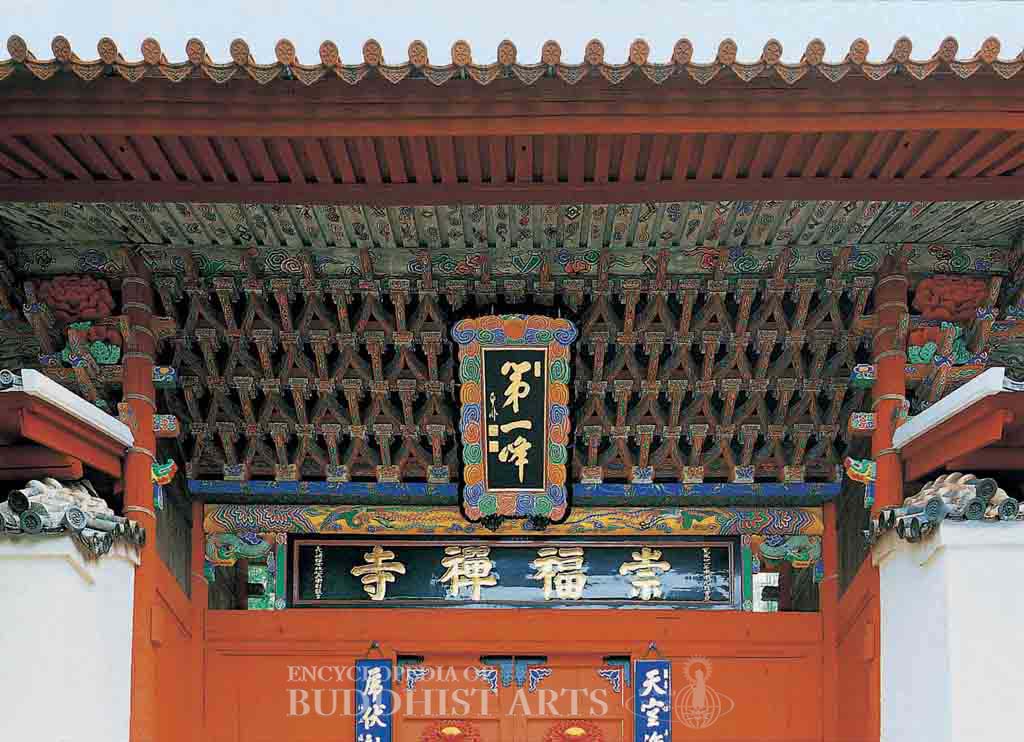
Sofukuji Temple: First Peak Gate (detail)
Sofukuji Temple
JAPAN, Nagasaki
This temple, which belongs to the Obaku school of Japanese Zen Buddhism, was founded by Chinese monk Chaoran at the request of the Chinese merchants of Nagasaki. Its halls were constructed in 1629 during the Edo period, and it is also called China Temple. The temple is also known as the Red Temple because of its color. During the early Edo period (1615–1868), the Chinese Master Yinyuan Longqi and his disciple Sokuhi Nyoitsu lived at this temple while propagating the Dharma. The temple was modeled on temples in Fuzhou, China.
The main buildings of the temple are the main temple gate, Dharma Protector Hall, drum and bell towers, and founder’s hall, as well as the First Peak Gate and Great Hero Hall, both of which were listed as National Treasures in 1953. The five-by-four bay Great Hero Hall, built in 1646 during the Edo period, has a double-eave hip-and-gable roof covered with cylindrical tiles. An unusual feature of the hall is the ceiling of the veranda: it has undulating rafters supported by highly decorated beams with camel humps, which are characteristic of Obaku temples. The hall houses a statue of Sakyamuni Buddha, flanked by the Eighteen Arhats on both sides. The First Peak Gate, built during the Edo period, is a four-legged gate with a double-eave hip-and-gable roof covered with cylindrical tiles. The vertical inscribed board showing the gate name was written by Sokuhi Nyoitsu. Under the eaves there are complex bracket sets which are painted in vivid colors. The walls of the temple halls are painted bright red and the courtyard is laid with paving stones, which are different than other Japanese temples.
For more details, go to the Encyclopedia of Buddhist Arts: Architecture M-S, page 1036.
Cite this article:
author = Hsingyun and Youheng and Johnson, Peter and Mankuang and Lancaster, Lewis,
booktitle = {Encyclopedia of Buddhist Arts: Architecture M-S},
pages = 1036,
title = {{Sofukuji Temple}},
volume = 3,
year = {2016}}