
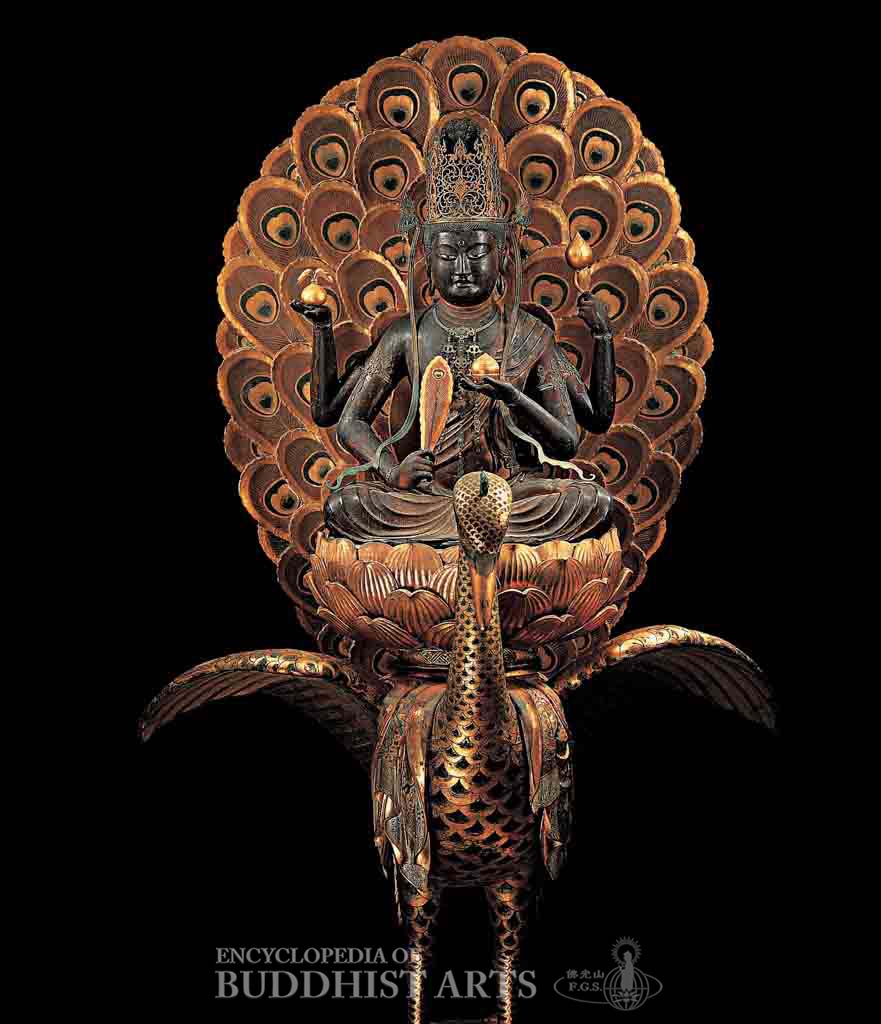
Kongobuji Temple Mahamayuri Hall: Mahamayuri
Cypress wood
Kongobuji Temple Mahamayuri Hall: Mahamayuri
JAPAN, Wakayama, Ito; Kamakura period
The statue of Mahamayuri was made under order of Emperor Go-Toba (reigned 1183–1198) in 1199. The inner section of the knee was later inscribed with the name of the sculptor Kaikei. The statue is assembled from many pieces of wood and the eyes are inlaid with semi-precious stone. The coloring, the peacock mount and the feathered mandorla behind the figure were later additions. The figure was listed as an Important Cultural Property in 1908.
In Vajrayana Buddhism, Mahamayuri is a protective deity who has the peacock’s power to transform snake poison. The figure faces forward and sits in full lotus position upon a four-layered lotus throne that is perched on the bird’s back. The deity is richly jeweled and wears a tall openwork crown around a topknot, while the tassels hanging down the body appear to float to either side. The outer pair of hands hold an unopened lotus blossom and a medicinal fruit; while the inner pair hold a jewel and a peacock feather. The proportions between the body and the four arms are well balanced and the carving of the garments is skillfully styled.
For more details, go to the Encyclopedia of Buddhist Arts: Sculpture G-M, page 556.
Cite this article:
author = Hsingyun and Youheng and Lovelock, Yann and Chou, Yuan and Huntington, Susan and Edson, Gary and Neather, Robert,
booktitle = {Encyclopedia of Buddhist Arts: Sculpture G-M},
pages = 556,
title = {{Kongobuji Temple Mahamayuri Hall: Mahamayuri}},
volume = 11,
year = {2016}}