
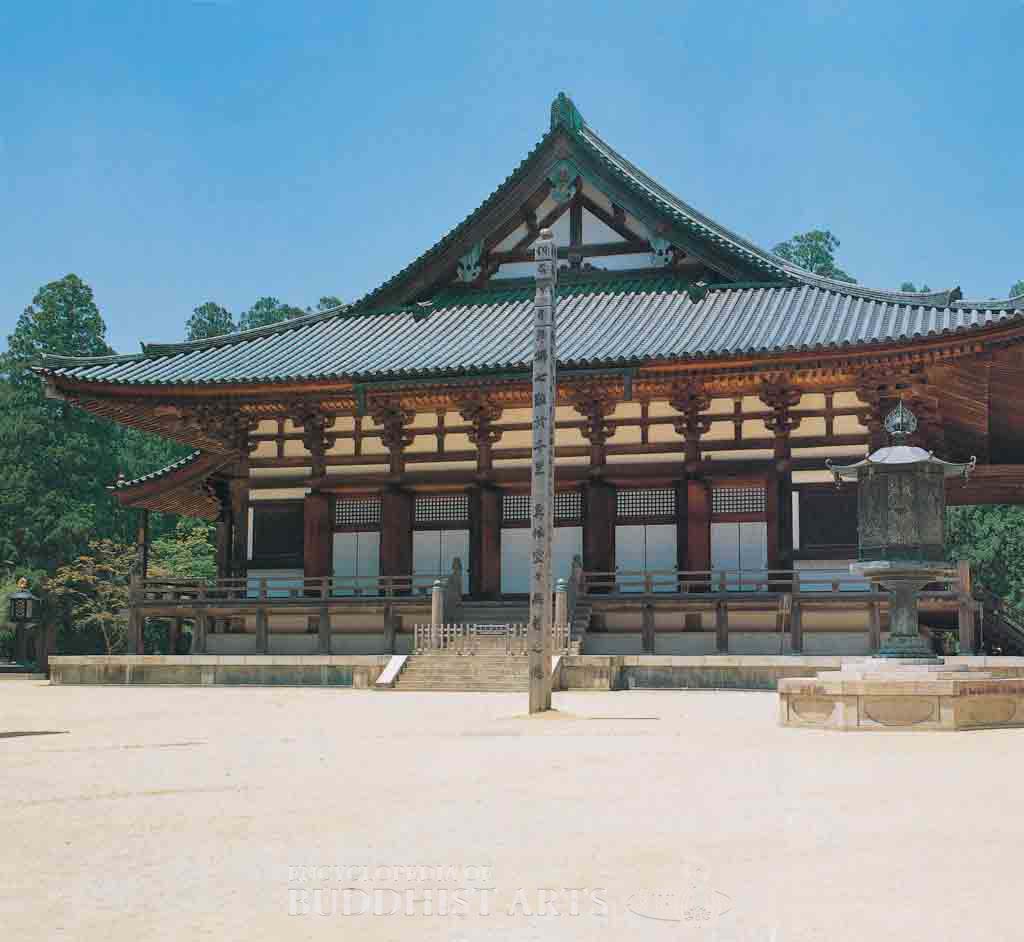
Kongobuji Temple: Golden Hall
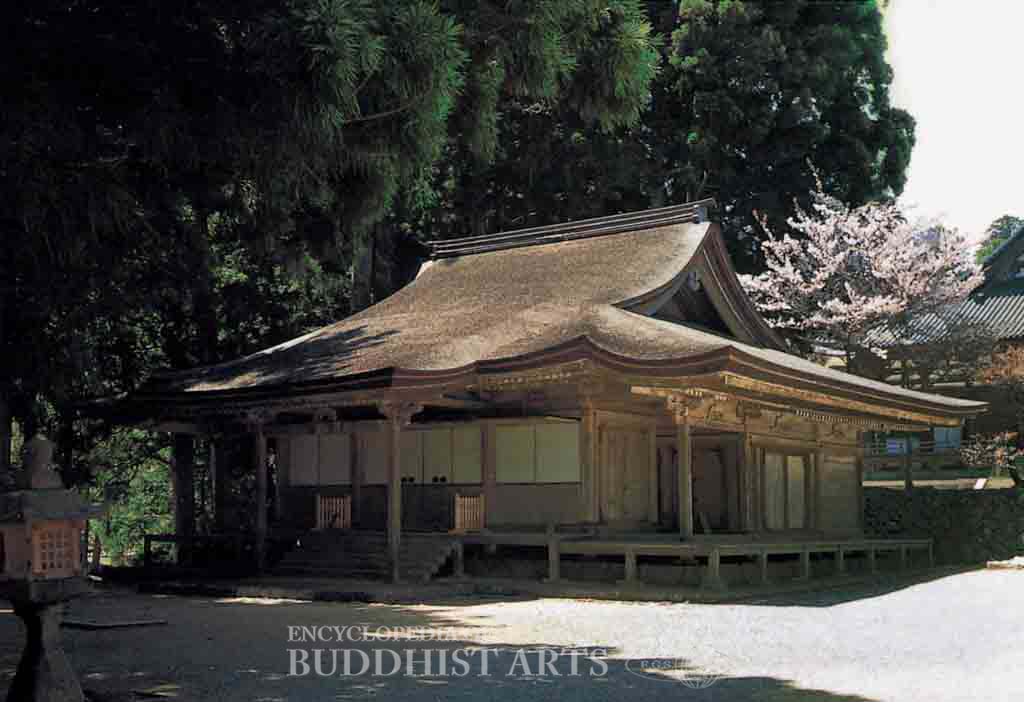
Kongobuji Temple: Acala Hall
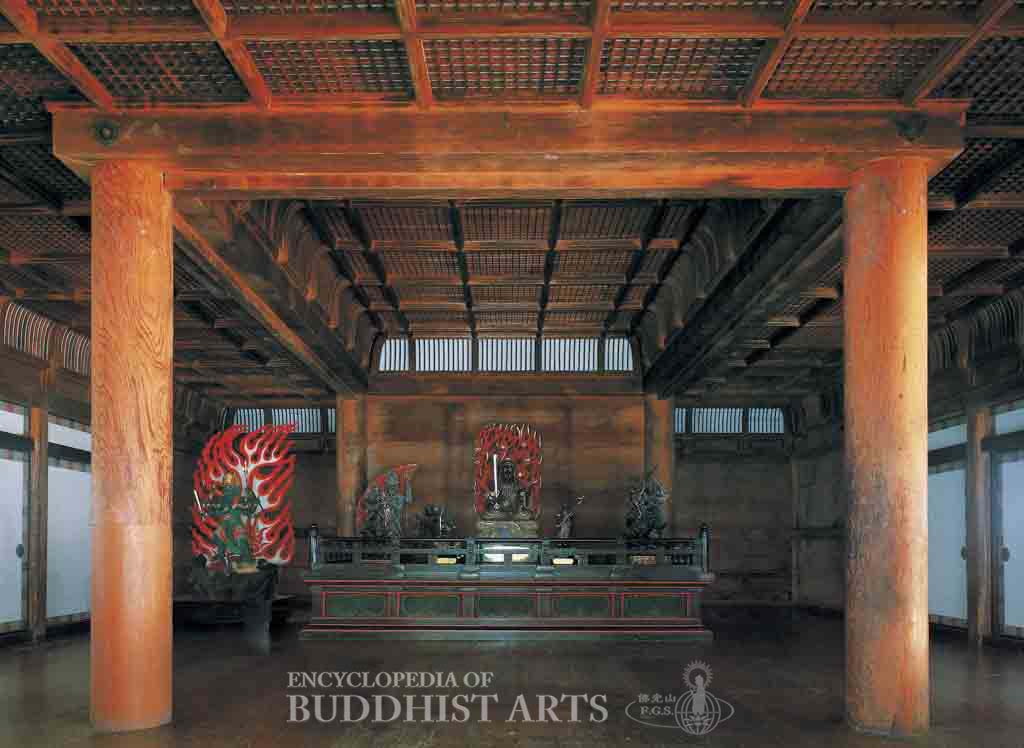
Kongobuji Temple: Acala Hall (interior)
Kongobuji Temple
JAPAN, Wakayama, Ito
Kongobuji Temple is the head temple of the Shingon school of Japanese Buddhism. It is located on Mount Koya, at 800 m above sea level, and occupies a large compound measuring 5.5 km from east to west and 2.2 km from north to south. In 816 during the Heian period, Emperor Saga (reigned 809–823) commissioned the building of the temple. In 835, it became an official temple in the same year that Master Kukai passed away there. According to his dying wish, his disciple Shinzen Daitoku succeeded him in overseeing the construction, which was completed in 887. The temple was burnt down and rebuilt a number of times. As part of the Sacred Sites and Pilgrimage Routes in the Kii Mountain Range, it was listed as a UNESCO World Heritage Site in 2004.
The main buildings of the temple include the Golden Hall, founder’s hall, Acala Hall, Prabhutaratna Pagoda, and west pagoda. In addition there is the inner sanctuary where Kukai entered samadhi. The Acala Hall was listed as a National Treasure in 1952. The Golden Hall, which was the lecture hall when the temple was first established, is now the main hall. The Golden Hall has had several renovations, the latest in 1932 during the Showa period. The hall is built of steel and concrete and has a single-eave hip-and-gable roof. It measures 30 m wide, 23.8 m deep, and 23.7 m high. A statue of the Medicine Buddha is enshrined within the hall. The founder’s hall was rebuilt in 1847 during the Edo period. It has a single-eave pyramidal roof and each side is 15.1 m long. It was once the personal shrine of Master Kukai and now houses a portrait of Kukai painted by Shinnyo Shinno, one of his leading disciples.
The three-by-four bay Acala Hall was built in 1197 during the Kamakura period. It has a hip-and-gable roof covered with cypress bark. A seated statue of Acala is enshrined within the hall. The reconstruction of the Prabhutaratna Pagoda was started in 1936 during the Showa period, and was completed the following year. It is made of reinforced steel mixed with concrete. The temple houses various paintings, sculptures, sutra manuscripts, and artifacts.
For more details, go to the Encyclopedia of Buddhist Arts: Architecture G-L, page 617.
Cite this article:
author = Hsingyun and Youheng and Johnson, Peter and Mankuang and Lancaster, Lewis,
booktitle = {Encyclopedia of Buddhist Arts: Architecture G-L},
pages = 617,
title = {{Kongobuji Temple}},
volume = 2,
year = {2016}}