
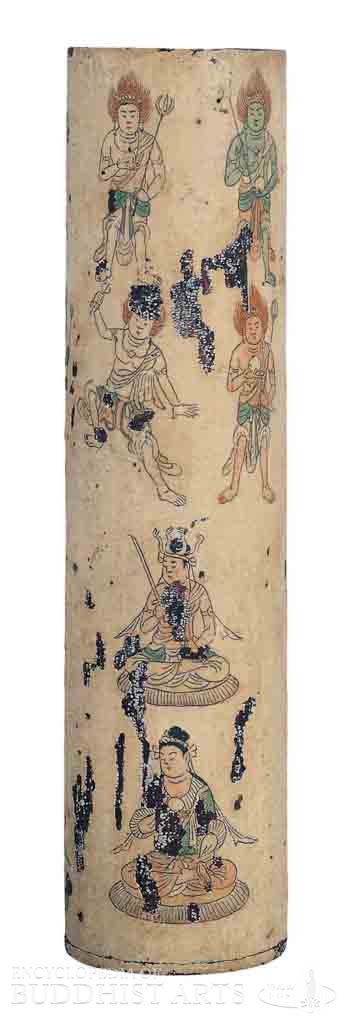
Kozanji Temple: Dharmacakra Cylinder (detail)
Wood
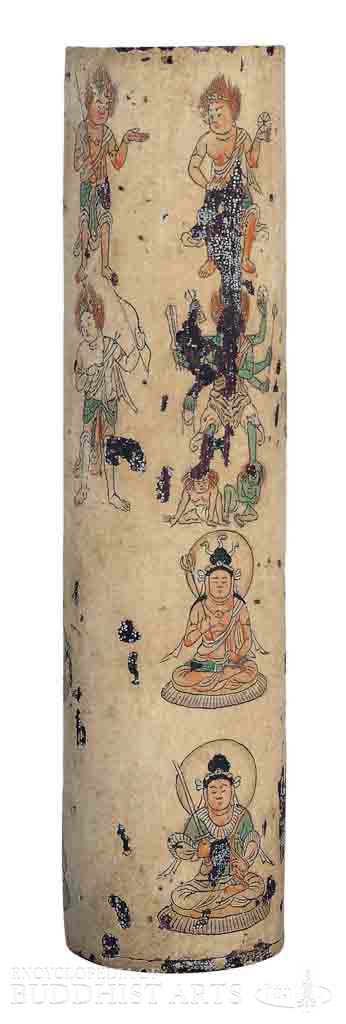
Kozanji Temple: Dharmacakra Cylinder (detail)
Kozanji Temple: Dharmacakra Cylinder
JAPAN, Kyoto; Heian to Kamakura period
Placed on the altar, the purpose of this ritual instrument was to bring peace by subduing evil spirits and enemies. This practice was based on the Dharmacakra Bodhisattva’s Method of Driving Away Demons and Enemies, and was initiated by the Shingon school in the 11th century.
The cylinder is made of wood and is 23.1 cm high and 5.7 cm in diameter. It is white and painted with ten yaksas, three naga kings, and three empresses. On the lid, there is a wheel with Sanskrit seed syllables.
For more details, go to the Encyclopedia of Buddhist Arts: Artifacts, page 166.
Cite this article:
Hsingyun, et al. "Kozanji Temple: Dharmacakra Cylinder." Encyclopedia of Buddhist Arts: Artifacts , vol. 18, 2016, pp. 166.
Hsingyun, Youheng, Youji, Stefanie Pokorski, Mankuang, and Wen Fan. 2016. "Kozanji Temple: Dharmacakra Cylinder" In Encyclopedia of Buddhist Arts: Artifacts , 18:166.
Hsingyun, Youheng, Youji, Pokorski, S., Mankuang, & Fan, W.. (2016). Kozanji Temple: Dharmacakra Cylinder. In Encyclopedia of Buddhist Arts: Artifacts (Vol. 18, pp. 166).
@misc{Hsingyun2016,
author = Hsingyun and Youheng and Youji and Pokorski, Stefanie and Mankuang and Fan, Wen,
booktitle = {Encyclopedia of Buddhist Arts: Artifacts },
pages = 166,
title = {{Kozanji Temple: Dharmacakra Cylinder}},
volume = 18,
year = {2016}}
author = Hsingyun and Youheng and Youji and Pokorski, Stefanie and Mankuang and Fan, Wen,
booktitle = {Encyclopedia of Buddhist Arts: Artifacts },
pages = 166,
title = {{Kozanji Temple: Dharmacakra Cylinder}},
volume = 18,
year = {2016}}