
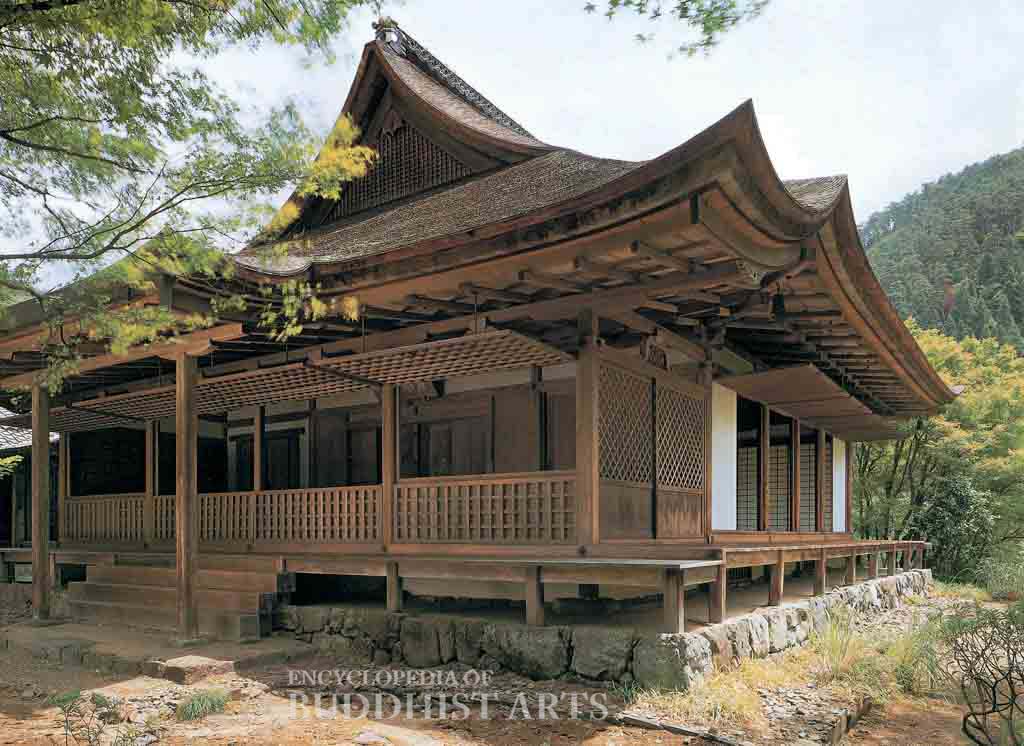
Kozanji Temple: Sekisuiin Hall
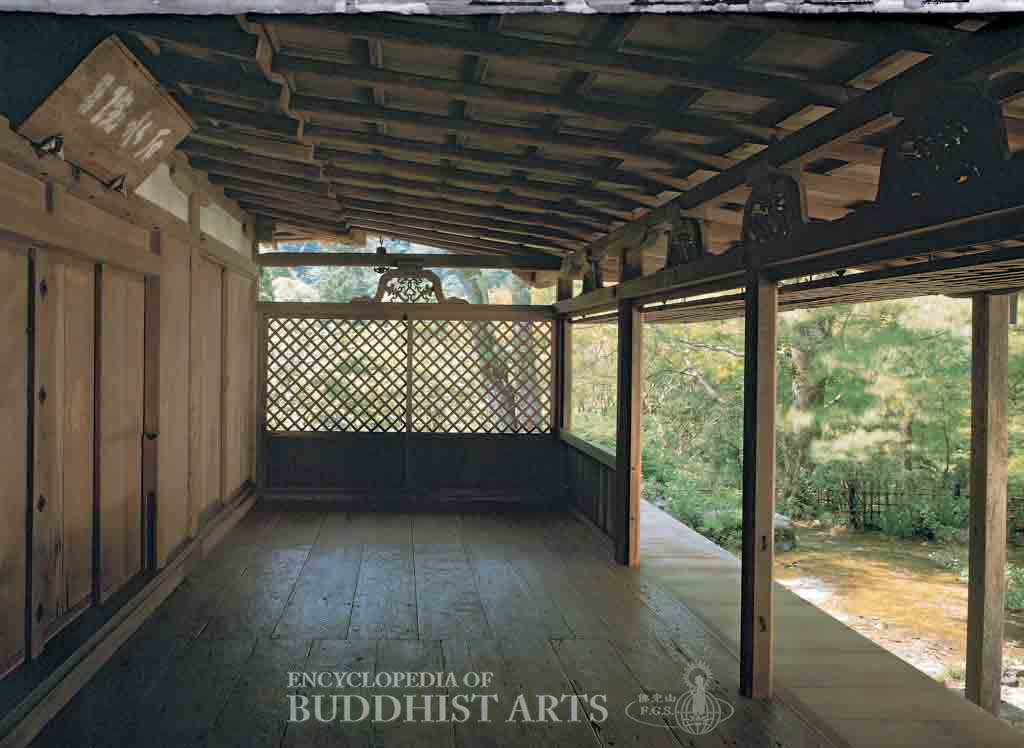
Kozanji Temple: Sekisuiin Hall - Portico
Kozanji Temple
JAPAN, Kyoto
Kozanji means High Mountain Temple. The temple belongs to the Shingon school of Japanese Buddhism and was established during the Nara period (710–794). As part of the Historic Monuments of Ancient Kyoto, the temple was listed as a UNESCO World Heritage Site in 1994.
The main buildings of the temple include the Sekisuiin Hall, Golden Hall, founder’s hall, temple gate, and study room. The Sekisuiin Hall, listed in 1953 as a National Treasure, was originally the living quarters of Master Myoe Shonin. During the Edo period (1615–1868), the building was converted to a sutra repository, housing scriptures from both Mahayana and Vajrayana schools. In 1889 during the Meiji period, the building was relocated to its current position. The Sekisuiin Hall has a single-eave hip-and-gable roof covered in cypress bark. There is an extra roof protruding above the entrance, which is typical of early Kamakura period (1185–1333) architecture. The Golden Hall was originally a part of Ninnaji Temple but was relocated to the temple in 1634. It has a hip-and-gable roof covered in copper sheets. Inside, there is a seated statue of Sakaymuni Buddha. Master Myoe used the founder’s hall for meditation. It has a single-eave pyramidal roof.
The temple houses a number of National Treasures including paintings of Buddhalocani, Master Myoe, and Patriarchs of the Kegon school, along with a Kamakura period manuscript of Buddhist tales entitled Meihoki.
For more details, go to the Encyclopedia of Buddhist Arts: Architecture G-L, page 624.
Cite this article:
author = Hsingyun and Youheng and Johnson, Peter and Mankuang and Lancaster, Lewis,
booktitle = {Encyclopedia of Buddhist Arts: Architecture G-L},
pages = 624,
title = {{Kozanji Temple}},
volume = 2,
year = {2016}}