
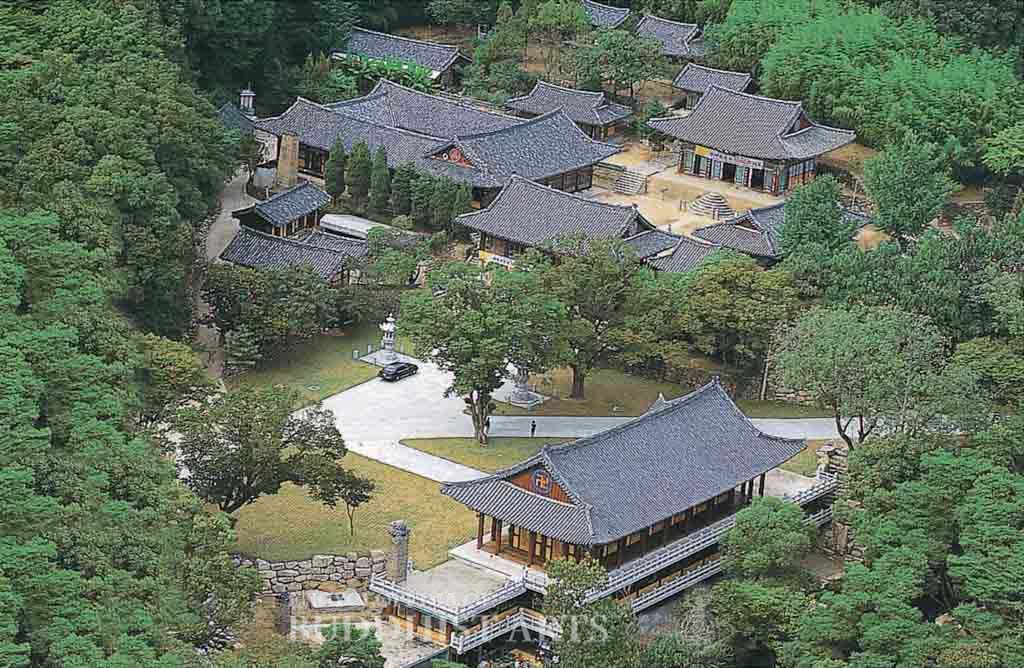
Donghwasa Temple (aerial view)
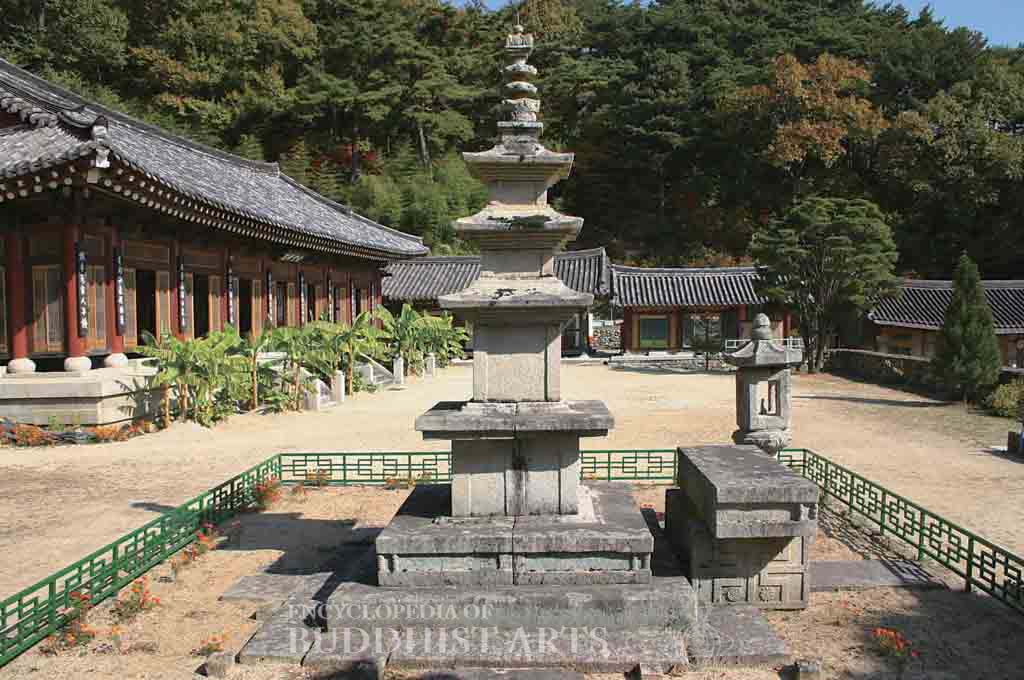
Donghwasa Temple: Geumdangam Hermitage - East Three-Tier Stone Pagoda
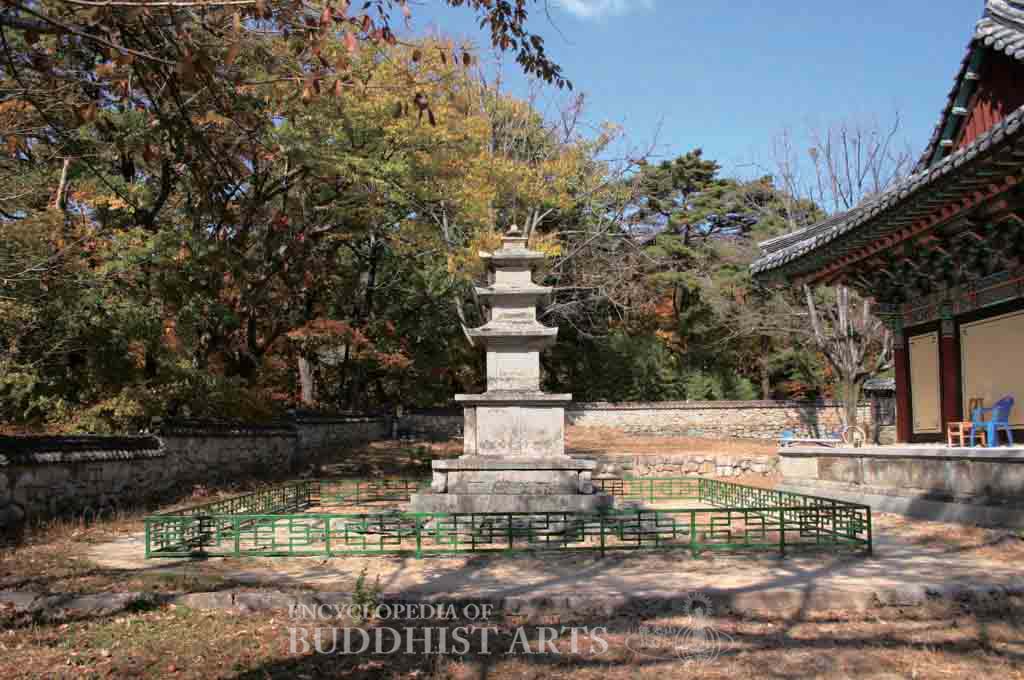
Donghwasa Temple: Geumdangam Hermitage - West Three-Tier Stone Pagoda
Donghwasa Temple
SOUTH KOREA, Daegu
Donghwasa means Royal Foxglove Tree Temple. It is the head temple for the 9th district of the Jogye order of Korean Seon Buddhism. According to the records, the temple was built by Master Geukdal in 493 with the original name of Yugasa (Yoga Temple). Master Simji renovated the temple in 832 and renamed it Donghwasa because at that time the Royal Foxglove trees there bloomed all year round, even in the winter. The temple has been renovated a number of times.
Its layout is typical of Korean temples: a cluster of buildings around a central courtyard, with the Great Hero Hall occupying a central position. The Great Hero Hall, listed as Municipal Tangible Cultural Property No. 10, was rebuilt in 1727 during the Joseon dynasty. It is a three-by-three bay structure famous for its natural looking columns that are made of plain tree trunks. It contains statues of the Three Buddhas: Sakyamuni Buddha, Amitabha Buddha, and the Medicine Buddha. The ceiling is decorated with birds from the Western Pure Land, as well as other motifs.
The temple manages six branch temples: the Geumdangam (Golden Hall Hermitage), Biroam (Vairocana Hermitage), Yeomburam (Chanting Hermitage), Budoam (Stupa Hermitage), Yangjinam (Foster Genuine Hermitage), and Naewonam (Inner Courtyard Hermitage). The Geumdangam Hermitage includes famous structures like the Sumajejeon Hall and three-tier stone pagodas. Sumajejeon Hall contains a large gilt bronze Buddha from the early Joseon dynasty (1392–1910). The east and west twin pagodas are listed as Treasure No. 248. Each of them has a square layout, two-layer base, three-tier body, and upturned roofs.
Biroam Hermitage contains a 3.2 m high three-tier stone pagoda, which is listed as Treasure No. 247. During a renovation in 1967, reliquaries and artifacts were found within this pagoda, and their inscriptions state that the pagoda was built in 863 during the Unified Silla dynasty. The hermitage also includes a seated stone statue of Vairocana Buddha, which is 293.6 cm high and listed as Treasure No. 244. Near the entrance to the temple, there is another precious item, designated Treasure No. 243, which is a relief of a seated Buddha carved into the cliff.
For more details, go to the Encyclopedia of Buddhist Arts: Architecture A-F, page 250.
Cite this article:
author = Hsingyun and Youheng and Johnson, Peter and Mankuang and Lancaster, Lewis,
booktitle = {Encyclopedia of Buddhist Arts: Architecture A-F},
pages = 250,
title = {{Donghwasa Temple}},
volume = 1,
year = {2016}}