
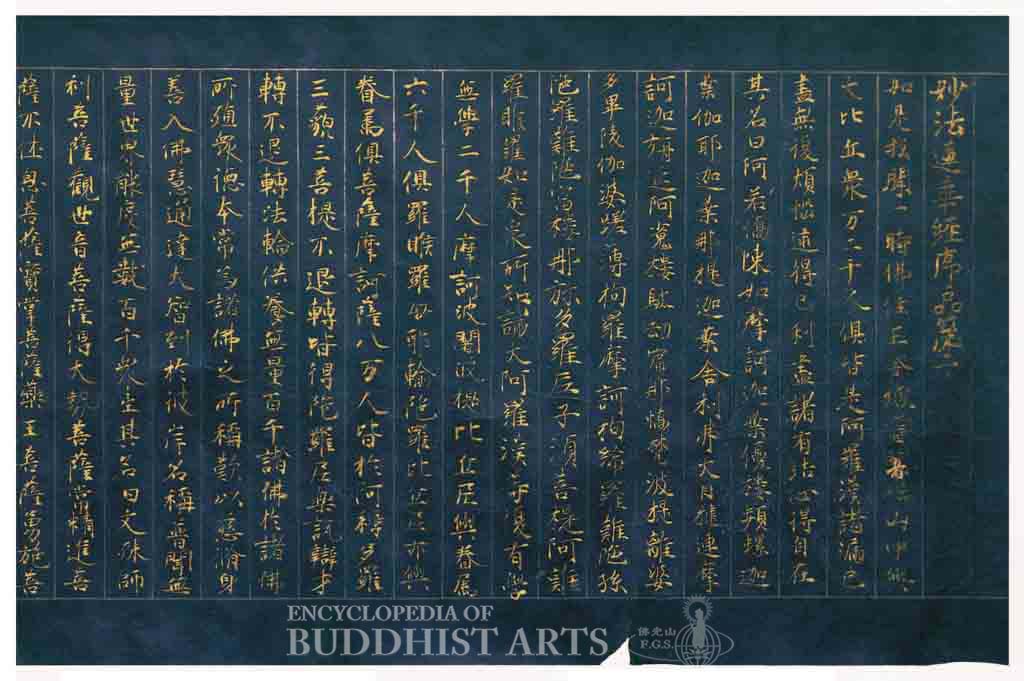
Lotus Sutra and Samantabhadra Meditation Sutra - Lotus Sutra - Introductory Chapter (right end section)
Gold on paper
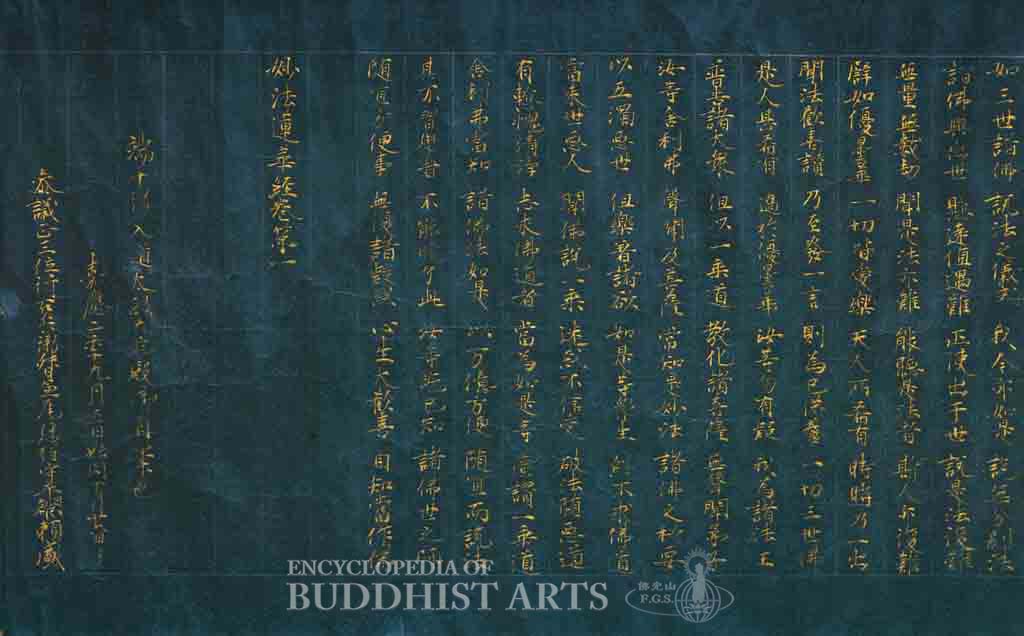
Lotus Sutra and Samantabhadra Meditation Sutra - Lotus Sutra - Fascicle 1 (left end section)
Lotus Sutra and Samantabhadra Meditation Sutra
JAPAN; Heian period
This manuscript was co-written by Taira no Kiyomori and his brother Taira no Yorimori. The Lotus Sutra was popular during the Heian period (794–1185) and was often copied with the Sutra of Innumerable Meanings as a preface, and the Samantabhadra Meditation Sutra as an epilogue. Originally, this manuscript consisted of 10 fascicles, but only 8 remain. Seven fascicles comprise the Lotus Sutra, which range from 856 to 1196 cm long each. The last scroll, containing the Samantabhadra Meditation Sutra, measures 842 cm in length. In 1172, the manuscript was enshrined in Itsukushima Shrine in Hiroshima along with other sutras copied by members of the Taira family. It was listed as a National Treasure in 1954.
Each scroll begins with Kiyomori’s calligraphy, while the latter halves of each were completed by Yorimori. The gold-inked characters are spaced closely together in a respectful and restrained manner. The Lotus Sutra scrolls contain brushstrokes that are orderly, smooth, and lengthy, while the Samantabhadra Meditation Sutra was written with simpler strokes in a more spacious confine. The outer and inner flanks of the wooden stave found at the start of the scrolls were elaborately decorated with gold-inked floral patterns and an illustration of Sakyamuni Buddha teaching the Dharma. This sutra copy is a classic example of a late Heian period manuscript written on indigo-dyed paper.
For more details, go to the Encyclopedia of Buddhist Arts: Calligraphy, page 143.
Cite this article:
author = Hsingyun and Youheng and Youlu and Pokorski, Stefanie and Mankuang and Edson, Gary,
booktitle = {Encyclopedia of Buddhist Arts: Calligraphy },
pages = 143,
title = {{Lotus Sutra and Samantabhadra Meditation Sutra}},
volume = 17,
year = {2016}}