
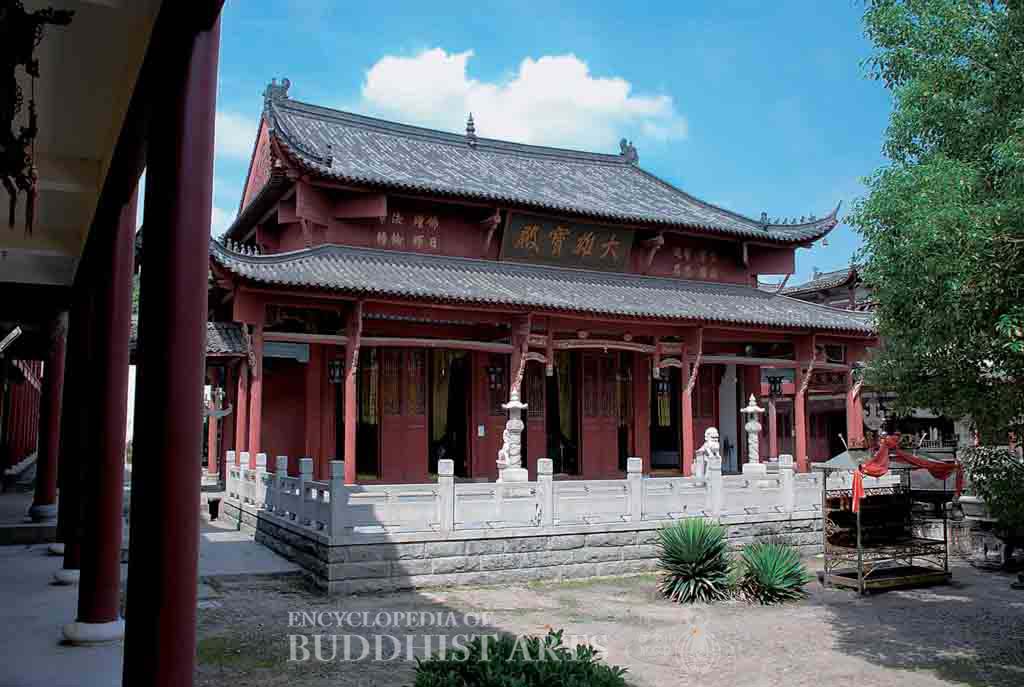
Nengren Temple: Great Hero Hall
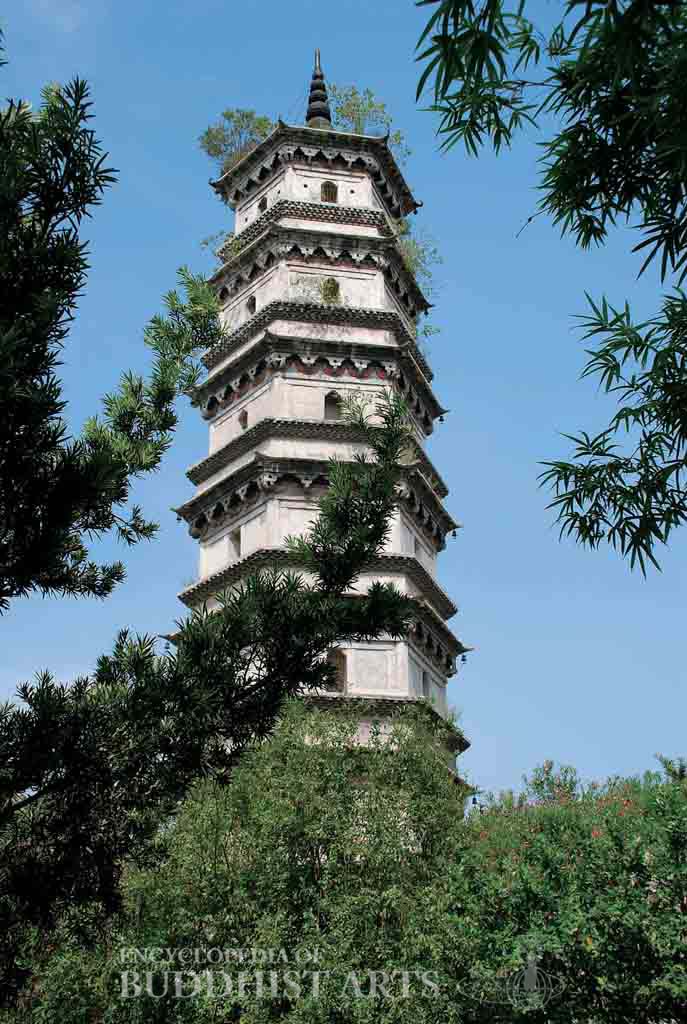
Nengren Temple: Dasheng Pagoda
Nengren Temple
CHINA, Jiangxi, Jiujiang
The temple was built during the rule of Emperor Wu (reigned 502–549) of the Liang dynasty. During the rule of Emperor Daizong (reigned 762–779) of the Tang dynasty, the temple was rebuilt by Chan Master Baiyun. It was damaged by fire in wartime during the Yuan dynasty (1271–1368). The temple has been expanded and repaired a number of times throughout its history. The present layout dates back to the rule of Emperor Tongzhi (reigned 1861–1875) of the Qing dynasty. It was listed as a key Buddhist temple in the Han region of China in 1983.
The principal buildings of the temple include the main temple gate, Heavenly King Hall, Great Hero Hall, Iron Buddha Hall, abbot’s quarters, sutra repository, Patriarch Hall, Dharma Hall, and the Dasheng Pagoda. The pagoda was built in 1379 during the Ming dynasty, and was repaired in 1870 during the Qing dynasty. It is a seven-story, hexagonal, brick and stone pagoda, which is 42 m high. Stone bracket sets support the eaves. On each story there are extra eaves formed by courses of dogtooth bricks. The hexagonal pyramidal roof is surmounted by a bronze spire. The main door of the pagoda faces west. From the second story upwards there is a door on every side. Half the doors are real while the others are for decorative purposes. Inside the pagoda there is a brick spiral staircase leading to the top.
For more details, go to the Encyclopedia of Buddhist Arts: Architecture M-S, page 792.
Cite this article:
author = Hsingyun and Youheng and Johnson, Peter and Mankuang and Lancaster, Lewis,
booktitle = {Encyclopedia of Buddhist Arts: Architecture M-S},
pages = 792,
title = {{Nengren Temple}},
volume = 3,
year = {2016}}