
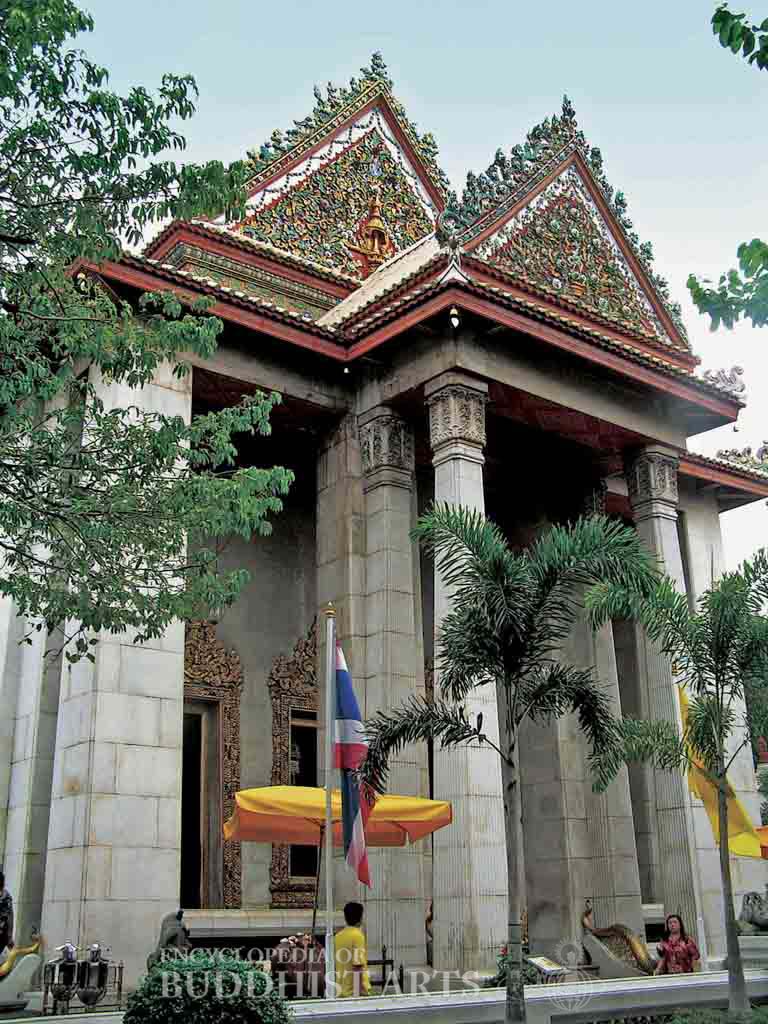
Wat Bowon: Ordination Hall - Pediments
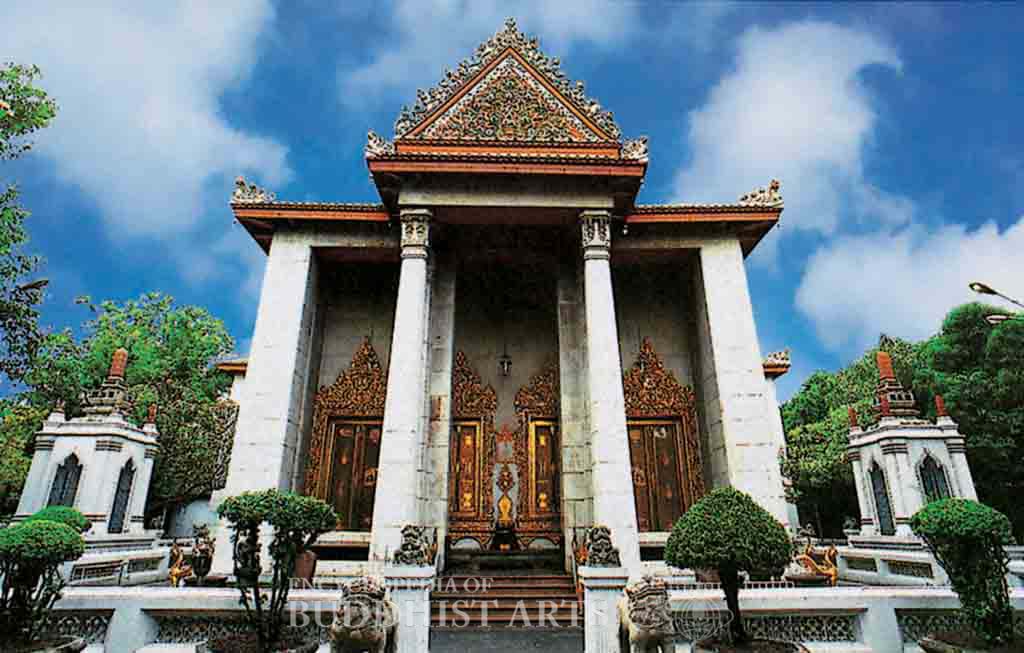
Wat Bowon: Ordination Hall
Wat Bowon
THAILAND, Bangkok
The temple is a first class royal temple with the full name Wat Bowonnivet Vihara Rajaworavihara. It is the residence of many royal family members who join the monastic order, as well as the residence of many Sangharajas of Thailand. It is also the temple where King Rama VI (reigned 1910–1925), King Rama VII (reigned 1925–1935), and King Rama IX (reigned 1946–present) renounced. The temple was built by Prince Bowon between 1824 and 1832 during the time of King Rama III (reigned 1824–1851). Originally called Wat Mai, the temple was given its present name when King Rama IV (reigned 1851–1868), then a monk, became the abbot and held that position for 14 years before ascending the throne. During the reign of King Rama VI, the temple incorporated the neighboring temple, Wat Rangsee Suddhawas, and more buildings were added to form its present layout.
The temple faces north. The main temple gate, ordination hall, the Great Stupa, and a Buddha hall are located along the central axis, while two red pavilions, the Hall of the Buddha’s Footprint, a lecture hall, and a sutra repository are situated on the sides. The main structures are the ordination hall and the Great Stupa. The ordination hall is roofed in Chinese-style glazed tiles. It has a three bay wide portico. The pediments and the portico are decorated with elegant multi-colored glazed tiles. The window and door frames are made of plaster gilded with gold leaf. The ordination hall contains two Sakyamuni Buddha statues, namely the Phra Buddha Chinasi at the front, and the larger Phra Suwanakhet, or Luang Phor To, at the back. They are both seated with legs in half lotus position, and their hands form the bhumisparsa (earth-touching) mudra. The well-known 19th century Thai artist, Khrua In Khong, painted the murals depicting the Buddha’s teachings.
The Great Stupa is over 50 m high with its entire body covered in gold mosaic tiles. Above the elevated base there is a two-tier terrace. At each corner of the first terrace there is a Chinese-style structure, in which there are bas-reliefs depicting the journey of Chinese Master Xuanzang to India. The first terrace has stairs ascending on the east and west sides. At each corner of the second terrace there is a niche with a Buddha statue inside. There are four entrances spaced evenly around the bell-shaped stupa body. Inside there is a chamber containing a small stupa, in which relics of the Buddha are enshrined. The sides of the square base of this small stupa are engraved with relief carvings of four important scenes from the Buddha’s life: birth, enlightenment, the first turning of the Dharma wheel, and parinirvana.
For more details, go to the Encyclopedia of Buddhist Arts: Architecture T-Z, page 1184.
Cite this article:
author = Hsingyun and Youheng and Johnson, Peter and Mankuang and Lancaster, Lewis,
booktitle = {Encyclopedia of Buddhist Arts: Architecture T-Z},
pages = 1184,
title = {{Wat Bowon}},
volume = 4,
year = {2016}}