
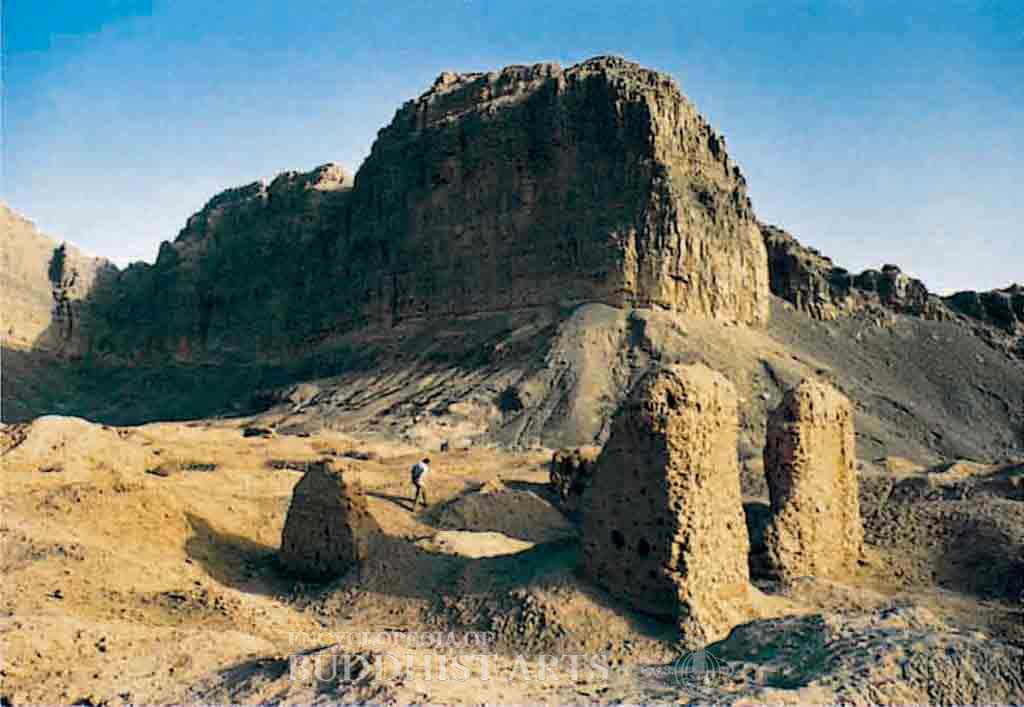
Tuokuzisalai
Tuokuzisalai
CHINA, Xinjiang, Kashgar
Also known as Tokuz Saray, the monastery ruins are located 60 km northeast of Maralbexi and they are the largest Buddhist ruins discovered in Xinjiang. The monastery was built during the 3rd to 4th century. Tuokuzisalai was an important transport and communication hub on the Silk Road during the Tang dynasty (618–907). In 1906 Paul Pelliot, a French explorer, studied and excavated the monastery ruins. He uncovered a large number of Buddhist sculptures and artifacts. It was listed as a National Cultural Heritage Site in 2001.
The ruins are distributed at the southern foot and slope of Mount Tuokuzisalai. It is a comprehensive monastery compound, which consists of a large central stupa, small Buddha halls at the two sides, and a relatively large Buddha hall in the north.
The large Buddha hall, known as Hall B, is located northwest of the monastery compound. All that remains of the hall is the back wall and parts of the two side walls. There are traces of a standing statue in front of the back wall. Externally the three walls originally contained delicate reliefs depicting Buddhist stories. At present, only four sets of these reliefs remain. Despite the damage, the images can be seen to relate to stories about Bodhisattvas. The second set of reliefs refers to the Jataka of the Bodhisattva Staying Still for Birds, while the fourth set may be illustrating the Prince Sudana Jataka.
For more details, go to the Encyclopedia of Buddhist Arts: Architecture T-Z, page 1157.
Cite this article:
author = Hsingyun and Youheng and Johnson, Peter and Mankuang and Lancaster, Lewis,
booktitle = {Encyclopedia of Buddhist Arts: Architecture T-Z},
pages = 1157,
title = {{Tuokuzisalai}},
volume = 4,
year = {2016}}