
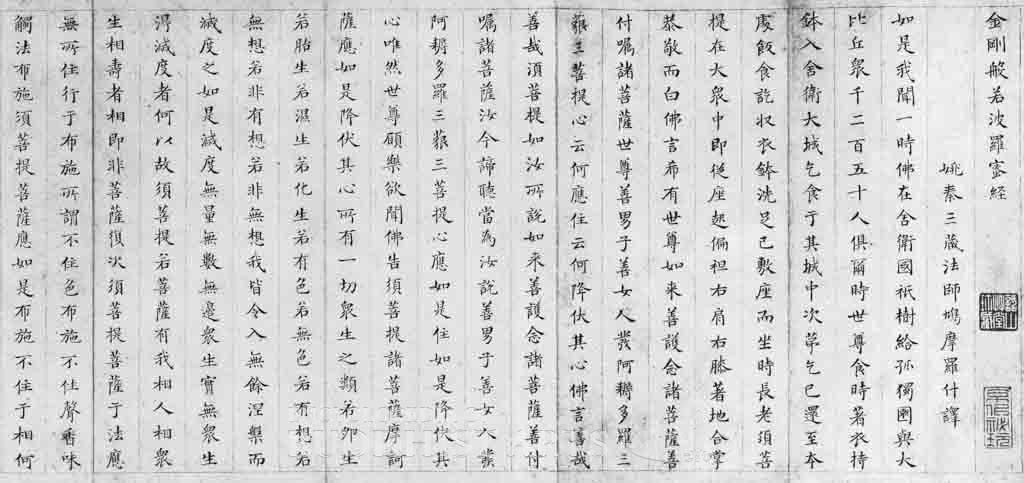
Diamond Sutra (right end section)
Ink on paper

Diamond Sutra (detail)
Diamond Sutra
CHINA; Qing dynasty
This scroll was written by Wan Shouqi when he was 46 years old. As stated at the end of the piece, this was his tenth copy of the Diamond Sutra, which was a testament of his faith and dedication to Buddhism. The Diamond Sutra is a Mahayana text that expounds the teachings on the emptiness of all phenomena and the illusory concept of self. The sutra advocates the Middle Way and discusses the ultimate truth.
Wan Shouqi studied and emulated Yan Zhenqing’s calligraphy, which explains the spacious, uncluttered composition of this sutra. Hints of Yu Shinan’s style are also observed in the work. The use of sparse arrangement with thin, light strokes resulted in a beautifully executed manuscript.
Wan Shouqi was also known as Wan Daoren or Nianshao. As a scholar who witnessed the demise of the Ming dynasty (1368–1644), he often traveled between the Wu and Chu regions dressed as a scholar but with a monastic hat. He was well-versed in the sutras, Chan practices, and was adept in the art of seal engraving.
For more details, go to the Encyclopedia of Buddhist Arts: Calligraphy, page 56.
Cite this article:
author = Hsingyun and Youheng and Youlu and Pokorski, Stefanie and Mankuang and Edson, Gary,
booktitle = {Encyclopedia of Buddhist Arts: Calligraphy },
pages = 56,
title = {{Diamond Sutra}},
volume = 17,
year = {2016}}