
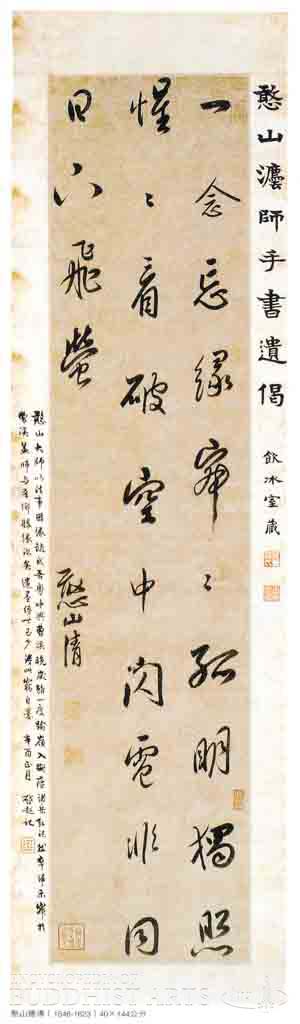
Six-Character Poem
Ink on paper
Six-Character Poem
CHINA; Ming dynasty
This poem denotes the enlightenment of Chan Master Hanshan Deqing. Hanshan’s calligraphic works display the influence of such calligraphers as Li Zhi and Dong Qichaung. Likewise, Dong Qichang’s sparse and crisp calligraphic style is considered a result of Hanshan’s influence. The spaciousness and clarity in this particular work is similar to that found in Dong’s calligraphy. Overall, the running script brushwork of this piece maintains a sense of ease and equanimity where there are several instances in which character strokes join together with implicit links.
Hanshan Deqing’s original name was Cai and he was also known as Chengyin. A Chan master and calligrapher of the Ming dynasty (1368–1644), he was well-versed in poetry and writing. Master Hanshan authored numerous written works, many of which were collated by his disciples into a publication entitled Collection of Dream Roamings. This compilation is collected in the Buddhist Canon, as well as the Complete Library in Four Branches of Literature.
For more details, go to the Encyclopedia of Buddhist Arts: Calligraphy, page 231.
Cite this article:
author = Hsingyun and Youheng and Youlu and Pokorski, Stefanie and Mankuang and Edson, Gary,
booktitle = {Encyclopedia of Buddhist Arts: Calligraphy },
pages = 231,
title = {{Six-Character Poem}},
volume = 17,
year = {2016}}