
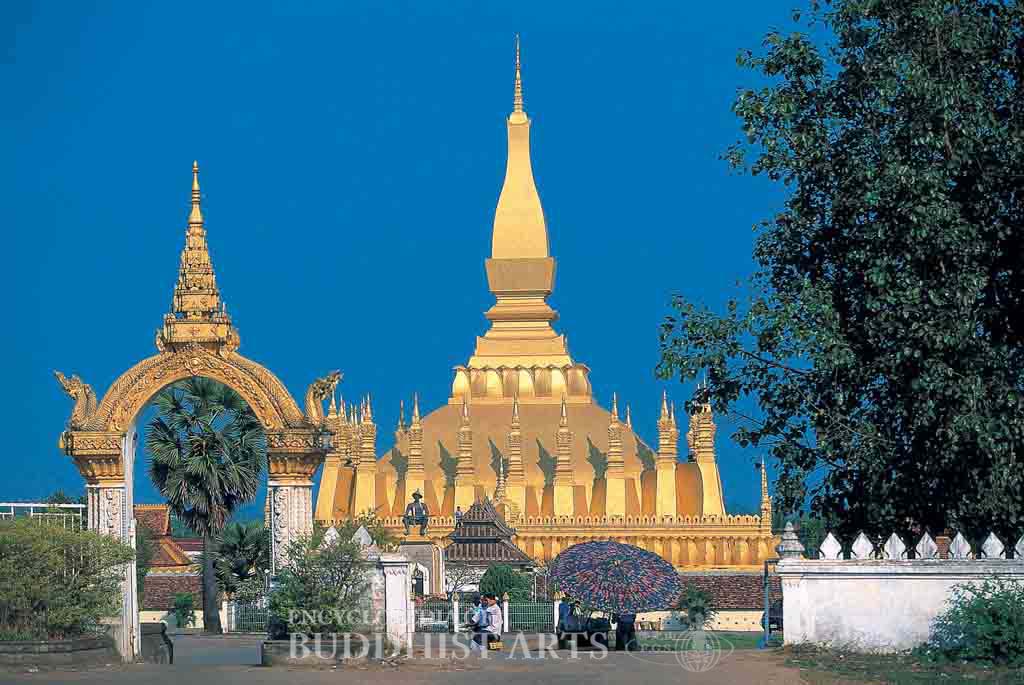
Pha That Luang
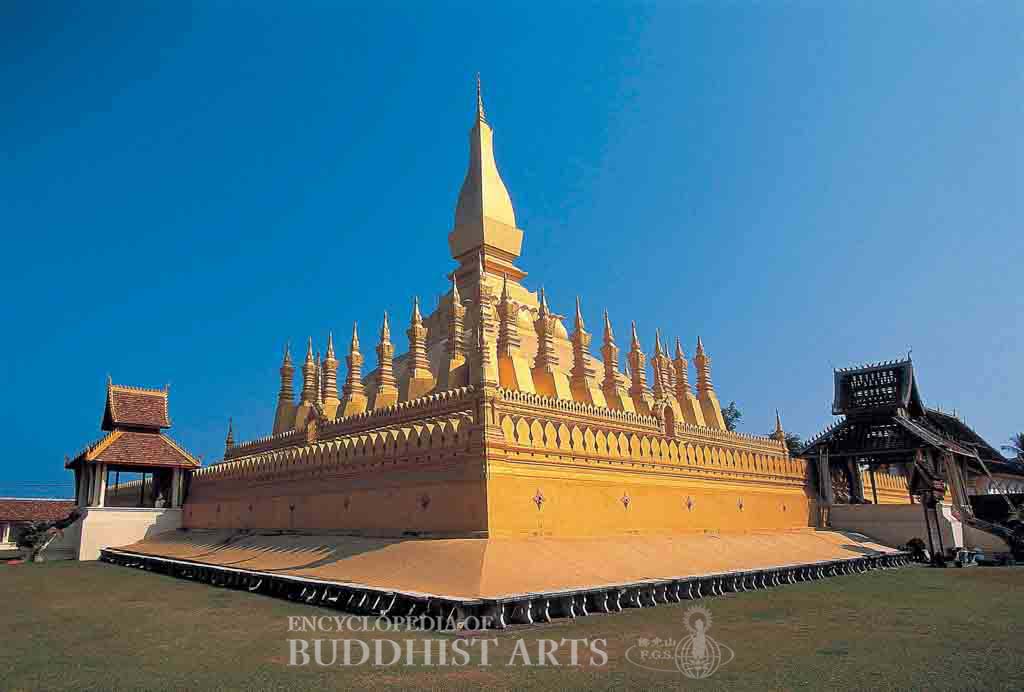
Pha That Luang
Pha That Luang
LAOS, Vientiane
Pha That Luang means Sacred Great Stupa, and its official name is Pha Jedi Lokajulamani (Sacred Stupa of the World). It is located about 4 km north of Vientiane. Legend dates it to the 3rd century BCE, when missionaries from King Asoka (reigned cica 269–232 BCE) of Maurya built a small stupa to enshrine the Buddha’s relic. However, judging from the remains at the site, it seems to date from the 12th century. In 1566 King Setthathirath (reigned 1547–1571) enlarged the stupa to three levels. In 1827 and 1873, the stupa was damaged by Thai and by Yunnan invaders. After several restorations and a reconstruction assisted by the French in the 1930s, the stupa was restored to its original form. This magnificent stupa is listed as an Important National Monument.
The stupa is made of gray bricks covered in gold leaf. The entire stupa is 50 m high and consists of three levels, which symbolize the three realms of desire, form, and formlessness. The first level measures 68 m x 69 m and its wall is surmounted by 323 boundary stones. The second level measures 48 m on each side and its wall has 288 boundary stones. This wall is decorated with lotus petals. Within the wall there are 30 slim multi-layer stupas with elegant pointed spires. The third level measures 30 m on each side. The central stupa is composed of a dome, an upright lotus base, a three-tier harmika, and a slender square vase structure, followed by the finial. The stupa’s unique appearance incorporates various elements from different architectural traditions, including the Indian inverted bowl and the square vase of the Lao stupa.
The stupa is surrounded by a 85 m long cloister containing a large number of Lao and Khmer sculptures. Local Buddhists regard this stupa as a symbol of sanctity.
For more details, go to the Encyclopedia of Buddhist Arts: Architecture M-S, page 812.
Cite this article:
author = Hsingyun and Youheng and Johnson, Peter and Mankuang and Lancaster, Lewis,
booktitle = {Encyclopedia of Buddhist Arts: Architecture M-S},
pages = 812,
title = {{Pha That Luang}},
volume = 3,
year = {2016}}