
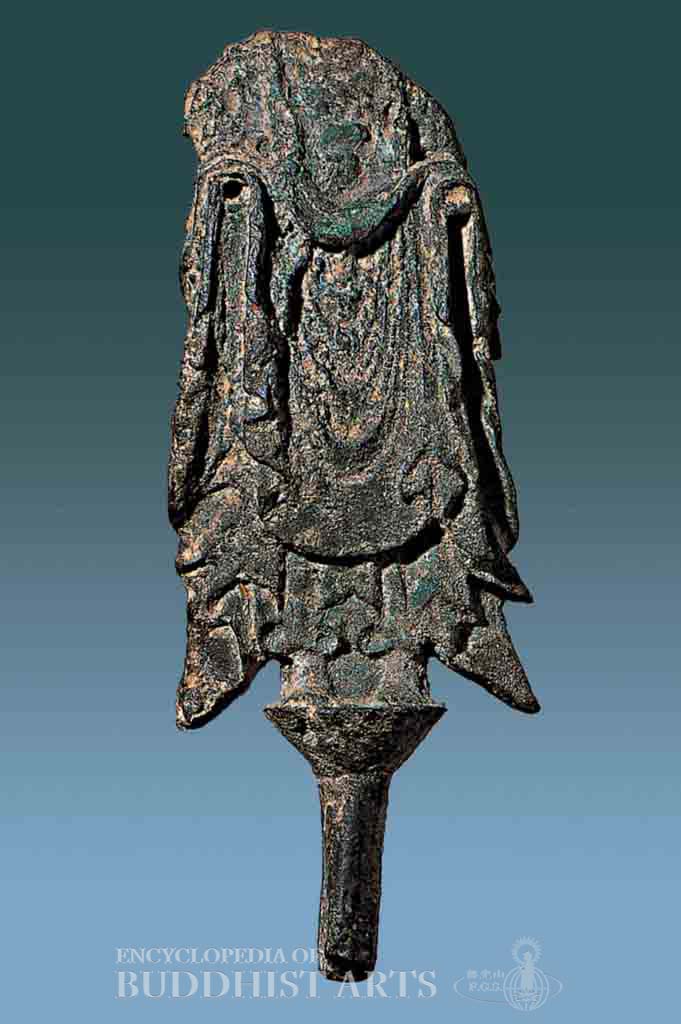
Hwangnyongsa Temple: Standing Buddha
Gilt bronze
Hwangnyongsa Temple: Standing Buddha
SOUTH KOREA, North Gyeongsang, Gyeongju; Silla dynasty
Unearthed from the site of Hwangnyongsa Temple, this statue is headless and fire-damaged. The shoulders and back reveal evidence of extreme heat exposure that may have resulted from fire during the destructive Mongol invasions during the Yuan dynasty (1271–1368). The figure appears to date from the Three Kingdoms period (57 BCE–668 CE) but scholars believe it was created in the Silla dynasty (57 BCE–935 CE). Chinese influence is apparent in the sculptural style shown in the figure’s elaborate robes that flare outwards in their fall, and in the hanging stole overlapping one of the missing arms.
For more details, go to the Encyclopedia of Buddhist Arts: Sculpture G-M, page 471.
Cite this article:
Hsingyun, et al. "Hwangnyongsa Temple: Standing Buddha." Encyclopedia of Buddhist Arts: Sculpture G-M, vol. 11, 2016, pp. 471.
Hsingyun, Youheng, Yann Lovelock, Yuan Chou, Susan Huntington, Gary Edson, and Robert Neather. 2016. "Hwangnyongsa Temple: Standing Buddha" In Encyclopedia of Buddhist Arts: Sculpture G-M, 11:471.
Hsingyun, Youheng, Lovelock, Y., Chou, Y., Huntington, S., Edson, G., & Neather, R.. (2016). Hwangnyongsa Temple: Standing Buddha. In Encyclopedia of Buddhist Arts: Sculpture G-M (Vol. 11, pp. 471).
@misc{Hsingyun2016,
author = Hsingyun and Youheng and Lovelock, Yann and Chou, Yuan and Huntington, Susan and Edson, Gary and Neather, Robert,
booktitle = {Encyclopedia of Buddhist Arts: Sculpture G-M},
pages = 471,
title = {{Hwangnyongsa Temple: Standing Buddha}},
volume = 11,
year = {2016}}
author = Hsingyun and Youheng and Lovelock, Yann and Chou, Yuan and Huntington, Susan and Edson, Gary and Neather, Robert,
booktitle = {Encyclopedia of Buddhist Arts: Sculpture G-M},
pages = 471,
title = {{Hwangnyongsa Temple: Standing Buddha}},
volume = 11,
year = {2016}}